

Renovation Notes
The Complete Guide to Renovating a Baltimore Rowhome
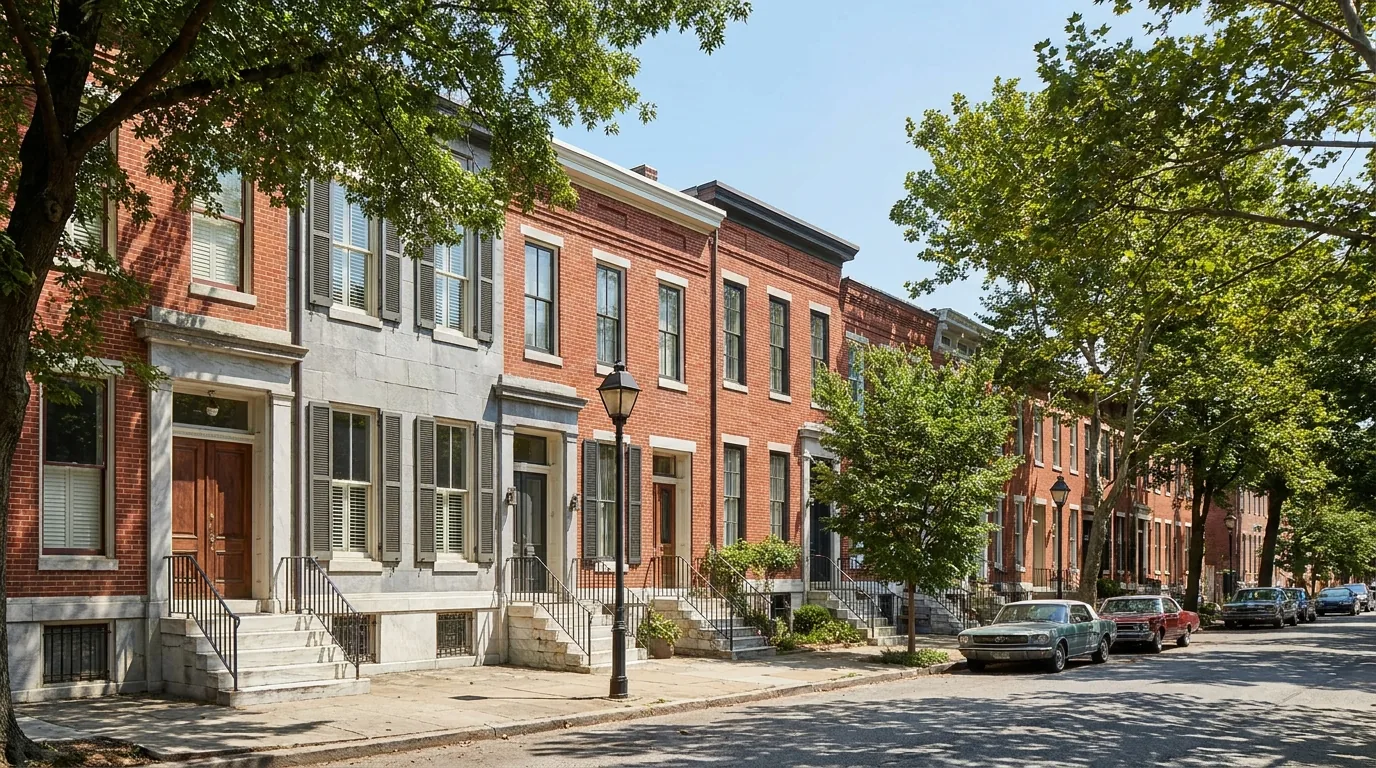
If you own a rowhome in Baltimore, you own a piece of the city’s architecture, and a building with a personality all its own. These are not generic suburban houses. A Canton 2-up-2-down, a Federal Hill alley house, a Patterson Park daylight rowhome, and a Bolton Hill mansion all renovate very differently, and the things that surprise homeowners (and underqualified contractors) are almost always the same handful of rowhome-specific realities: formstone, party walls, plaster, knob-and-tube wiring, galvanized plumbing, and CHAP historic rules.
This guide is the one resource we wish every Baltimore homeowner had before they started. At Monarch Bay Renovations we renovate rowhomes across Baltimore City, Federal Hill, Canton, Hampden, Patterson Park, Hampden, and beyond, and we are sharing exactly what makes these houses different, what you will likely have to touch, what it costs, and how to pick a contractor who actually knows these buildings. We are a licensed Maryland home improvement contractor (MHIC #149066) and a Google Guaranteed business, and we publish this because informed homeowners make better clients.
A classic Baltimore rowhome block: mixed formstone and brick facades, white marble steps, flat roofs, and narrow vertical windows.
A Quick History: Why Baltimore Rowhomes Are the Way They Are
Baltimore has more rowhomes than almost any city in America, and they were built across more than a century. Understanding roughly when your house went up tells you most of what you need to know about its bones.
Rowhouse construction took off in the 1820s, using two ideas imported from England: connected blocks of houses that share party walls, and the local quirk of ground rent, where you owned the house but leased the land beneath it. Builders put large, fine houses on the main streets, smaller versions on side streets, and tiny units on the alleys, those Fells Point and Federal Hill alley houses with names like Strawberry Alley.
A few rough eras:
- Pre-1850s rowhomes often used soft, porous “salmon brick” that needed regular painting, which is part of why so many of these facades were later covered.
- 1850s to 1900 brought harder pressed brick and the ornate Italianate style, tall narrow windows, heavy projecting lintels, and elaborate cornices.
- Around 1915 through the 1920s and 30s came the daylight rowhome, the design that solved the dark-middle-room problem of older houses. Builders widened the house from the old 12-to-16-foot footprint to 20 or 21 feet and used a two-room-wide by two-room-deep “2x2” plan so every room got a window. Many got front porches, radiator heat, and indoor plumbing from day one.
That widening matters for renovations. An older 14-foot alley house and a 1925 daylight rowhome are completely different animals when it comes to opening up floorplans, fitting a modern kitchen, or finding room for ductwork.
Sources: Baltimore Heritage – Anatomy of a Rowhouse, Baltimore Magazine – Anatomy of a Baltimore Rowhome, Neighborhoods.com – A Guide to Baltimore Rowhouses.
The Rowhome Anatomy: What You’re Actually Working With
Before you touch anything, picture the standard Baltimore rowhome layout, because it drives every renovation decision:
- Narrow and deep. Typically 12 to 21 feet wide but 30 to 45+ feet deep, often three rooms front-to-back on the main floor.
- Two party walls. Your left and right walls are shared masonry walls with your neighbors. They are usually load-bearing and they are where fire, sound, and moisture move between houses.
- A flat or low-slope roof. Most rowhomes have flat roofs (often modified-bitumen, rubber/EPDM, or older built-up “tar” roofs), not pitched shingle roofs.
- Marble front steps. The white Cockeysville marble steps are a Baltimore icon, roughly 60% of the city’s marble came from the Beaver Dam quarry in Baltimore County.
- A basement, often with a low ceiling, the original kitchen location in older houses, and the spot where the plumbing main and electrical service usually live.
- Plaster-and-lath walls in anything built before roughly the 1950s, not drywall.
This narrow, deep, party-wall geometry is exactly why rowhome renovations reward a contractor who has done dozens of them. There is no side yard to stage materials, no driveway for the dumpster, and your demolition noise and dust are shared with the neighbors on both sides.
Formstone: Baltimore’s Most Famous Renovation Decision
No material is more uniquely Baltimore than formstone. It was patented in 1937 by Albert Knight, a cementitious faux-stone coating troweled over brick and scored to look like cut stone. It was marketed as a permanent, waterproof, maintenance-free skin, and Baltimoreans loved it. Filmmaker John Waters famously called it “the polyester of brick.”
- It was applied for a reason. A lot of formstone went over soft, porous salmon brick that was failing or needed constant painting. It genuinely sheltered that brick for decades.
- Removing it is not free, and not always reversible. Formstone is keyed into the brick with wire lath and deep scoring. Taking it off frequently chips and scars the brick face beneath. By the 1970s formstone had also developed a reputation for trapping moisture and accelerating brick deterioration, so what you uncover can be ugly.
- The honest decision tree: open a test patch first. If the brick beneath is sound and handsome, removal and repointing can restore a beautiful original facade (and is often encouraged in historic districts). If the brick beneath is poor or badly damaged, you may be better off keeping sound formstone, or removing it and finishing with stucco or a quality masonry paint.
Anyone who quotes you a flat “we’ll just rip the formstone off” without a test section and a plan for the brick underneath does not understand the material. Source: Baltimore Magazine.
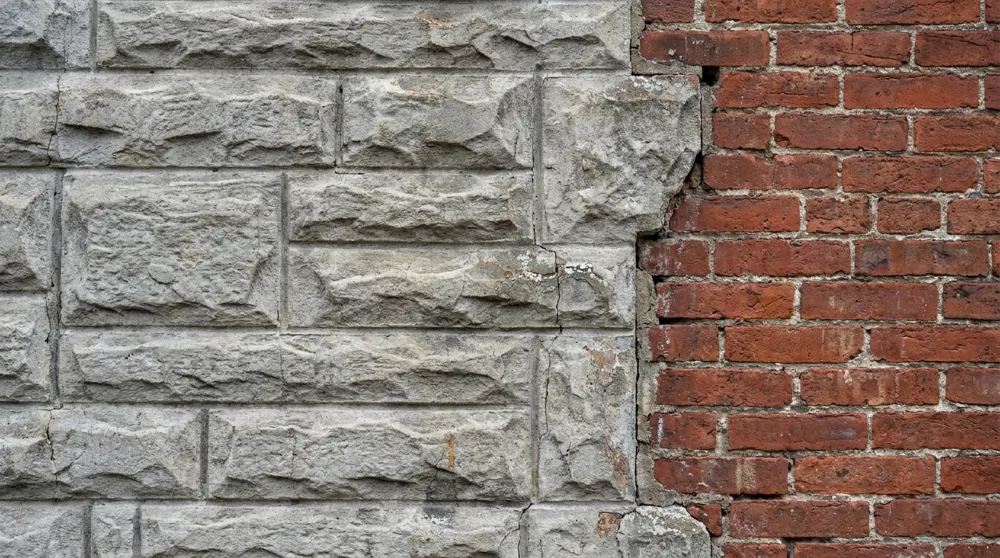
Formstone, patented in 1937, was troweled over brick and scored to imitate cut stone. Removing it is a decision, not a default.
The Systems You’ll Almost Certainly Touch
In a rowhome built before about 1960, demolition routinely uncovers the same set of aging systems. None of these are unusual, but all of them cost money, and a good estimate accounts for them up front instead of as “surprise” change orders.
Electrical: Knob-and-Tube and Undersized Panels
Homes built before roughly 1950 often still have fragments of knob-and-tube (K&T) wiring, individual hot and neutral conductors run through ceramic knobs and tubes. K&T is not inherently dangerous when undisturbed, but for a renovation it is a dead end:
- It has no ground wire, so it cannot safely serve modern grounded outlets.
- It cannot be buried in insulation, it relies on open air to shed heat, which conflicts with any energy upgrade.
- Most insurers will not write a policy on a home with active K&T.
Add to that the 60-amp or early 100-amp panels common in these houses, which cannot carry a modern kitchen, HVAC, and EV charging, and a rewire plus panel upgrade is one of the most common rowhome line items. Whole-home rewiring is a significant cost, and it is far cheaper to do while the walls are already open. Read our drywall repair guide for what happens to the plaster when wires get fished.
Plumbing: Galvanized Supply and Cast-Iron Drains
The two usual suspects:
- Galvanized steel supply lines corrode from the inside over decades, choking water pressure and shedding rust. By the time a rowhome is renovation-aged, galvanized supply is usually due for replacement with copper or PEX.
- Cast-iron drain stacks can last a long time but crack, scale shut, or rot at the base. Opening walls and floors during a kitchen or bathroom remodel is the moment to inspect and, where needed, replace them.
Because the main and the stack usually run through the basement and up through the center of the house, plumbing work in a rowhome is rarely “just the bathroom”, it is connected to the whole vertical run.
HVAC: Where Do the Ducts Even Go?
Older rowhomes were built for radiator heat and no central air. Retrofitting modern HVAC into a narrow house with plaster walls and no chases is a genuine design challenge. The two common answers:
- High-velocity mini-duct systems (small flexible ducts that fish through tight cavities), or
- Ductless mini-split heat pumps, which need no ductwork at all and are increasingly our go-to for rowhomes.
Plan the HVAC strategy early, because it influences ceiling heights, soffits, and where you can and cannot open up walls.
The Roof: Flat, Not Pitched
Most rowhomes have flat or low-slope roofs, which is a different world from suburban shingles. They need the right membrane (modified bitumen or EPDM rubber), proper drainage, and attention to the parapet walls and the flashing where your roof meets the neighbors’. Flat roofs have a real service life and are a frequent big-ticket item on an older rowhome, our roof replacement guide covers what to expect.
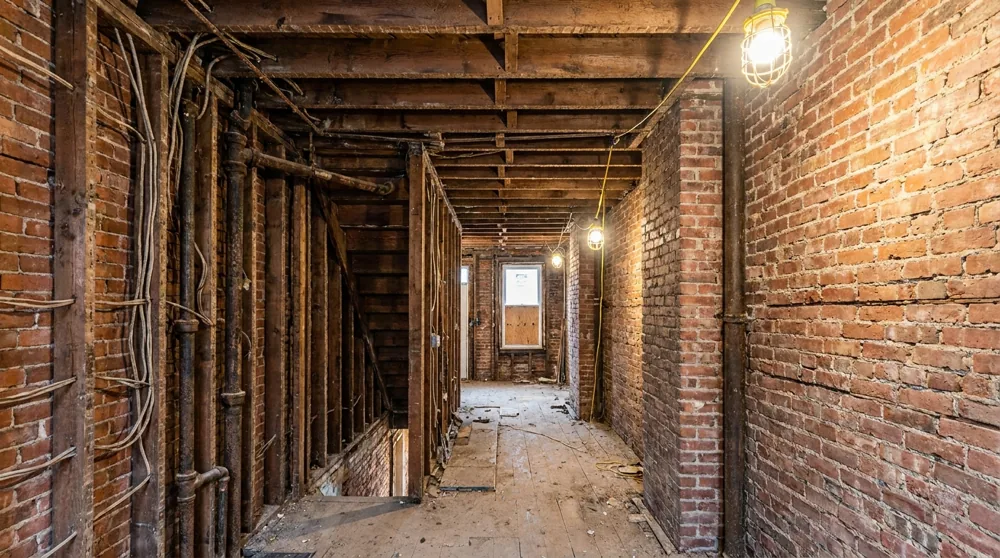
Behind the plaster: brick party walls, original joists, and aging wiring are routine discoveries in a Baltimore rowhome gut.
Structural Realities: Party Walls and Opening Up the Floorplan
The single most-requested rowhome renovation is opening up the dark, chopped-up first floor into a bright open-concept main level. It is absolutely achievable, and it transforms how these narrow houses live. But it has rules.
- Your party walls are usually load-bearing masonry shared with the neighbors. You generally do not touch these (and you cannot unilaterally, they are shared). They carry your joists and roof.
- There is often a central spine wall running front-to-back, or cross-walls between the front, middle, and back rooms, that are load-bearing. Removing one means installing a properly sized beam (steel or engineered LVL) and, frequently, new posts and footings to carry the new point loads down to the foundation.
- Permits and engineering are required. Any load-bearing wall removal needs a Baltimore City building permit and, in most cases, beam sizing by a structural engineer. This is not a weekend demo project.
Done right, removing the center wall and the front-to-middle wall is the move that finally lets light from the front windows reach the back of the house, the same instinct that produced the daylight rowhome a century ago. Our open-concept wall removal guide walks through the beam sizing and permit process in detail.
While walls are open is also the right time to address party-wall sound and fire separation and any moisture transfer from the neighbor’s side, issues that simply do not exist in a detached house.
Plaster, Lead Paint, and the Pre-1978 Rules
Anything built before the 1950s has plaster-and-lath walls, not drywall. Plaster is more durable and better at sound than drywall, but it cracks, it is heavier, and patching it well is a skilled trade. Many renovations keep sound plaster and patch it; gut rehabs typically replace it with drywall.
The bigger compliance issue is lead paint. Maryland law and the federal RRP rule treat any home built before 1978 as presumed to contain lead-based paint. If you disturb painted surfaces, the work must be done lead-safe, by a contractor with the proper RRP certification and containment practices. This is not optional and it is not a place to cut corners with children or pregnant residents in the home. A legitimate rowhome contractor builds lead-safe work practices into the project from the start. Source: Maryland lead-paint compliance for pre-1978 homes via CHAP / Baltimore City.
CHAP and Historic Districts: Get Approval Before You Start
If your rowhome sits in one of Baltimore’s local historic districts, Fells Point, Federal Hill, Mount Vernon, Bolton Hill, Union Square, and many others, the Commission for Historical and Architectural Preservation (CHAP) reviews changes to the exterior of your home. That includes windows, doors, steps, cornices, roofing visible from the street, and even paint colors and formstone removal.
The key facts:
- Approval comes first. You need CHAP sign-off before you do exterior work, not after. Doing it backwards risks a stop-work order and undoing finished work.
- It is usually faster than people fear. CHAP itself describes the design review as typically processable in a few days for routine work, and it is not expensive.
- There is money on the table. The Maryland Historic Revitalization Tax Credit offers a 20% state income-tax credit for approved rehab of historic homes (minimum $5,000 in eligible work), and Baltimore City has its own historic property tax credit. Both require pre-approval, which is one more reason to plan historic work early.
Sources: CHAP Baltimore – Review Procedures, Live Baltimore – Historic tax credit.
Permits: What Baltimore City Requires
Baltimore City requires permits for electrical, plumbing, mechanical (HVAC), and structural work, the very categories a rowhome renovation lives in. Cosmetic work like painting, flooring, or cabinet swaps generally does not. For a full renovation, permit costs commonly run from a few hundred dollars for a single trade up to a few thousand for a whole-home rehab with multiple trades and structural work.
A licensed MHIC contractor should pull every permit in their name, schedule the inspections, and meet the inspector, you should not be running to the Benton Building yourself. Our Baltimore remodeling permits guide breaks down which permits apply to which projects.
What a Rowhome Renovation Actually Costs in 2026
Every house is different, but here are honest, Baltimore-specific ranges for 2026. These assume professional, permitted, lead-safe work, not a flip cutting corners.
| Project scope | Typical 2026 range | What it includes |
|---|---|---|
| Cosmetic refresh (sound house) | $40,000 – $80,000 | Paint, flooring, kitchen and bath updates, minor electrical/plumbing, no major systems or structural work |
| Mid-level renovation | $80,000 – $150,000 | New kitchen and baths, partial rewire and replumb, open up the first floor, new HVAC, some plaster/drywall |
| Full gut rehab | $150,000 – $250,000+ | Down to the studs: new electrical, plumbing, HVAC, roof, insulation, all-new finishes, structural beam work |
Where the money goes on a single-system basis:
- Kitchen: a mid-level Baltimore kitchen runs $19,000 to $35,000, see our kitchen remodel cost guide.
- Bathroom: a full bath remodel typically runs $15,000 to $19,000+, see the bathroom cost guide.
- Finishing the basement to add living space, see basement finishing costs.
- Full rehab of a vacant or distressed rowhome, see our dedicated full rehab cost guide.
Exterior systems each carry their own budget: window replacement, roof replacement, siding, and flooring installation throughout.
The biggest cost driver is not finishes, it is how much of the original electrical, plumbing, and structure has to be replaced versus reused. A house with updated systems and good bones can be transformed affordably. A 1900 alley house that never had its wiring or plumbing touched is a different budget entirely. A good contractor tells you which one you have before you sign.
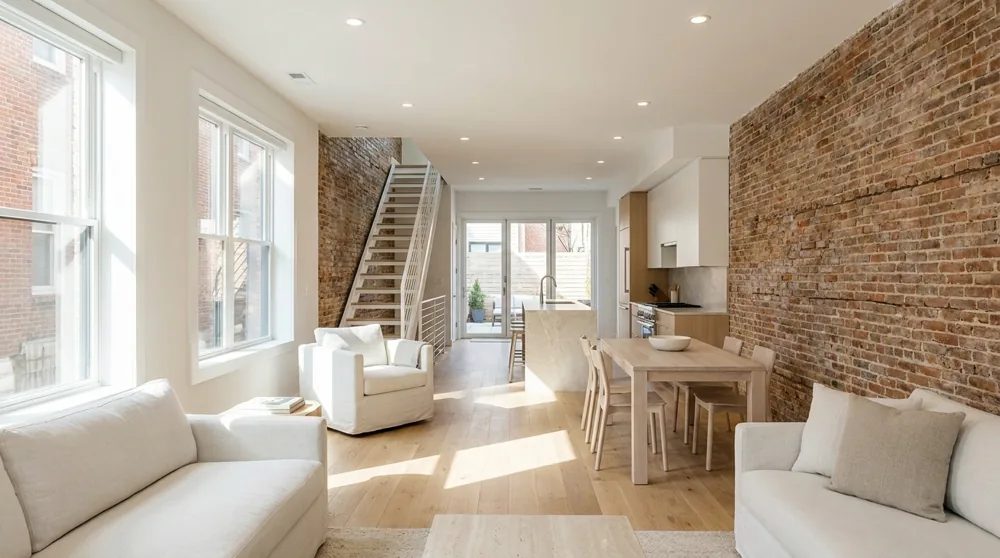
Removing the load-bearing center wall lets front-window light reach the back of a narrow rowhome, the same idea that produced the daylight rowhome a century ago.
Smart Sequencing: The Order That Saves Money
Rowhome renovations go sideways when the order is wrong. The sequence we follow:
- Inspect and plan first. Open test sections (formstone, a plaster wall, the panel) to learn what you actually have before pricing.
- Permits and CHAP approval before any covered work, especially exterior and structural.
- Demolition, lead-safe, with the neighbors warned and dust contained.
- Structural and rough-in together, beam work, then electrical, plumbing, and HVAC rough-in while everything is open. Do all of it now; reopening finished walls is the most expensive mistake in remodeling.
- Insulation and inspections, pass rough inspections before you close anything up.
- Drywall/plaster, then finishes, flooring, cabinets, counters, paint, fixtures.
- Final inspections and punch list.
The theme: do the invisible, in-the-walls work right and all at once. That is where rowhomes punish shortcuts.
How to Choose a Contractor Who Actually Knows Rowhomes
Not every good contractor is a good rowhome contractor. Before you hire, ask:
- Are you MHIC licensed and insured? In Maryland, your home improvement contractor must hold a valid MHIC license. Ours is #149066. Verify it, and ask for proof of insurance.
- How many Baltimore rowhomes have you renovated? You want someone who has met formstone, party walls, knob-and-tube, and flat roofs many times, not someone learning on your house.
- Will you open test sections before quoting? A contractor who commits to a gut-rehab price without ever opening a wall is guessing, and you will pay for the guesses in change orders.
- Are you lead-safe (RRP) certified? Mandatory for any pre-1978 home where paint is disturbed.
- Who pulls the permits and handles CHAP? It should be them, in their name.
- Can you walk me through the structural plan for opening up the first floor? They should talk comfortably about load-bearing walls, beam sizing, and engineering.
A contractor who answers these crisply, and who publishes real prices instead of hiding behind “it depends,” is the one who has done this before.
Ready to Renovate Your Baltimore Rowhome?
A Baltimore rowhome is one of the best renovation values in the country, if you go in with eyes open about formstone, party walls, old wiring and plumbing, historic rules, and flat roofs. Get those right and you end up with a bright, modern, open home inside a building with a century of character.
At Monarch Bay Renovations we have renovated rowhomes across the city and we will give you straight answers and real numbers, not a sales pitch. We are licensed (MHIC #149066), Google Guaranteed, and we handle the permits, the CHAP review, and the lead-safe work so you do not have to.
Get started: request a free estimate, contact us, or call (443) 602-9300. Tell us your neighborhood and what you are dreaming about, and we will tell you honestly what your rowhome needs to get there.
Common Questions
- How much does it cost to fully renovate a Baltimore rowhome in 2026?
- A whole-home rowhome renovation in Baltimore typically runs $80,000 to $250,000 or more in 2026, depending on the size of the house, the condition of the systems, and your finish level. A cosmetic refresh of a sound house can land in the $40,000 to $80,000 range, while a full gut rehab of a vacant or distressed rowhome, new electrical, plumbing, HVAC, roof, and finishes, commonly runs $150,000 to $250,000+. The single biggest variable is how much of the original electrical, plumbing, and structure has to be replaced versus reused.
- Should I remove the formstone on my Baltimore rowhome?
- It depends on what is underneath. Formstone was applied over brick starting in the late 1930s, and removing it almost always damages the original brick face, which then needs repointing, patching, or a full stucco or paint treatment. If the brick beneath is in good shape and you are in a historic district where it is encouraged, removal can restore the home's original character. If the formstone is sound and the brick beneath was poor-quality salmon brick, leaving it in place is often the smarter, cheaper call. Either way, get a contractor to open a test section before you commit.
- Can I knock down a wall to open up my rowhome's first floor?
- Often yes, but you must identify load-bearing walls first. Most Baltimore rowhomes carry their floor and roof loads on the two party walls and frequently on a central spine wall running front-to-back. Removing a load-bearing wall requires engineered beam sizing and a Baltimore City permit. The narrow, deep layout of a rowhome makes open-concept conversions popular and very doable, but never assume a wall is non-structural, especially the center wall.
- Do I need a permit to renovate a rowhome in Baltimore?
- Yes, for almost any meaningful work. Baltimore City requires permits for electrical, plumbing, mechanical, and structural work, and for changes to the exterior if your home is in a CHAP historic district. Cosmetic work like painting or flooring usually does not. Permit costs for a full renovation commonly run several hundred to a few thousand dollars depending on scope. A licensed MHIC contractor pulls these permits and schedules the inspections for you.
- Is knob-and-tube wiring in my rowhome dangerous?
- Knob-and-tube wiring is not automatically dangerous if it is undisturbed, but it is a real problem for a renovation. It has no ground, cannot be safely buried in insulation, and most insurers will not cover a home with active knob-and-tube. During any rowhome renovation that opens walls, plan to replace it along with the old 60 or 100-amp panel. Budget for a full or partial rewire, it is one of the most common hidden costs we find behind Baltimore plaster.