

Renovation Notes
Roof Replacement in Baltimore: 2026 Costs, Flat-Roof Realities & When to Replace
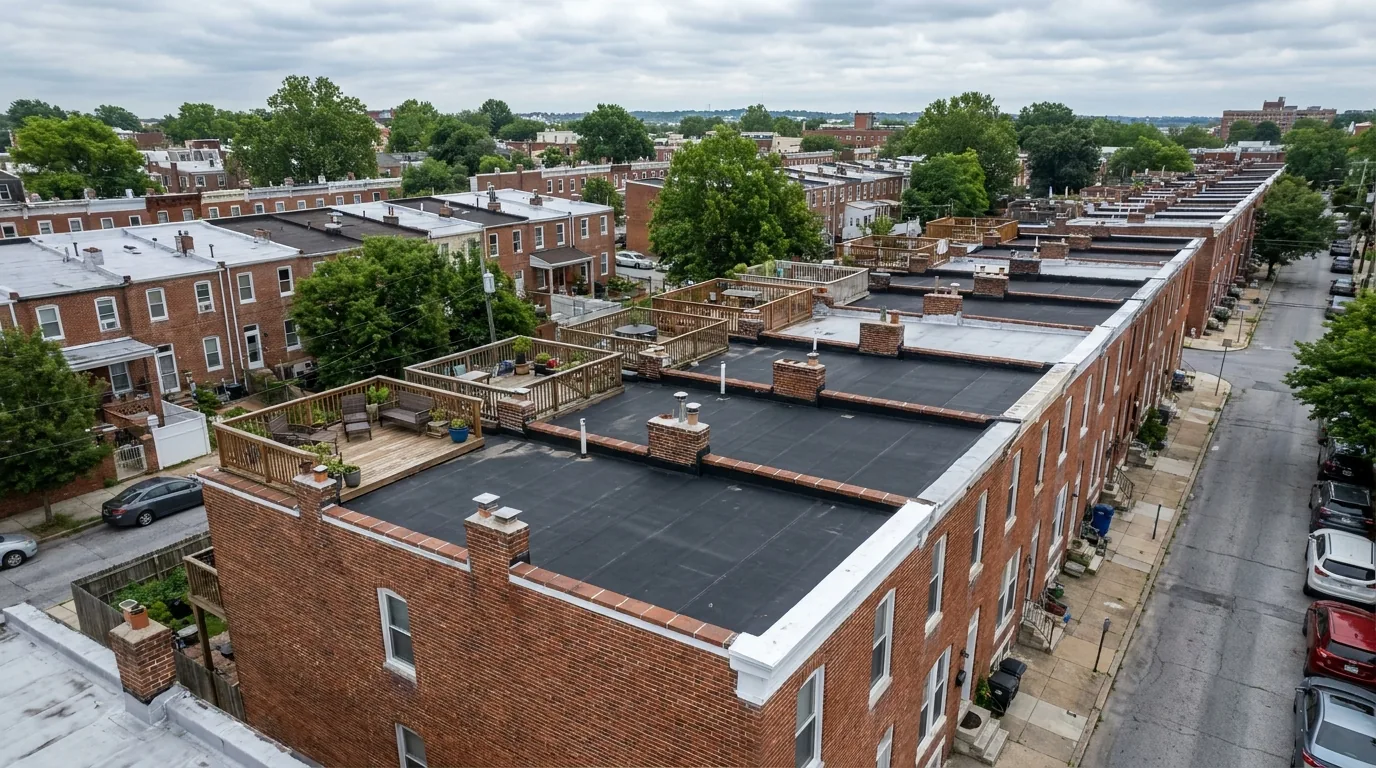
If you own a home in Baltimore, your roof is doing harder work than you think. Between blistering July afternoons, January cold snaps, and the summer thunderstorms that roll through almost weekly, the average Baltimore roof takes a beating the manufacturer’s brochure never accounts for. And if you live in one of this city’s hundreds of thousands of brick rowhouses, your roof probably isn’t even a roof in the way most cost calculators assume. It’s flat, and it plays by completely different rules.
This guide is the straight version. We’ll cover what roof replacement actually costs in Baltimore in 2026, why so many rowhouses have flat roofs and what that means for your wallet, how to tell repair from replacement without getting talked into a tear-off you don’t need, and the local realities (party walls, parapets, formstone fronts, MD storms) that a national roofing site will never mention. At Monarch Bay Renovations, we’ve worked on Baltimore roofs from Canton to Catonsville, and we’re going to tell you what we’ve learned.
How Much Does Roof Replacement Cost in Baltimore?
Let’s get to the number you came for. In 2026, a full roof replacement in the Baltimore metro typically runs $8,000 to $16,000 for a standard home with asphalt shingles, which works out to roughly $4 to $7 per square foot installed. Roofers price in “squares” (one square = 100 square feet), and locally you’ll see anywhere from $350 to $1,000+ per square depending on the shingle grade, the steepness, and how many old layers have to come off.
Here’s how the asphalt-shingle numbers break down by tier:
| Tier | Material | Installed cost per sq. Ft. | Typical roof (≈20 squares) |
|---|---|---|---|
| Budget | 3-tab asphalt shingles | $3.50 – $4.50 | $7,000 – $9,000 |
| Mid-range | Architectural / dimensional shingles | $4.50 – $6.50 | $9,000 – $13,000 |
| Premium | Designer / impact-rated shingles, complex roof | $6.50 – $9.00+ | $13,000 – $18,000+ |
For a flat rowhouse roof, the math is different (more on why below). A typical Baltimore rowhouse roof of 1,200 to 1,800 square feet usually lands between $6,000 and $13,000, depending on the membrane you choose and how much rotted decking or soaked insulation has to be hauled out.
What Actually Drives Your Roofing Cost
- What’s hiding under the old roof. This is the single biggest variable. Rotted plywood or plank decking, wet insulation, or a deck that’s been quietly leaking for years all add cost, and you usually can’t see it until the tear-off starts. An honest contractor inspects first and tells you the likely surprises before you sign.
- Layers to remove. Baltimore homes often have two or even three roofs stacked on top of each other from past “just go over it” jobs. Each layer that has to come off and get hauled away is labor and dumpster cost.
- Slope and access. A steep front gable, a three-story rowhouse with no rear alley, or a roof you can only reach over a neighbor’s property all push labor up.
- Material grade. Architectural shingles cost more than 3-tab but last longer and look far better. On flat roofs, TPO and EPDM cost more upfront than modified bitumen but buy you years.
- Flashing, drains, and details. The line items people ignore are the chimney flashing, vent boots, drains, coping caps, and parapet seals. Those are the exact spots where almost every roof leak actually starts.
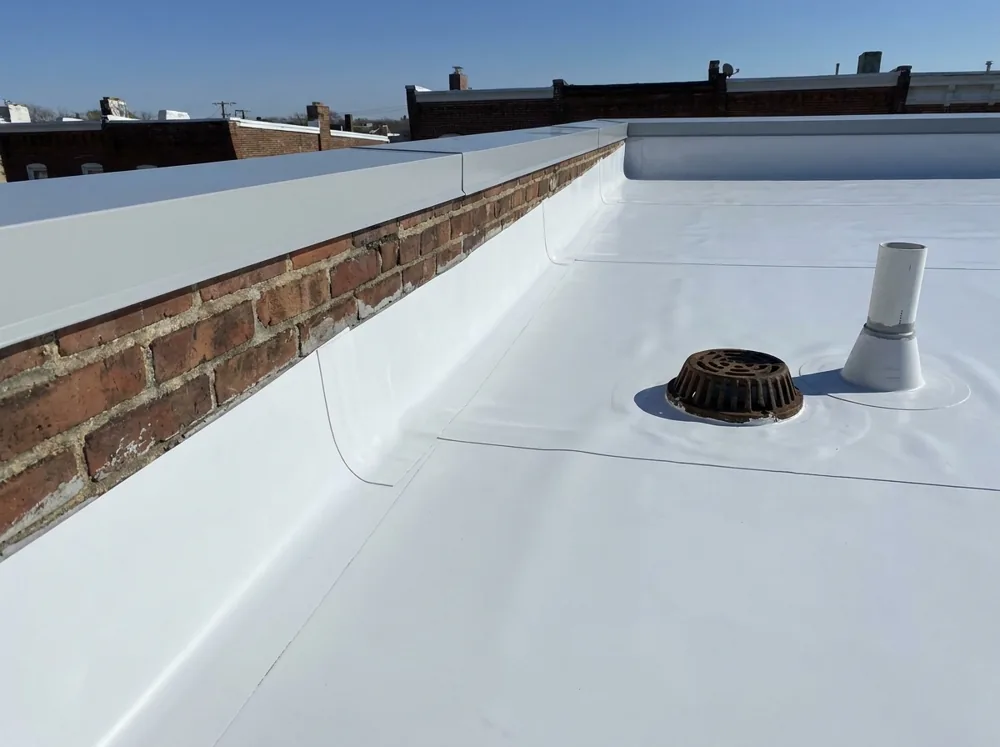
A new single-ply TPO membrane on a rowhouse roof. The white surface reflects summer heat and lowers cooling bills.
The Baltimore Rowhouse Flat-Roof Reality
Here’s the thing most cost guides get wrong about Baltimore: a huge share of the city’s homes don’t have a slanted, shingled roof at all. Baltimore has more rowhouses than almost any city in America, and the classic two- and three-story brick rowhome was built with a flat or very low-slope roof.
Why? Because these homes share party walls and sit shoulder-to-shoulder down the block. A flat roof lets each unit drain quietly to the back of the house and keeps the whole row’s front facade clean and uniform, the look that gives neighborhoods like Canton, Federal Hill, and Hampden their character. Shingles need pitch to shed water, so they simply don’t work on a true flat roof. Instead, a flat roof relies on a continuous waterproof membrane stretched across the deck.
If you’ve got a flat roof, forget shingle pricing and shingle thinking entirely. You’re choosing a membrane system, and the three you’ll hear about in Baltimore are EPDM, TPO, and modified bitumen.
EPDM (Rubber)
EPDM is the black rubber membrane you’ve seen on countless Baltimore rowhouse roofs. It’s tough, handles UV and freeze-thaw well, and lasts 20 to 30+ years when installed right. The trade-off: that black surface soaks up summer heat, which can warm the top floor and run up the AC. Cost typically runs $8 to $15 per square foot installed.
TPO (White Single-Ply)
TPO is the rising favorite, and for good reason in our climate. Its white, reflective surface bounces summer sun off the roof instead of into your house, which genuinely lowers cooling bills on a hot Baltimore third floor. Seams are heat-welded into a continuous waterproof sheet. Lifespan runs 15 to 25 years, and cost lands around $10 to $18 per square foot installed.
Modified Bitumen
Modified bitumen, sometimes called “mod-bit” or “torch-down,” is the modern descendant of the old built-up tar-and-gravel roof. It’s the budget-friendly option at roughly $5 to $9 per square foot, and it installs in rolls, but it’s more vulnerable to Baltimore’s freeze-thaw cycle and tends to last 15 to 20 years. It’s a reasonable call on a rental or a tight budget; it’s not the longest-lasting choice.
Party Walls, Parapets, and Coping: The Details That Leak
This is where rowhouse roofs get specific. Your flat roof doesn’t just end at the edge. It meets a brick parapet wall (the low wall that rises above the roofline along your party walls and front). On top of that parapet sits the coping, a cap that keeps water out of the masonry. And right where the membrane turns up to meet the parapet is the most leak-prone spot on the entire roof.
When a rowhouse roof leaks, nine times out of ten it’s not the middle of the membrane. It’s a failed seam at the parapet, cracked coping letting water into the brick, or old flashing around a vent stack. A good Baltimore roofer obsesses over those transitions. A cheap one rolls membrane across the field, skimps on the parapet detail, and you’re back to staining your ceiling within two winters.
There’s also the shared-wall question: because you and your neighbor literally share that parapet, water getting behind a failing coping can travel and show up in their top floor or yours. It’s worth a friendly conversation with the neighbor when either of you re-roofs, because the seam where two roofs meet is everyone’s problem.
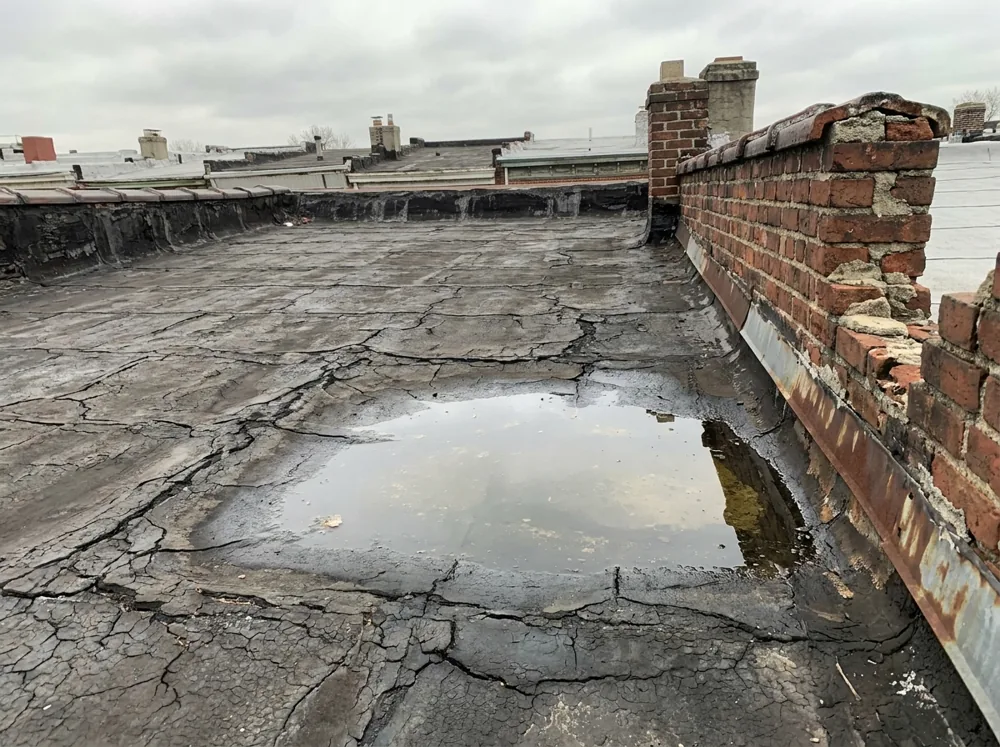
Alligatored cracking, ponding water, and a failing parapet: the classic signs a flat rowhouse roof has reached the end of the line.
When the Front Is Sloped and the Back Is Flat
Plenty of Baltimore homes (porchfront rowhomes, Daylights, and many semi-detached houses in the county) have a hybrid roof: a sloped, shingled front section that’s visible from the street, and a flat or low-slope rear roof you never see. These need two different repairs and two different materials, and that catches people off guard at quote time. Don’t assume “I need a new roof” means one price and one material; on a hybrid house it’s really two roofs, and a contractor who treats it as one is either guessing or cutting a corner.
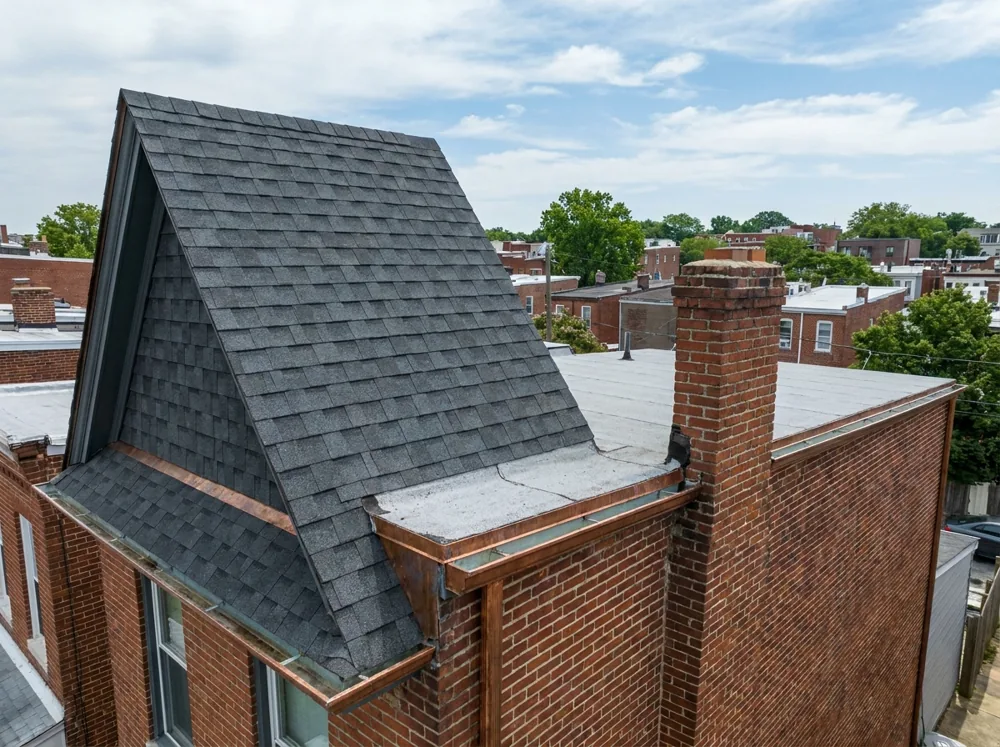
Many Baltimore homes have a sloped shingled front and a flat rear roof, effectively two roofing systems on one house.
How Long Does a Roof Last in Baltimore?
The package says 30 years. Baltimore weather says otherwise. Here’s the honest local lifespan:
- Architectural (dimensional) asphalt shingles: 20 – 25 years
- 3-tab asphalt shingles: 15 – 20 years
- EPDM rubber (flat): 20 – 30+ years
- TPO (flat): 15 – 25 years
- Modified bitumen (flat): 15 – 20 years
Our climate is the reason real-world numbers come in under the brochure. Maryland summers push attic and roof-deck temperatures sky-high; winter nights drop below freezing. Shingles and membranes expand in the heat and contract in the cold, over and over, and that constant flexing cracks, curls, and loosens them years ahead of schedule. Add the wind and water from our summer storm season and the occasional remnants of a tropical system, and a “30-year roof” installed in Baltimore is realistically a 20-to-25-year roof. The flashing and seams usually give out before the field does, which is exactly why installation quality matters more than the warranty on the box.
Repair or Replace? An Honest Framework
Nobody wants to spend roof money they don’t have to, and a good contractor won’t push you toward a full tear-off when a repair will do. Here’s the framework we actually use when we walk a Baltimore roof.
Repair is usually the right call when:
- The damage is isolated: a punctured spot, a single failed seam, a few wind-lifted shingles, or flashing that’s pulled loose at a vent or chimney.
- The rest of the roof is sound and relatively young (a flat membrane under ~10 years old, a shingle roof with most of its life left).
- You can point to one event that caused it, like a storm or a fallen branch, rather than general age.
- A targeted fix at the parapet, coping, or a vent boot will stop the leak without disturbing a healthy roof.
Replacement is the smarter money when:
- You see widespread cracking or alligatoring (that grid of tiny interlocking cracks), or blisters across the whole field of a flat roof.
- Water still ponds 48 hours after rain, a sign the deck has sagged and the roof can no longer drain.
- The insulation is wet or the deck feels spongy underfoot. Once water’s in the deck, patching the surface only traps it.
- Shingles are curling, balding, or losing granules across the roof, not just in one spot.
- Your annual repair bills are creeping toward 30 to 40 percent of what a full replacement would cost. At that point you’re renting a failing roof.
- You’re chasing the same leak for the third time. Recurring leaks usually mean a systemic problem a patch can’t solve.
The grey-area cases are real, and that’s where you want a contractor who’ll give you the unglamorous answer. We’ll tell you when your roof has five good years left and a $600 repair buys them. We’ll also tell you when patching is just delaying the inevitable and wasting your money. Both answers come free with an inspection. See our exterior services for how roofing fits into the bigger picture of protecting your home’s envelope.
Storm Damage and Insurance in Baltimore
Baltimore’s summer is one long storm season. Strong straight-line winds, hail a few times a year, and the soaked remnants of tropical systems coming up the coast all do real damage: lifted shingles, torn membrane, clogged or overwhelmed flat-roof drains, and the slow leaks that follow.
The key distinction for insurance: most homeowners policies cover roof damage from a sudden, covered event (a windstorm, a fallen tree, hail) but not from age or gradual wear. If a storm damages your roof, photograph it promptly, file your claim quickly, and expect your deductible to apply. The grey zone is “is this storm damage or just an old roof?” An experienced eye helps, and so does documentation. We handle insurance restoration work regularly and can walk a roof with you to assess whether a claim is realistic before you ever call your carrier.
A word of caution: after every big storm, out-of-town “storm chasers” flood Baltimore neighborhoods knocking on doors. Some are fine; many are not. Before you sign anything, confirm the contractor is a licensed Maryland Home Improvement Contractor (MHIC), is local, and will still be here when you need the warranty honored.
Permits, Historic Districts, and Doing It Right
In Baltimore City, roof replacement generally requires a building permit. If your home sits in one of the city’s historic districts (Fells Point, Federal Hill, Mount Vernon, Bolton Hill, parts of Canton and Charles Village) and the roof is visible from the street or you’re changing materials, the work may also need review by the Commission for Historical and Architectural Preservation (CHAP). On most flat rowhouse roofs the membrane isn’t visible from the sidewalk, so this comes up less than it does for windows, but it’s worth checking before you start.
Skipping the permit to save a few dollars is a false economy. Unpermitted work invites fines, can force you to redo finished work, and absolutely surfaces as a problem when you sell. A licensed contractor pulls the permit, schedules the inspections, and hands you a clean paper trail. We handle all of that as part of the job. It’s not an add-on, it’s just doing it right. Learn more about how we run a project on our process page.
Why Baltimore Homeowners Work With Monarch Bay Renovations
- We know Baltimore roofs. Flat rowhouse membranes, party walls and parapets, formstone fronts, hybrid sloped-and-flat houses, and the leak-prone details that come with all of them. This is our home turf.
- Honest repair-vs-replace guidance. We’ll tell you when a $600 repair buys you five years, and we’ll tell you when a tear-off is the only thing that actually solves the problem. No fear-selling.
- Licensed, insured, Google Guaranteed. Fully licensed Maryland Home Improvement Contractor (MHIC #149066), carrying real insurance, and Google Guaranteed.
- Permits and inspections handled. We manage the City permit and inspections so you don’t have to.
- Free, transparent estimates. A real inspection and a written, line-item quote, no allowance games, no surprises after the tear-off starts.
Ready for a straight answer on your roof? Call us at (443) 602-9300 or request a free estimate online. We’ll inspect your roof, tell you honestly whether you need a repair or a replacement, and give you a detailed written quote. No pressure, no obligation.
Get Your Free Baltimore Roof Estimate
Whether you’ve got a leaking flat roof in Canton, aging shingles in Towson, or storm damage you’re not sure about, Monarch Bay Renovations gives you a real assessment and real numbers. We serve Baltimore City, Baltimore County, Howard County, Anne Arundel County, and the surrounding areas.
Call (443) 602-9300 or fill out our online form to schedule your free roof inspection. You can also reach us through our contact page with any questions, we typically respond within one business day.
Common Questions
- How much does roof replacement cost in Baltimore in 2026?
- A full asphalt shingle roof replacement on a typical Baltimore home runs roughly $8,000 to $16,000 in 2026, or about $4 to $7 per square foot installed. Flat rowhouse roofs (EPDM, TPO, or modified bitumen) usually land between $6,000 and $13,000 depending on the membrane, the insulation, and how much rotted decking or wet insulation has to come out. The biggest swing factor is what we find under the old roof, which is why an honest contractor inspects before quoting.
- Why do so many Baltimore rowhouses have flat roofs instead of shingles?
- Baltimore's classic two- and three-story brick rowhouses were built with flat or very low-slope roofs because the homes share party walls and sit shoulder-to-shoulder. A flat roof lets each unit drain to the back and keeps the front facade clean and uniform along the block. Shingles need slope to shed water, so they don't belong on a true flat roof. Instead, flat rowhouse roofs use a waterproof membrane — rubber (EPDM), TPO, or modified bitumen — rolled or welded across the deck.
- How long does a roof last in Baltimore's climate?
- In Maryland's freeze-thaw climate, architectural asphalt shingles realistically last 20 to 25 years, and older three-tab shingles closer to 15 to 20 — not the 30 years on the package. For flat rowhouse roofs, EPDM rubber lasts 20 to 30+ years, TPO 15 to 25, and modified bitumen 15 to 20. Hot summers, cold winters, and heavy summer storms all shorten those numbers, especially where flashing and seams were installed poorly.
- Should I repair my flat roof or replace it?
- Repair makes sense when the damage is isolated — a punctured spot, a failed seam, loose flashing at a vent or parapet — and the rest of the membrane is sound and under about 10 years old. Replace when you see widespread cracking or alligatoring, blisters across the field, water that still ponds 48 hours after rain, wet or spongy insulation, or when yearly patch bills start reaching 30 to 40 percent of a full replacement. We'll tell you honestly which side of that line your roof is on.
- Does homeowners insurance cover roof replacement in Baltimore?
- Insurance typically covers roof replacement when the damage comes from a covered, sudden event — a windstorm tearing off shingles, a fallen tree, or hail — not from age or gradual wear. Baltimore's summer thunderstorms and the occasional remnants of a tropical system are common claim triggers. Document the damage with photos, file promptly, and your deductible will apply. We work on insurance restoration jobs regularly and can help you understand whether a claim is realistic.
- Do I need a permit to replace a roof in Baltimore City?
- Yes, in most cases. Baltimore City requires a permit for roof replacement, and historic districts (Fells Point, Federal Hill, Mount Vernon, and others) may require CHAP review if the roof is visible from the street or you're changing materials. A licensed contractor handles the permit and inspections as part of the job, which also protects you when you sell the home.