

Renovation Notes
Drywall & Plaster Repair in Baltimore: 2026 Costs & Rowhouse Guide
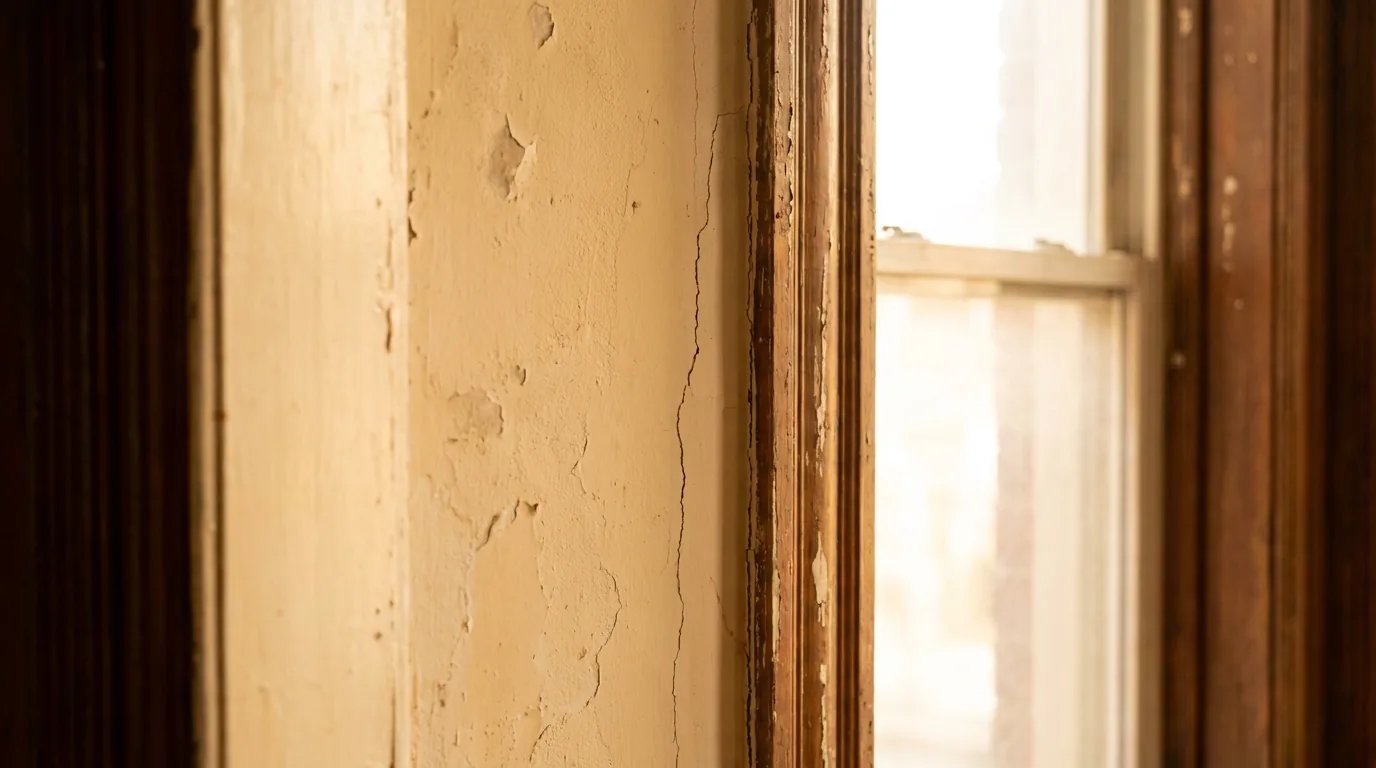
If you own an older home in Baltimore, you have almost certainly watched a crack march its way across a wall or ceiling, found a soft brown stain spreading after a hard rain, or pressed a thumb against plaster that gave a little more than it should have. Cracked and damaged walls are one of the most common reasons homeowners call us, and they are also one of the most misunderstood. A wall problem is rarely just a wall problem.
This guide covers what drywall and plaster repair actually costs in Baltimore in 2026, why the city’s housing stock cracks the way it does, how to handle water damage without making it worse, and the lead-paint rules that apply to nearly every rowhouse. At Monarch Bay Renovations, we repair walls and ceilings across Baltimore City and the surrounding counties every week, in everything from a 1910 Federal Hill rowhouse to a 1990s colonial in Towson, and we are sharing what we have learned.
Drywall and Plaster Are Not the Same Thing
This is the distinction that trips up most Baltimore homeowners, and it changes everything about the repair.
Drywall (also called Sheetrock or gypsum board) is the modern standard: a panel of compressed gypsum sandwiched between paper, screwed to studs, with seams taped and mudded. Nearly every home built in Baltimore from the 1950s onward uses it, and so does every renovation since. It is fast to install, easy to patch, and forgiving.
Plaster-and-lath is what came before it, and Baltimore has a tremendous amount of it. In a true plaster wall, thin wooden strips called lath are nailed across the studs, and wet plaster is troweled over them in coats. The plaster oozes through the gaps between the lath and hardens into “keys” that lock the whole wall in place. When those keys break, which they eventually do, the plaster starts to separate from the lath and the wall fails from behind.
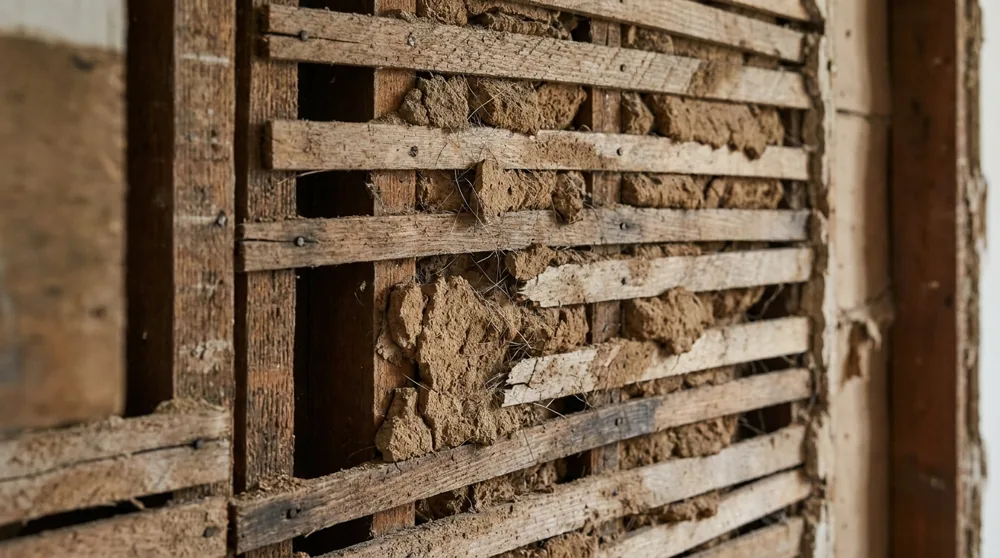
Behind the plaster in many older Baltimore rowhouses: thin wooden lath and the plaster “keys” that hold the wall together until they don’t.
Why does this matter to you? Because a contractor who only knows drywall will treat your plaster wall like drywall, and it will not hold. Patching plaster correctly means re-keying it to the lath, building it back in layers, and feathering it into a surface that was never perfectly flat to begin with. It is slower, it is more of a craft, and it is exactly the kind of work a lot of general contractors quietly avoid. We do not.
How Much Does Drywall and Plaster Repair Cost in Baltimore?
| Repair type | Typical Baltimore cost |
|---|---|
| Small hole (doorknob, anchor, under 4”) | $100 – $250 |
| Medium hole (fist to ~12”) | $200 – $500 |
| Replacing a section of drywall | $50 – $75 per sq ft |
| Plaster crack repair | $4 – $5 per linear ft (small) |
| Plaster patch / re-key to lath | $40 – $75 per sq ft |
| Water-damaged drywall (after leak is fixed) | $500 – $2,000 |
| Mold remediation (if present) | $10 – $20 per sq ft |
| Full plaster-to-drywall conversion | $4,000 – $18,000 |
A few things drive these numbers up or down more than homeowners expect:
- Texture matching. A smooth patch is the cheap part. Matching knockdown, orange-peel, or old hand-troweled plaster texture so the repair disappears adds roughly 30 to 40 percent, and it is worth every penny. A patch you can see from across the room is not a finished repair.
- Ceilings versus walls. Ceiling work is slower and harder on the body, so it costs more per square foot than the same repair on a wall.
- What’s behind the damage. If we open a wall and find a live leak, failed insulation, knob-and-tube wiring, or rotted framing, that gets addressed honestly before we close it back up. We document surprises with photos and talk to you before spending your money, never after.
- Access and prep. Moving furniture, protecting floors, and lead-safe containment in a pre-1978 home all take time, and time is most of the cost in a repair.
Why Baltimore Walls Crack: It’s Usually the House, Not the Plaster
A crack is a symptom. Before you spend money covering one up, it is worth understanding what your house is telling you, because Baltimore’s housing stock cracks for specific, predictable reasons.
A classic Baltimore settling crack: a thin line working diagonally from the corner of a window, where the wall is weakest.
Settling and seasonal movement
Baltimore rowhouses are old, and old houses move. A century of seasonal expansion and contraction, slow foundation settling, and the simple aging of materials produces hairline cracks, especially radiating from the corners of doors and windows where the wall is structurally weakest. Most of these are cosmetic and stable. A few are not. The tell is whether a crack keeps coming back after it’s patched, or keeps growing, which can point to ongoing movement worth investigating before you just fill it again.
Failed plaster keys
In true plaster walls, the keys that grip the lath eventually crack and crumble with age and vibration. When enough of them go, the plaster bellies out away from the wall, you can sometimes push on it and feel it flex. This is not a paint-over situation. The plaster has to be re-secured to the lath or the failed area removed and rebuilt, or it will keep separating.
Water, and lots of it
This is the big one in Baltimore. Old roofs, failing window flashing (especially on formstone-clad rowhouses where moisture gets trapped against the wall), aging galvanized supply lines, and clogged gutters all push water into walls and ceilings. Water is behind a huge share of the wall damage we repair, and it never fixes itself.
Party-wall realities
Because rowhouses share side walls with the homes on either side, what your neighbor does, or fails to do, can show up on your walls. A leak two doors down or a vacant unit with no heat can migrate moisture through a shared wall. It is one more reason a wall problem deserves a real look, not just a tube of spackle.
Water-Damaged Walls and Ceilings: Stop the Source First
If you take one thing from this guide, take this: do not let anyone patch water damage before the source of the water is found and fixed. We see it constantly, a freshly painted ceiling stain that bleeds right back through a month later, now with mold behind it. Covering up water damage without stopping the water doesn’t save money. It multiplies the eventual bill.
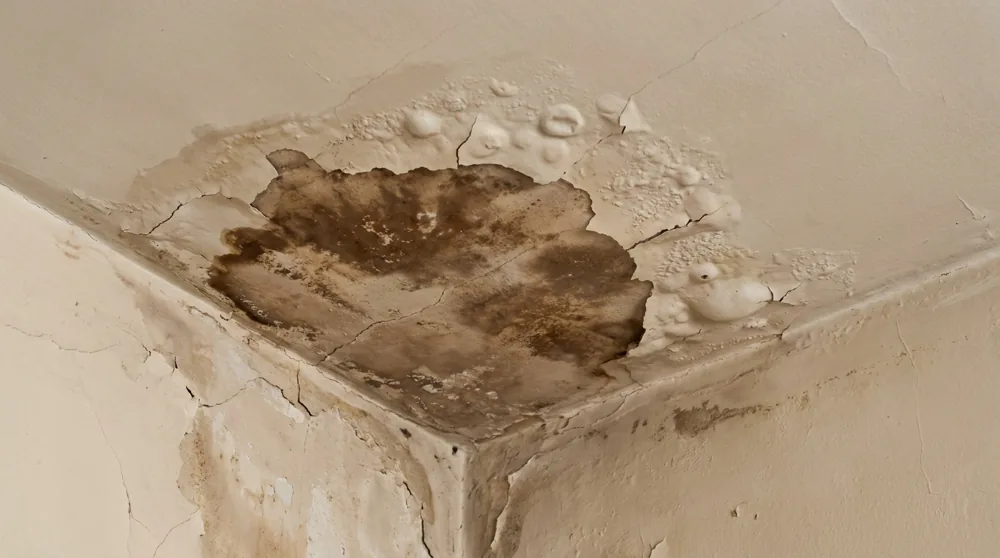
A water-stained ceiling is a message, not just a blemish. The right first step is finding where the water came from.
The right sequence is straightforward:
- Find and fix the source. In Baltimore that’s usually a roof leak, failed window flashing, or an old pipe. This is the step that actually solves the problem.
- Dry it out completely. Wet drywall and plaster have to reach a true dry state before anything goes back, or you are sealing moisture and mold inside the wall.
- Assess for mold and check what’s behind it. Soft, sagging, or musty-smelling material gets removed. We look at the insulation and framing behind it while the wall is open.
- Repair and finish. New material in, taped or re-keyed, textured to match, and painted so the repair disappears.
Once the leak is handled and the area is dry, water-damaged drywall repair typically runs $500 to $2,000. If mold has taken hold, remediation adds $10 to $20 per square foot. The honest truth is that the repair is the easy part; the leak is the part that matters, and a contractor who skips straight to the patch is doing you no favors.
The Lead Paint Rule Every Pre-1978 Baltimore Home Should Know
Baltimore has some of the oldest housing in America, which means most of the city’s rowhouses were built before lead paint was banned in 1978. Repairing walls in these homes means sanding and cutting into painted surfaces, and that disturbs any lead paint underneath, releasing fine lead dust that is genuinely hazardous, especially to children.
This is not a formality. Maryland law and the federal EPA Renovation, Repair, and Painting (RRP) rule require certified lead-safe work practices on pre-1978 homes: containing the work area, controlling dust, cleaning up with HEPA equipment, and disposing of debris properly. A contractor who sands old painted plaster with no containment is breaking the rules and putting your household at risk.
Monarch Bay Renovations follows RRP practices on every pre-1978 home we touch. It adds a little time to the job, and it is non-negotiable. When you get repair quotes, it is worth asking any contractor directly how they handle lead-safe containment, the answer tells you a lot about who you are dealing with.
Repair the Plaster or Switch to Drywall?
One of the most common questions we get on older homes is whether to keep repairing original plaster or just tear it out and hang drywall. There is no single right answer, it depends on the house and how far the damage has spread.
Keep and repair the plaster when: the damage is isolated to cracks and a few soft spots, the walls are mostly sound, and you value the character, the mass, and the genuine sound-deadening that thick old plaster gives a rowhouse. Repairing plaster preserves what makes these homes feel solid, and on a per-room basis it is usually cheaper than a full tear-out and conversion.
Convert to drywall when: the plaster is bowing away from the lath across a large area, most of the keys have failed, or you are already gutting the room for other work. A full plaster-to-drywall conversion runs roughly $4,000 to $18,000 depending on how many rooms and the condition of what’s behind the walls, but it gives you flat, modern, easy-to-maintain surfaces and a clean slate for wiring and insulation.
We will not push you toward a tear-out just because it is simpler for us. We walk the house, look at the actual condition wall by wall, and tell you which approach we would choose if it were our own home. Sometimes that’s a careful plaster repair in the front parlor and full drywall in a back bedroom that’s already been hacked up by three previous renovations.
Why Texture Matching Is the Whole Game
A proper repair feathers the joint compound far wider than the actual damage, so there is no ridge or shadow line where the patch meets the original wall. Then the texture gets matched, smooth plaster, knockdown, orange-peel, or one of the hand-troweled finishes you find layered through old Baltimore homes, before any paint goes on. Skip that step and the patch catches the light at a different angle than the wall around it, and you’ll see it forever. Done right, you genuinely cannot find the repair afterward, and that is the standard we hold our crews to.
Why Baltimore Homeowners Call Monarch Bay Renovations
- Real rowhouse experience. We work in Baltimore’s plaster-and-lath housing stock constantly. We know how it fails, how to repair it, and when it makes more sense to convert to drywall.
- We find the cause, not just the symptom. Especially with water damage, we trace it to the source so the repair actually lasts.
- Lead-safe on every old home. Full EPA RRP practices on pre-1978 houses, no shortcuts.
- Self-performing crews. Our team handles demo, repair, texture, and paint in-house, which means tighter quality control and one point of accountability, not a chain of subs.
- Licensed, insured, and Google Guaranteed. Maryland Home Improvement Contractor, MHIC #149066, with full insurance and transparent, line-item estimates.
Whether it’s a single cracked ceiling or every plaster wall in a 1920s rowhome, we’ll give you a straight assessment and a real number. Learn more about our drywall and plaster repair services or explore our full range of interior renovation work.
Get Your Free Drywall & Plaster Repair Estimate
Cracks, water stains, holes, or walls that flex when you press on them, we have seen all of it across Baltimore, and we will tell you honestly what is going on and what it takes to fix it for good.
Call (443) 602-9300 or request a free estimate online to schedule a walkthrough. We serve Baltimore City, Baltimore County, Howard County, Anne Arundel County, and the surrounding areas. We’ll assess the damage, identify the real cause, and give you a detailed written estimate, no pressure, no obligation.
You can also reach us through our contact page with any questions about your walls or ceilings. We typically respond within one business day.
Common Questions
- How much does drywall repair cost in Baltimore in 2026?
- Most single drywall repairs in the Baltimore area run $150 to $700, with the typical job landing around $400 to $600. A small hole (doorknob or anchor size) is $100 to $250, a fist-to-medium hole is $200 to $500, and replacing a full section of damaged drywall runs $50 to $75 per square foot once you factor in patching, taping, sanding, texture matching, and paint. Plaster repair in older rowhomes costs more, often $40 to $75 per square foot, because the work is slower and the material is harder to match.
- Is plaster repair more expensive than drywall repair?
- Usually, yes. Repairing original plaster-and-lath walls, common in Baltimore rowhouses built before the 1950s, runs roughly $40 to $75 per square foot versus $50 to $75 per square foot for cutting in new drywall, but plaster repairs are more labor-intensive and skill-dependent. Plaster has to be keyed back to the lath, built up in coats, and feathered to match a wall that is rarely flat. Matching the texture and thickness of 100-year-old plaster is genuinely a craft, which is why fewer contractors do it well.
- Should I patch my old plaster walls or replace them with drywall?
- It depends on how widespread the damage is. If you have isolated cracks and a few soft spots, repairing the plaster preserves the character, the sound deadening, and the value of an original Baltimore rowhouse, and it is usually cheaper than a full tear-out. If a wall is bowing away from the lath across a large area, or most of the keys have failed, replacing that wall with drywall (about $4,000 to $18,000 for a full conversion depending on room count) is often the smarter long-term call. We walk the house and tell you honestly which way we would go room by room.
- What should I do first if my drywall or ceiling is water-damaged?
- Find and stop the water source before anyone touches the drywall. In Baltimore that is usually a roof leak, a failed window flashing, or an old galvanized supply line. Patching a stained ceiling without fixing the leak just hides the problem until it comes back worse, often with mold. Once the source is fixed and the area is fully dry, water-damaged drywall repair typically runs $500 to $2,000, more if mold remediation ($10 to $20 per square foot) or insulation replacement is involved.
- Do I need to worry about lead paint when repairing walls in an old Baltimore home?
- Yes. Any home built before 1978 may have lead paint, and Baltimore has one of the oldest housing stocks in the country, so this applies to most rowhouses. Sanding or cutting into painted plaster and drywall disturbs that paint and creates lead dust. Maryland law and the EPA Renovation, Repair, and Painting (RRP) rule require certified lead-safe work practices, containment, HEPA cleanup, and proper disposal. Monarch Bay Renovations follows RRP on every pre-1978 home. It is not optional, and it protects your family during the work.
- Can you match the texture on my existing walls?
- In most cases, yes. Baltimore homes carry everything from glass-smooth plaster to knockdown, orange-peel, and old hand-troweled finishes layered over decades of renovations. A good repair is invisible because the patch is feathered wide and the texture is matched before painting. Texture matching adds roughly 30 to 40 percent over a smooth patch, but it is the difference between a repair you never notice and one that catches the light from across the room.