

Renovation Notes
Does a Kitchen Remodel Add Value in Baltimore? What the Data Actually Shows
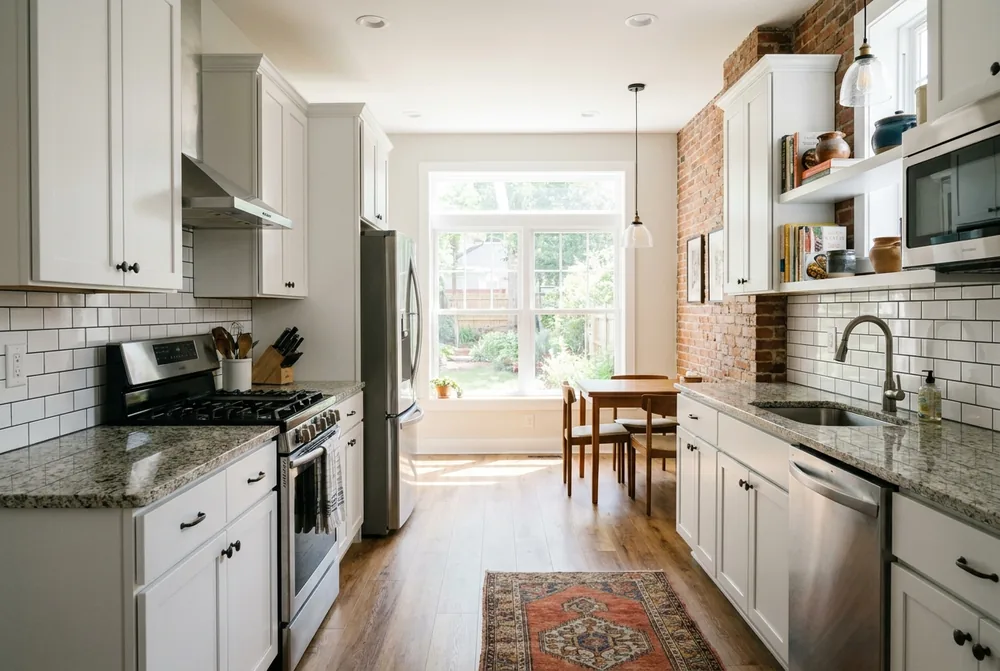
The honest answer is: it depends on what you spend, what your house is worth, and what the market around you looks like. A $15,000 kitchen refresh on a $350,000 Canton rowhouse is a different financial move than an $80,000 gut renovation on a $220,000 rowhouse in Waverly. The industry data supports one and not the other.
Here is what the real numbers say — and how they apply to Baltimore’s specific housing stock.
What the Cost vs. Value Data Shows
Every year, Remodeling Magazine (now published by Zonda) surveys real estate professionals and contractors across 130+ U.S. markets to calculate what homeowners actually recover on common renovation projects. The 2026 report has a clear hierarchy for kitchens:
| Project | Typical Cost | Resale Value Added | ROI |
|---|---|---|---|
| Minor kitchen remodel (same layout, new surfaces + appliances) | ~$28,500 | ~$32,100 | 113% |
| Major kitchen remodel — midrange | ~$80,000 | ~$39,600 | ~50% |
| Major kitchen remodel — upscale | ~$158,500 | ~$60,200 | ~38% |
The minor kitchen remodel is one of the very few interior projects that crosses the 100% return threshold. The definition is specific: keep the existing cabinet boxes, replace the doors and drawer fronts, put in new countertops, update the sink and faucet, add new flooring, and swap in mid-grade appliances. The layout stays the same. No plumbing moves.
The gap between 113% and 38% is not a small variation — it reflects a fundamentally different type of project. The full gut renovation that most people picture when they say “kitchen remodel” (move the island, add a range hood, custom cabinetry, integrated appliances) recovers roughly a third of its cost at resale in the best case.
The National Association of Realtors’ 2025 Remodeling Impact Report puts the cost recovery for a complete kitchen renovation at 60% nationally. That same report found that realtors cite kitchen upgrades as generating a 48% increase in buyer demand — the highest of any project category. Buyers are looking at the kitchen and making decisions. The market rewards having a clean, updated kitchen more than it rewards having an expensive one.
Why Baltimore Changes the Math
Baltimore’s housing market has two distinct tiers that behave very differently for kitchen ROI.
Baltimore City (median ~$215,000–$230,000)
The city’s median home price means you have a hard ceiling on how much kitchen spend makes financial sense. At $220,000, a $20,000–$30,000 kitchen refresh is well-positioned — it represents 9–14% of home value, stays under the common 10–15% guideline, and can meaningfully lift a dated kitchen that would otherwise drag on the sale price or sit on market.
An $80,000 kitchen gut renovation at this price point is an over-improvement. The comparable sales in most city rowhome neighborhoods will not support a price high enough to recapture that spend. A buyer looking at a $300,000 rowhouse in Baltimore City is comparing you to every other $300,000 rowhouse — and the finishes they expect at that price point don’t require a luxury kitchen.
There’s also a Baltimore-specific constraint: about 72% of Baltimore City housing was built before 1960, and more than half the city’s housing units are rowhouses. These are narrow buildings, typically 12–16 feet wide, with kitchen layouts that run against the back wall. Moving plumbing in a Baltimore rowhouse is expensive and rarely worth it on a resale calculation. The cost-effective move is almost always to refresh the footprint you have, not redesign it.
Baltimore County, Howard County, and the suburbs (median $329,000–$444,000)
The suburbs tell a different story. In Towson, Lutherville, Catonsville, Ellicott City, and Annapolis, home values support higher kitchen investment and buyers expect more. A $40,000–$60,000 kitchen renovation is defensible in a market where comparable sales regularly come in at $375,000–$500,000 and buyers are looking at the kitchen as a deal point.
In Baltimore County, Howard County, and Anne Arundel County, the colonial and cape-style housing stock also has more flexible kitchen layouts than city rowhomes — open walls are easier and more common, which changes what the project scope looks like.
The Over-Improvement Problem
The kitchen is the most common room where homeowners over-improve in Baltimore.
It happens because the kitchen is where you spend the most time and feel the renovation most acutely day-to-day. A $10,000 cabinet refresh feels inadequate when you’re cooking in it. The pull toward $50,000 is real. But the Baltimore market does not reward that spend the way a higher-cost market in the DMV does.
A practical way to check yourself: what are homes selling for on your block and the two blocks around it? That’s the ceiling. Your finished home after the renovation should be able to sell somewhere in that range. If your kitchen spend pushes your all-in costs past what the neighborhood can support, you won’t recover it.
A Dated Kitchen Costs You Money Too
The other side of the ROI equation is what a bad kitchen costs you at sale.
An outdated kitchen — original 1980s cabinets, laminate counters, old appliances, dull lighting — can knock $20,000–$40,000 off a Baltimore sale price, either through buyers negotiating down or through the house sitting long enough that you reduce the list price. A $15,000–$20,000 refresh to a clean, neutral, functional kitchen can prevent that loss. At that math, the ROI is well over 100% because you’re comparing it to the money you were going to leave on the table.
This is different from adding a $50,000 luxury kitchen in hopes of getting $50,000 back. It’s preventing a price concession for a visible problem. Real estate agents who sell Baltimore rowhouses regularly see the dated kitchen as one of the top three reasons a house gets low offers or low appraisals.
The Lifestyle Factor
If you’re staying in the house for five to ten years, the financial ROI calculation is only part of the picture. A kitchen you use every day for ten years has real value that doesn’t show up in the resale column.
At MBR, we do plenty of kitchens for people who are not selling anytime soon. They want the room to work better, look better, and stop irritating them. That’s a legitimate use of $20,000 to $30,000. The resale math in ten years is fine — Baltimore is appreciating at 3–4% per year, and the kitchen will be embedded in a more valuable home when the time comes.
Where it changes is when someone is selling in the next two years and scoping a kitchen that costs twice what the market will return. That’s the conversation worth having before committing.
Our Read on What Makes Sense in Baltimore
Based on what we see in the market and in the Cost vs. Value data:
Worth doing before a sale: New cabinet fronts and hardware, new countertops (granite or quartz), a new sink and faucet, updated lighting, fresh paint. Keep the layout. This lands in the $12,000–$22,000 range with us for most Baltimore rowhouses and returns well.
Worth doing if you’re staying: A full mid-level remodel in the $19,000–$35,000 range — new cabinets (not just fronts), counters, floor, electrical, plumbing hookups. You get a real kitchen built to last 15–20 years. The resale math is defensible, and you get years of daily use before you test it.
Think hard before doing: An $80,000+ custom kitchen on a Baltimore City rowhouse unless your block has comps at $450,000 or more.
For the detailed breakdown of what goes into each price tier, see the 2026 Baltimore kitchen remodel cost guide and the kitchen remodel page with a line-item breakdown of what our price covers.
Ready to talk through what your specific kitchen is worth doing? We walk every house before we quote. Get an estimate or call (443) 602-9300.
Common Questions
- Does a kitchen remodel add value to a Baltimore home?
- Yes, but the amount depends on scope and your home's value. A minor kitchen refresh (new cabinet fronts, countertops, appliances, flooring — same layout) nationally returns 113% of cost at resale according to the 2026 Remodeling Magazine Cost vs. Value report. A full gut kitchen renovation returns closer to 50% nationally, and even less if your home's value doesn't support the spend. In Baltimore, which has a median city home price around $215K, an $80K kitchen remodel on a $220K rowhouse will not return dollar-for-dollar.
- What's the ROI on a kitchen remodel in Baltimore?
- For a mid-range kitchen remodel in the Baltimore-DC-Virginia corridor, Remodeling Magazine data puts cost recovery around 70–85% — better than the national midrange average of ~50%. A cosmetic kitchen refresh (keeping the layout, updating surfaces and appliances) can recover 100% or more because the cost is lower and the buyer impact is high. Baltimore County and the suburbs (Towson, Lutherville, Catonsville) support higher spend and higher recovery than Baltimore City's median price point.
- Should I remodel my kitchen before selling my Baltimore home?
- A targeted refresh — new cabinet fronts, fresh countertops, updated fixtures, clean appliances — often makes sense before listing. A dated kitchen depresses Baltimore sale prices by $20,000–$40,000 in a competitive market, and a $15K–$25K refresh can prevent that loss, putting it well above 100% ROI. A full gut renovation before selling rarely makes sense: you spend $60K–$80K and recoup $30K–$50K. Fix what buyers will notice and negotiate on, not what makes you happy to live in.
- What kitchen upgrades add the most resale value in Baltimore?
- Cabinet refacing or new doors (keeping the box), new quartz or granite countertops, a fresh coat of neutral paint, updated hardware, a new sink and faucet, and mid-grade appliances. The NAR 2025 Remodeling Impact Report found that realtors report a 48% increase in buyer demand for kitchen upgrades — the highest of any project type — meaning buyers are looking at the kitchen and making offers accordingly.
- How do I know if I'm over-improving my Baltimore kitchen?
- A commonly cited guideline is to keep kitchen spend under 10–15% of your home's current value. On a $200,000 Baltimore City rowhouse, that's a $20,000–$30,000 cap. On a $400,000 Baltimore County colonial, you have $40,000–$60,000 to work with. Spending beyond that ceiling typically doesn't return at sale, because the market won't support a price that recaptures the premium spend.
- How long do I need to stay in my Baltimore home to benefit from a kitchen remodel?
- If you're remodeling for resale in the next one to two years, limit scope to the targeted refresh (surfaces, appliances, fixtures). If you're staying five to ten or more years, the financial calculation shifts: you're also buying years of daily enjoyment, and the kitchen value will be embedded in the home when you eventually sell. A 10-year stay in a Baltimore neighborhood appreciating at 3–4% per year means your home's value will grow regardless — the remodel is part of the package.