

Renovation Notes
Gutter Installation in Baltimore: 2026 Costs, Seamless vs. Sectional & Rowhome Realities
If you own a home in Baltimore, gutters are the most boring part of your house right up until the afternoon they aren’t. One bad summer thunderstorm, one clogged downspout dumping water against the back wall, and suddenly you’re mopping a basement, staring at a stain creeping down your formstone, or watching the soil pull away from your foundation. Gutters are cheap. The damage they prevent is not.
This guide is the honest version. We’ll cover what gutter installation actually costs in Baltimore in 2026, the real difference between seamless and sectional, which materials make sense in Maryland’s climate, whether gutter guards are worth it, and the rowhome-specific drainage realities that a national gutter site will never mention. At Monarch Bay Renovations, we’ve hung and fixed gutters on Baltimore homes from Canton rowhomes to Towson colonials, and we’re going to tell you what we’ve learned.
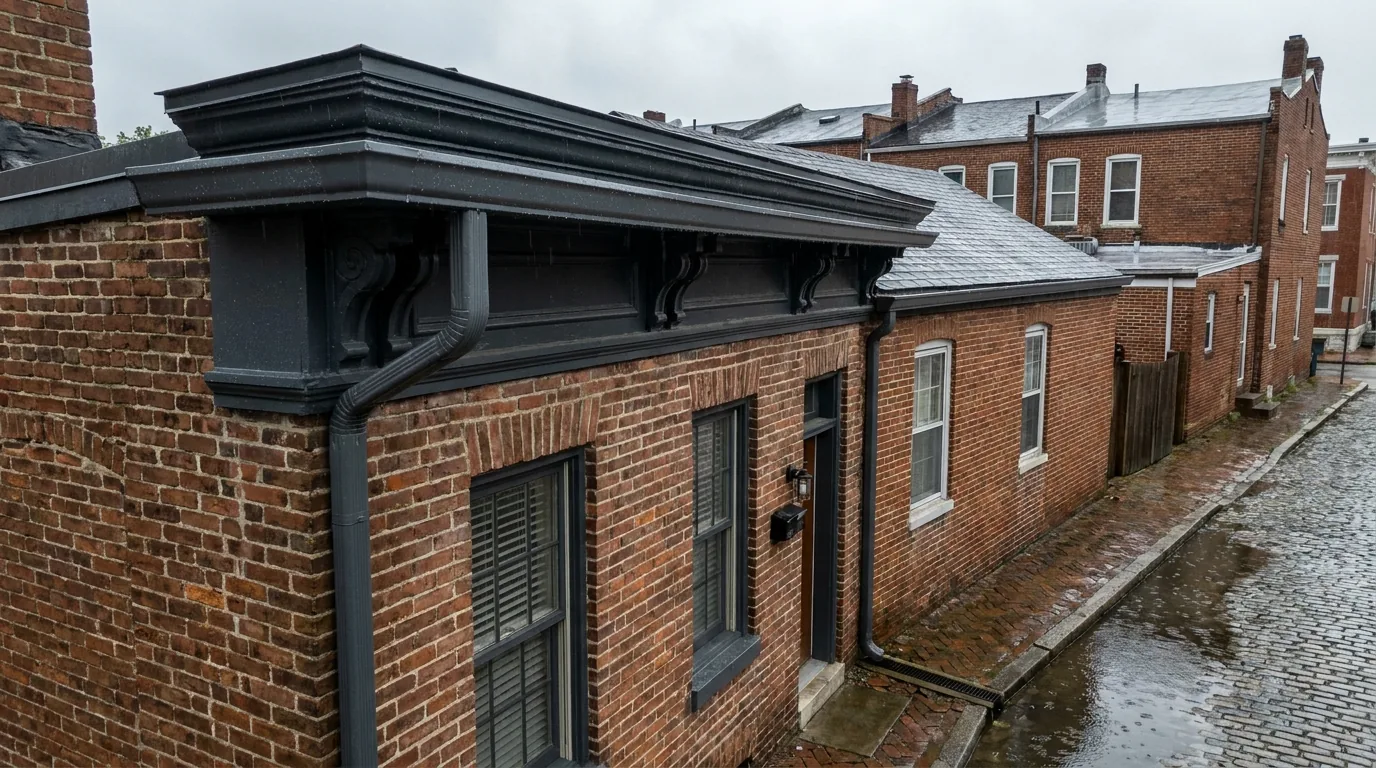
New seamless aluminum gutters keep storm water off the brick and away from the foundation of a Baltimore rowhome.
How Much Does Gutter Installation Cost in Baltimore?
Let’s get to the number you came for. In 2026, gutters are priced per linear foot installed, and for the seamless aluminum that most Baltimore homes use, you’re looking at roughly $6 to $12 per linear foot. Copper is a different category entirely at $25 to $50 per linear foot.
Here’s how that translates to real homes:
| Home type | Approx. Gutter length | Seamless aluminum (installed) |
|---|---|---|
| Small rowhome (front + rear only) | 50 – 80 ft | $400 – $900 |
| Typical rowhome / small detached | 80 – 130 ft | $700 – $1,500 |
| Larger detached / multi-corner home | 150 – 200 ft | $1,200 – $2,500 |
So a classic two-story Baltimore rowhome, where shared party walls mean gutters only run along the front and back, often lands in the $600 to $1,500 range for a full seamless aluminum replacement. A bigger detached house in the county with lots of corners, a porch roof, and several downspouts can climb past $2,500.
What drives the price up or down?
- Material. Seamless aluminum is the value sweet spot. Copper looks stunning and lasts 50-plus years but costs four to five times as much. Galvanized steel sits in between and is heavier-duty but can eventually rust.
- Corners and complexity. Every inside and outside corner is a custom miter and a potential leak point. A simple rectangular rowhome is cheap; a house with bays, dormers, and porch roofs costs more per foot.
- Downspouts. Rule of thumb is one downspout per 30 to 40 feet of gutter. More downspouts means more material and labor, but it also means water actually moves instead of overflowing. Downspouts themselves run roughly $5 to $40 per linear foot depending on size and material.
- House height. A three-story Federal Hill or Fells Point rowhome means more ladder and scaffold time than a one-story rancher, and that labor shows up in the quote.
- Tear-off and fascia repair. If your old gutters are coming down and the wood fascia behind them is rotted (extremely common on older Baltimore homes), that repair is added before anything new gets hung.
- Gutter guards. Optional, but popular on leafy lots. Budget another $6 to $13 per linear foot (more on guards below).
A quick, honest note on calculators: the online estimators that spit out a single number for “a 142-foot home” are a starting point, not a quote. Baltimore’s housing stock is too varied. The only way to get a real number is to have someone measure the runs, count the corners, and look at the fascia.
Seamless vs. Sectional Gutters: Which Should You Choose?
This is the first real decision, and for most homeowners it’s an easy one.
Sectional gutters come in pre-cut 10-foot lengths from the home store that you snap and seal together. They’re cheap, they’re DIY-friendly, and every single joint between sections is a future leak. Over a few Baltimore winters, those seams work loose, collect grit, and start dripping right where they shouldn’t.
Seamless gutters are formed on-site. The installer feeds an aluminum coil through a roll-forming machine on the truck and cuts a single continuous length for each run of your roof. The only joints are at the corners and the downspout outlets, far fewer places for water to escape. Seamless costs only about $1 to $2 more per linear foot than sectional, and on a full installation that small premium buys you a system that simply leaks less and lasts longer.
Our take: for a permanent, whole-house install, seamless aluminum is almost always the right call in Baltimore. Sectional still has its place for a short, simple run or a quick repair, but if you’re paying a crew to hang gutters around your whole house, pay the extra dollar a foot and skip the seams.
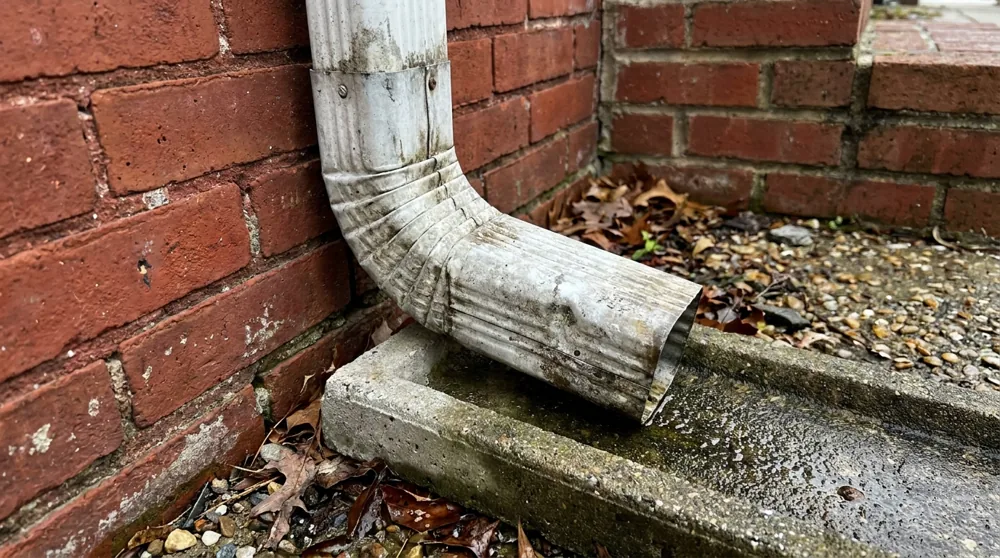
The downspout and its extension are where a gutter system actually protects your foundation, the part most people overlook.
Gutter Materials Compared
The frame material affects cost, lifespan, looks, and how it holds up to Maryland’s weather. Here’s how the common options stack up for Baltimore.
Aluminum (the Baltimore default)
Aluminum is what we install on the large majority of homes, and for good reason. It won’t rust, it’s light enough to hang cleanly, it handles our freeze-thaw cycles and heavy summer downpours, and it comes in dozens of baked-on colors so it can match or disappear against your trim. Seamless aluminum lasts 20-plus years and is the best balance of cost and performance for the typical Baltimore home.
Copper (the historic upgrade)
Copper is the premium choice. It’s genuinely beautiful, it never rusts, and it can last 50-plus years, weathering to that classic green patina over time. The catch is cost, at $25 to $50 per linear foot it’s four to five times the price of aluminum. We see copper mostly on historic homes in neighborhoods like Roland Park, Guilford, and Mount Vernon, where the look is part of the home’s character and CHAP review may be involved.
Galvanized and steel
Steel gutters are tougher than aluminum and stand up to ladders and falling branches better, which can matter on a heavily treed lot. The downside is weight and the long-term risk of rust at any scratched or worn spot. They’re a niche pick rather than a default.
Vinyl (rarely worth it)
Vinyl is the cheapest option and the most DIY-friendly, which is exactly why you see it. But Baltimore’s climate is hard on it: vinyl gets brittle and cracks in winter cold snaps and softens and sags under summer heat. For a quick fix on a shed or a short run it’s fine, but we rarely recommend it as a permanent solution on a home you plan to keep.
Are Gutter Guards Worth It in Baltimore?
If your home sits under mature oaks, maples, or sweetgums, common in Roland Park, Hampden, Mount Washington, and a lot of the older county neighborhoods, gutter guards can be a genuinely smart add-on. They keep leaves, seed pods, and roof grit out of the channel so water keeps flowing and you’re not up a ladder twice a year scooping out muck.
Professionally installed guards generally run $6 to $13 per linear foot on top of the gutters, depending on the type:
- Metal screens are the budget option (roughly $1 to $4 per foot for the material), keeping out big debris but letting finer grit through.
- Micro-mesh systems are the premium choice (closer to $9 to $13 per foot installed) and do the best job of blocking the small shingle granules and pine debris that actually clog Baltimore gutters.
- Surface-tension and foam-insert styles sit in between on both price and performance.
Honest framing: guards reduce cleaning, they don’t eliminate it. Even the best micro-mesh needs an occasional brush-off, and any contractor who promises “never clean your gutters again” is overselling. But on the right leafy lot, guards pay for themselves in saved ladder days and prevented overflow damage. On a wide-open rowhome block with no trees, you can usually skip them.
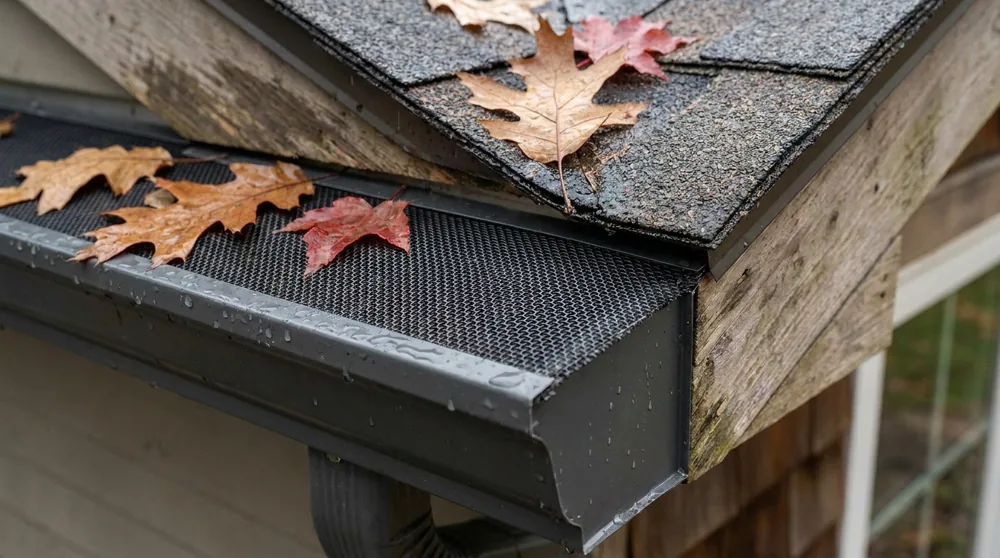
Micro-mesh guards do the best job of blocking the fine shingle grit and pine debris that actually clog Baltimore gutters.
Baltimore-Specific Gutter Realities
This is where a local contractor earns the difference. Baltimore’s housing stock creates drainage problems that generic gutter advice completely misses.
Rowhome gutters and downspouts
A Baltimore rowhome has nowhere to send its water but straight down its own narrow footprint. With shared party walls on both sides and a flat or low-slope roof, all the rain typically drains to one or two downspouts at the back of the house, often just a few feet from the foundation and the basement. That’s the whole game. If those downspouts clog, disconnect, or dump right at the wall, water goes into the cellar and undermines the slab. Good gutters here aren’t about looks, they’re about keeping the only water exit you have clear and pushing it well away from the house. We almost always recommend downspout extensions that carry water several feet out toward the alley or a splash block, not a trickle at the base of the brick.
Flat-roof scuppers and inner drainage
Many Baltimore rowhomes don’t have a front-edge gutter at all. Their flat roofs drain through scuppers (openings in the parapet wall) or interior roof drains that pipe water down through the building to the rear. If that’s your house, the conversation is less about hanging a new front gutter and more about making sure the scupper, the conductor head, and the downspout below it are clear, sealed, and routed away from the foundation. It’s a different inspection, and it’s one a roofing-and-exterior contractor should already understand. (Our roof replacement guide digs deeper into how flat rowhome roofs handle water.)
Protecting brick, formstone, and basements
Two of Baltimore’s signature wall surfaces, exposed brick and the stamped formstone cladding on thousands of rowhomes, are both vulnerable to chronic gutter overflow. Water sheeting down a wall finds every mortar gap and every seam behind formstone, and because formstone traps moisture against the wall, a leaking gutter above it can quietly rot what’s underneath for years. Then there’s the basement: Baltimore’s below-grade cellars and the city’s older, heavy clay soils mean roof water that isn’t carried away ends up against the foundation, which is the number-one preventable cause of a wet basement. Functioning gutters and extended downspouts are some of the cheapest water protection you can buy for a Baltimore home.
Maryland storms and freeze-thaw
Our weather is genuinely tough on gutters. Summer brings near-weekly thunderstorms and the occasional remnant of a tropical system, dumping more water faster than an undersized or clogged gutter can handle. Winter brings repeated freeze-thaw cycles that work seams loose, crack vinyl, and pull spikes out of softened fascia. A gutter system here has to be sized right (5-inch K-style is standard, 6-inch for big or steep roofs), pitched correctly, and fastened with hidden hangers rather than old-school spikes that back out over time.
Pro vs. DIY: An Honest Take for Homeowners Hiring Out
Plenty of articles will walk a confident DIYer through hanging their own gutters, and on a one-story shed or a short, simple run, it’s a reasonable weekend project. But if you’re reading this as a homeowner deciding whether to hire out, here’s the straight version of why most Baltimore homes are better off with a pro:
- Heights and rowhome geometry. A lot of Baltimore work is two and three stories up, off ladders set on uneven alley pavement or against neighbors’ walls. That’s real fall risk, and it’s the single biggest reason to let an insured crew handle it.
- Pitch and fastening done right. Gutters need a precise, barely-perceptible slope toward each downspout, too little and they pool, too much and they look crooked and overshoot in heavy rain. Getting that consistent across a long run is harder than it looks.
- Seamless equipment. The biggest advantage of seamless gutters, no mid-run joints, requires the on-truck roll-former that homeowners simply don’t have. DIY means sectional, which means seams.
- Fascia and hidden rot. Pros catch the soft, rotted fascia board behind old gutters before hanging anything new on it. Hanging fresh gutters on bad wood just means doing the job twice.
- It’s still affordable. Because aluminum gutters are one of the lower-cost exterior projects, the labor premium for professional installation is modest, and it comes with the system actually being pitched, sealed, and warrantied correctly.
Our honest rule: if it’s a short, ground-floor run and you’re handy, DIY is defensible. If it’s multi-story, has corners and scuppers, or involves any fascia repair, hire it out, the math and the safety both favor it.
Why Baltimore Homeowners Work With Monarch Bay Renovations
- We know Baltimore exteriors. Rowhome party walls and flat-roof scuppers, formstone fronts, downspout routing in tight alleys, and the basement-and-foundation realities that come with them. This is our home turf.
- Seamless, sized, and pitched right. We install seamless aluminum cut on-site, sized for your roof, pitched to actually move Maryland’s storm water, and fastened with hidden hangers.
- Honest guidance. We’ll tell you when guards make sense and when they don’t, and when a downspout extension solves more than a whole new gutter run would.
- Licensed, insured, Google Guaranteed. Fully licensed Maryland Home Improvement Contractor (MHIC #149066), carrying real insurance, and Google Guaranteed.
- Free, transparent estimates. A real on-site look and a written quote, no phone-quote guesswork.
Ready for a straight answer on your gutters? Call us at (443) 602-9300 or request a free estimate online. We’ll look at your roofline, your downspouts, and your fascia, and give you a detailed written quote. No pressure, no obligation.
Get Your Free Baltimore Gutter Estimate
Whether you’ve got overflowing gutters staining the brick in Canton, a downspout dumping into your Hampden basement, or you just want seamless aluminum done right before storm season, Monarch Bay Renovations gives you a real assessment and real numbers. We serve Baltimore City, Baltimore County, Howard County, Anne Arundel County, and the surrounding areas. Explore our full range of exterior services to see how new gutters fit alongside roofing, siding, and trim.
Call (443) 602-9300 or fill out our online form to schedule your free gutter estimate. You can also reach us through our contact page with any questions, we typically respond within one business day.
Common Questions
- How much does gutter installation cost in Baltimore in 2026?
- Seamless aluminum gutters, the most common choice in Baltimore, run roughly $6 to $12 per linear foot installed in 2026, so a typical rowhome front-and-rear run of 60 to 100 feet lands around $600 to $1,700, and a larger detached home with 150 to 200 feet of gutter usually falls between $1,200 and $2,500. Copper is a different world at $25 to $50 per linear foot. The real swing factors are the number of corners, how many downspouts you need, the height of the house, and whether old gutters and rotted fascia have to come off first.
- Are seamless gutters worth it over sectional?
- For most Baltimore homes, yes. Seamless aluminum is custom-cut on-site from a single coil, so the only joints are at corners and downspout outlets, which is exactly where sectional gutters leak first. Seamless runs about a dollar to two dollars more per linear foot than sectional, but it removes the seams that clog, drip, and stain your brick over time. Sectional still makes sense for a short, simple run or a quick DIY patch, but on a full install the seamless upgrade is usually worth it.
- How much does it cost to add gutter guards in Baltimore?
- Professionally installed gutter guards generally run $6 to $13 per linear foot on top of the gutters themselves, depending on the type. Basic metal screens sit at the low end, while micro-mesh systems that actually keep out roof grit and shingle granules run closer to $9 to $13 per foot. On a leafy lot near mature oaks or maples, common in Roland Park, Hampden, and the older county neighborhoods, guards can pay for themselves by saving you the ladder work twice a year.
- Why do gutters matter so much on a Baltimore rowhome?
- Because a rowhome has nowhere to push the water but its own narrow footprint. With shared party walls and a flat or low-slope roof, all the rain funnels to one or two downspouts at the back, often a few feet from the foundation and the basement you don't want flooding. Bad gutters on a Baltimore rowhome don't just drip, they soak the brick or formstone, run into the cellar, and erode the little bit of grade you have between you and the alley. Good gutters and properly extended downspouts are some of the cheapest foundation insurance you can buy.
- How long does gutter installation take?
- A straightforward gutter replacement on a typical Baltimore home is usually a one-day job. A simple rowhome front-and-rear run can be done in a few hours, while a larger detached home with multiple corners, several downspouts, and gutter guards may take a full day or spill into a second. Adding fascia repair, fresh downspout routing, or underground drainage extends the timeline, which is why an on-site look beats a phone quote.
- What material is best for gutters in Maryland's climate?
- For most Baltimore homeowners, seamless aluminum is the sweet spot: it won't rust, it handles Maryland's freeze-thaw swings and heavy summer storms, it comes in dozens of colors, and it lasts 20-plus years. Copper is beautiful and can last 50-plus years but costs four to five times as much, so it's usually reserved for historic homes where the look matters. Vinyl is cheap but gets brittle in our cold snaps and sags in summer heat, so we rarely recommend it for a permanent install.