

Renovation Notes
Baltimore Historic Tax Credits: CHAP and Maryland State Programs Explained (2026)
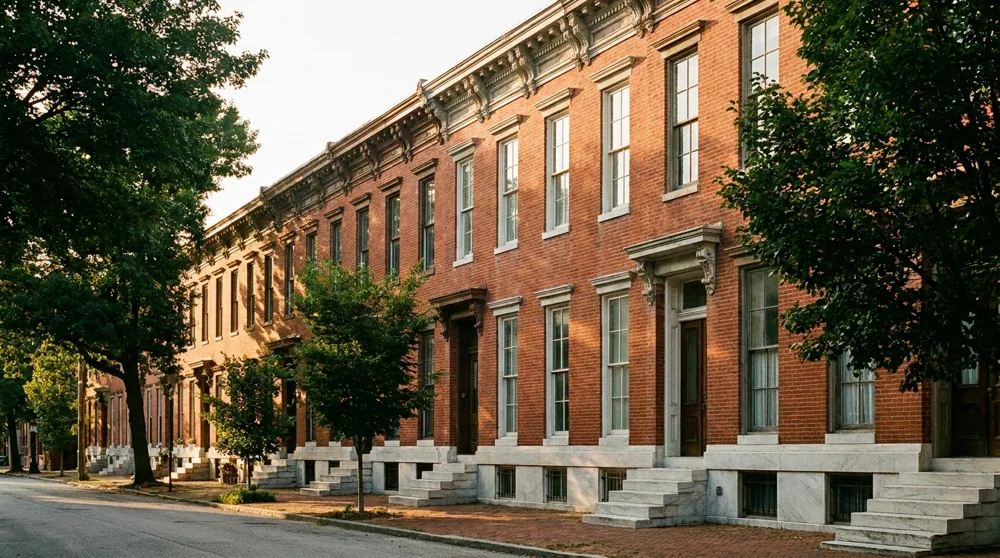
If you own a home in Federal Hill, Mount Vernon, Fells Point, Bolton Hill, or any of Baltimore’s other 30-plus historic districts, there is a good chance you qualify for property tax relief that most homeowners in those neighborhoods have never claimed.
Two programs — one local, one state — can meaningfully offset the cost of rehabilitating a Baltimore historic property. Neither one is well publicized. Most homeowners discover them only after the fact, by which point they have missed the window. Here is what they are, how the math works, and what you need to do before you break ground.
The Two Main Programs
The programs are distinct in what they credit:
| Program | Type | Credit | Who it’s for |
|---|---|---|---|
| Baltimore City CHAP Tax Credit | Property tax credit | 10 years of property taxes on increased assessed value | Homeowners + investors |
| Maryland Homeowner Historic Tax Credit | State income tax credit | 20% of eligible rehab expenses, up to $10,000 | Owner-occupants |
For investors in commercial or rental properties, the Maryland Small Commercial Tax Credit (also 20%, capped at $50,000 in eligible expenses) and the Federal Historic Tax Credit (20% federal income tax credit for income-producing certified historic structures) are also available. This guide focuses on the homeowner programs, but the eligibility rules for the commercial credits follow the same general structure.
Program 1: Baltimore City CHAP Property Tax Credit
What it is
In 1996, Baltimore City established the CHAP Historic Tax Credit to encourage the rehabilitation of historic buildings. It works as a property tax credit, not a cash refund. After you complete a qualifying rehabilitation, the city credits 10 years of property taxes on the increase in assessed value from the work.
The credit formula: City property tax rate × (post-rehabilitation assessed value − pre-rehabilitation assessed value), multiplied across 10 years.
The practical effect is that you pay property taxes as if the rehabilitation never happened — at your pre-rehab assessed value — for 10 years. The higher the value your rehab adds, the larger the credit.
What the numbers look like
If your Federal Hill rowhome is assessed at $200,000 before a major kitchen-plus-baths gut rehab, and the finished work brings the assessment to $375,000, the increase is $175,000. At Baltimore City’s residential property tax rate, that’s roughly $3,500 to $4,000 per year in credited property taxes. Over 10 years, that’s $35,000 to $40,000 in property tax savings — real money on a $150,000 to $200,000 gut rehab.
The credit is calculated once after the project completes and stays fixed for all 10 years, regardless of future assessments.
Who qualifies
Your property must be in one of these categories:
- A CHAP-designated local historic district
- A National Register Historic District within Baltimore City
- A designated local landmark
The rehabilitation must represent a total investment of at least 25% of the property’s pre-rehabilitation full cash value. Both residential and commercial buildings are eligible. The program does not distinguish between owner-occupants and investors — if your building is in a qualifying district and you hit the 25% threshold, you qualify.
CHAP currently oversees 33 local historic districts in Baltimore City, including Federal Hill, Mount Vernon, Fells Point, Bolton Hill, Canton, Hampden, Seton Hill, Otterbein, Ridgely’s Delight, Union Square, Butchers Hill, Washington Hill, Dickeyville, and Mount Washington, among others.
The catch
The application must be submitted before rehabilitation work begins, not after. Retroactive applications are not accepted.
The process: submit the online application at the CHAP portal, pay the $50 review fee, and obtain CHAP certification. If your project includes exterior work (windows, doors, masonry, additions), you also need a separate CHAP Authorization to Proceed before you can pull a building permit. The tax credit certification and the Authorization to Proceed are related but distinct steps — the CHAP staff can walk you through the sequence.
Program 2: Maryland Heritage Structure Rehabilitation Tax Credit (Homeowner)
What it is
The Maryland Historical Trust (MHT) administers a state income tax credit for homeowners who rehabilitate a certified historic structure. The credit equals 20% of eligible rehabilitation expenses, with a cap of $50,000 in eligible expenses per 24-month period — so the maximum credit is $10,000.
Unlike the CHAP credit (which is a property tax benefit), this is a state income tax credit that you claim on your Maryland income tax return for the year the work was completed and certified.
Who qualifies
To use this credit, you need to check three boxes:
1. You own and occupy the property. The Maryland homeowner credit is limited to owner-occupants. It covers your primary residence or a secondary residence. Investors in rental properties use a different program — the Maryland Small Commercial Tax Credit.
2. The property is a certified historic structure. That means it is individually listed on the National Register of Historic Places, or it is a contributing structure within a National Register Historic District and has been determined by MHT to be eligible for the register. Most buildings in Baltimore’s CHAP historic districts that are also in a National Register Historic District meet this standard — but check with MHT before assuming.
3. The work complies with the Secretary of the Interior’s Standards for Rehabilitation. MHT reviews your project against these federal standards before certifying the credit. The standards require that rehabilitation work preserve the historic character of the building rather than recreating a conjectural past appearance or stripping historic fabric. For a practical Baltimore rowhome rehab, this mostly affects exterior decisions: window profiles, door openings, masonry, and additions must be handled in ways that respect the building’s historic character.
The numbers
Spend $40,000 on a qualifying rowhome rehab in a qualifying historic district, get a $8,000 credit on your Maryland state income taxes.
Spend $50,000 or more, get the $10,000 maximum credit.
The minimum qualifying expenditure is $5,000. There is no income cap.
Application
MHT accepts applications year-round on a rolling basis. After a complete application is submitted, MHT review typically takes 30 to 45 days. Submit before work begins for pre-approval, then submit a completion application after the work is done to claim the credit.
Stacking Both Credits
On a qualifying project, you can claim both the CHAP property tax credit and the Maryland state income tax credit. They are separate programs administered by separate agencies, and one does not disqualify you from the other.
A realistic example: An owner-occupant in the Fells Point local historic district spends $90,000 on a whole-first-floor gut and exterior restoration — new kitchen, structural work, new windows per CHAP standards, masonry repointing.
- CHAP credit: If the work raises the assessed value by $120,000, the annual property tax credit is roughly $2,700/year for 10 years — $27,000 total.
- Maryland state credit: 20% of $50,000 in qualifying expenses = $10,000 in state income tax credit.
- Combined benefit: Up to $37,000 offset over 10 years on a $90,000 rehab.
The caveat: the CHAP tax credit cannot be combined with other Baltimore City tax credits on the same project. And both the CHAP credit and the MHT certification require pre-construction applications. If you miss the window, you miss both.
What CHAP Review Actually Adds to a Gut Rehab
If your property is in a CHAP historic district, exterior work triggers CHAP review before you can pull a building permit. This is separate from the tax credit application — all exterior work in a historic district requires it, not just work on tax-credit projects.
CHAP uses two tracks:
Minor work — window replacements that match original profiles, paint color changes, like-for-like door replacements. CHAP staff can approve these, sometimes in as little as a few days, without a full Commission hearing.
Major work — additions, new openings, demolitions, material changes. These go to the full Commission at a monthly public hearing. Applications are due 25 calendar days before the hearing date.
For a well-scoped gut rehab where the exterior work is primarily restoration-grade replacement (windows in kind, masonry repointing, no new additions), the CHAP review process typically adds three to six weeks to the pre-construction timeline. We factor this into the schedule when we quote historic district jobs.
We have handled CHAP submissions on gut rehabs in Federal Hill, Mount Vernon, and several other Baltimore historic districts. The process is manageable when you have a contractor who knows what CHAP is actually looking for and submits complete documentation the first time.
The MHIC License Requirement
One more thing worth knowing: in Maryland, any rehabilitation work on a one-to-two family residential property must be performed by a licensed MHIC contractor. Work done by an unlicensed contractor cannot generate a valid permit, which means the project won’t pass CHAP review or MHT certification — and you lose eligibility for both credits.
Monarch Bay Renovations holds MHIC license #149066 and has been pulling permits and handling CHAP submissions in Baltimore City since 2018.
What to Do Next
If you think your property qualifies:
- Confirm your address is in a CHAP local historic district at chap.baltimorecity.gov or in a National Register Historic District. CHAP has a full map of all districts.
- Check whether your property is a certified historic structure for the MHT program — either individually listed on the National Register or a contributing structure in a listed district.
- Contact MHT about the state homeowner credit application before starting work.
- Submit the CHAP tax credit application and, if needed, the Authorization to Proceed for exterior work before construction begins.
- Get a written estimate from a licensed MHIC contractor that covers permit costs.
If you’re planning a full gut rehab in a Baltimore historic district and want a single quote covering the scope, permits, CHAP submissions, and what the tax credit programs are likely to offset for your specific property, contact us for a walkthrough. We’ve done this enough times to give you a realistic picture of both the construction costs and the tax benefit, before you sign anything.
For full gut rehab pricing by tier, see the 2026 Baltimore gut rehab cost guide. For the complete permitting picture, including how the ePermits system works alongside CHAP, see the Baltimore remodeling permits guide.
Common Questions
- What is the Baltimore City CHAP historic tax credit?
- The CHAP Historic Tax Credit is a 10-year Baltimore City property tax credit for qualifying rehabilitation work on buildings in a CHAP local historic district or National Register historic district. The credit equals the city property taxes on the increase in assessed value resulting from the rehabilitation — meaning you pay property taxes at the pre-rehab assessment for 10 years after the project is complete. It applies to both residential and commercial properties, and the program has supported more than 5,000 rehabilitation projects since it launched in 1996.
- How much is the CHAP tax credit worth in dollars?
- It depends on how much the rehabilitation raises your assessed value. If your home's assessed value increases by $150,000 after a major rehab, your annual credit equals that $150,000 increase times the Baltimore City residential property tax rate, applied every year for 10 years. On a $150,000 assessment increase, that works out to roughly $3,000 to $3,500 per year — or $30,000 to $35,000 in total saved property taxes over the decade. Larger rehabs with bigger assessment bumps produce proportionally larger credits.
- Who qualifies for the CHAP historic tax credit?
- Any property owner, homeowner or investor, whose building is in a CHAP-designated local historic district, a National Register Historic District in Baltimore City, or is a locally designated landmark qualifies. You must invest at least 25% of the property's pre-rehabilitation full cash value in qualifying rehabilitation work. The project must receive CHAP certification before the credit is applied.
- Can I stack the CHAP tax credit with the Maryland state historic tax credit?
- Yes. The Baltimore City CHAP property tax credit and the Maryland Heritage Structure Rehabilitation Tax Credit (a state income tax credit) are separate programs that can be used on the same project. A homeowner who spends $40,000 on a qualifying rehab in a CHAP district could receive the 10-year property tax credit through CHAP and also claim a $8,000 Maryland state income tax credit (20% of $40,000) through the Maryland Historical Trust.
- Do I have to apply before starting the rehab to get the CHAP tax credit?
- Yes. You must apply for CHAP Authorization to Proceed and, separately, submit a tax credit application before rehabilitation work begins. Retroactive credit applications for completed work are not accepted. The application is online at the CHAP portal, the review fee is $50, and CHAP needs to review and certify the work as part of the tax credit process.