

Renovation Notes
The Baltimore Investor's Guide to Rowhome Gut Rehabs (2026)
If you are an investor looking at Baltimore, the math is hard to ignore. The city has one of the largest stocks of affordable, gut-able rowhomes in the country, a median home price still hovering around $210,000, and a wide spread between what a distressed shell costs and what a finished house is worth. That spread is the entire game. The question is never really “is there opportunity in Baltimore?” It is “can I rehab this rowhome on budget, on time, and to a standard that holds up?”
This guide is written for the investor making that call. It covers what a full gut rehab actually costs in 2026, how BRRRR and renovation financing work here, how to find and underwrite a Baltimore deal, what a real gut scope includes, the permit and lead-paint realities specific to this city, honest timelines, how draw schedules protect both sides, and why a licensed MHIC general contractor who knows rowhomes is the single biggest factor protecting your return.
At Monarch Bay Renovations we do gut rehabs for investors every month, alongside contract work for the Housing Authority of Baltimore City. We will be straight with you throughout: these are ranges, not quotes, and the only number that means anything comes after we walk the house.
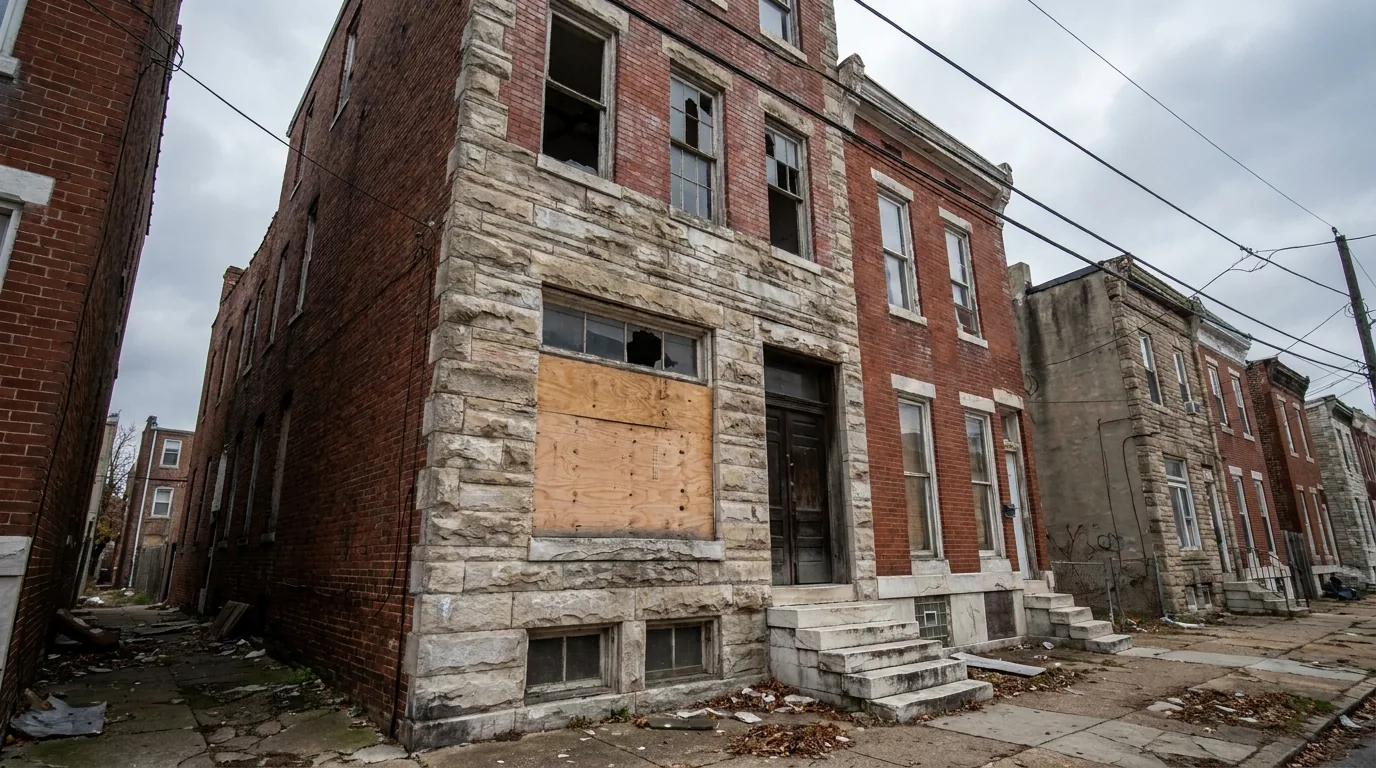
Baltimore has tens of thousands of distressed and vacant rowhomes. For an investor with the right contractor, a shell like this is a deal, not a liability.
The Baltimore Investor Opportunity
Baltimore is an investor’s market for three structural reasons that have nothing to do with hype.
First, supply of distressed inventory is enormous. The city has spent more than a decade running its Vacants to Value program specifically to move abandoned and tax-delinquent properties into the hands of people who will rehab them. There is a published open bid list, a steady tax-sale pipeline, and an active wholesaler network. You are not fighting over a handful of listings; you are filtering a firehose.
Second, acquisition prices are low relative to after-repair value. Wholesale rowhome deals in Baltimore are commonly contracted 30–50% below ARV. A house that finishes at $200,000 might get put under contract in the $80,000–$120,000 range depending on how much rehab it needs. That gap is what funds your profit, your holding costs, and your margin for error.
Third, rental demand is real and durable. Anchor employers like Johns Hopkins and the University of Maryland, plus a large renter base across the metro, keep tenant demand steady in the neighborhoods investors target. That matters whether you are flipping (you want a buyer) or running BRRRR (you want a tenant and a clean refinance).
The catch, and there is always a catch, is that Baltimore’s housing stock is old, masonry, and full of surprises. The same age that makes these homes cheap is what makes the rehab unpredictable. That is the whole reason this guide exists.
What a Baltimore Gut Rehab Costs in 2026
The investor tier is built around one goal: a clean, leasable, code-compliant house at the lowest defensible number, not a luxury showpiece. A typical scope on a 1,000–1,400 sq ft rowhome includes:
- Full demo of kitchen, baths, and dated finishes
- A budget-tier kitchen (roughly $10K–$15K in cabinets, counters, and appliances)
- One full bath plus a half bath refreshed
- LVP flooring on the main level, carpet upstairs
- Paint throughout
- Electrical brought to code: new outlets, GFCI, smoke/CO detectors, panel upgrade if needed
- Plumbing repairs, with galvanized supply replaced as needed and a full re-pipe if it is extensive
- Existing HVAC kept if functional, replaced if not
- Roof patched, or fully replaced only if it is past its useful life
- Drywall patch and paint throughout
That is the bread-and-butter rental rehab. Our deeper full rehab cost guide for Baltimore walks through the higher owner-occupant and high-end tiers, but for pure investment work, the investor tier is where the numbers live.
What actually drives the price
Four things move your rehab number more than anything else:
- Square footage. The $75–$150/sq ft range is real, and the bottom belongs to clean, simple rowhomes. The top is for full mechanical replacement and masonry headaches.
- Mechanical replacement. A 200-amp service upgrade, a full re-pipe from galvanized to PEX, a new HVAC system, and a new water heater can total $25K–$60K by themselves. This is the most under-budgeted line item on almost every investor deal we see.
- Finish level. Even on a rental, the choice between builder-basic and one notch up changes the kitchen and bath numbers materially.
- Surprises behind the walls. Pre-1950 masonry rowhomes routinely hide knob-and-tube wiring, cast-iron drain stacks, galvanized supply lines, asbestos floor tile, and structural brick that needs repair. Any one of these can move a project a tier.
A reasonable industry rule of thumb, and one we agree with, is to hold back 5–10% of your total budget as a contingency for rot, bad framing, and supply delays, and to plan on roughly 8–12% of construction cost for permits, engineering, and design soft costs. Build those into your underwriting from day one, not after the surprise shows up.
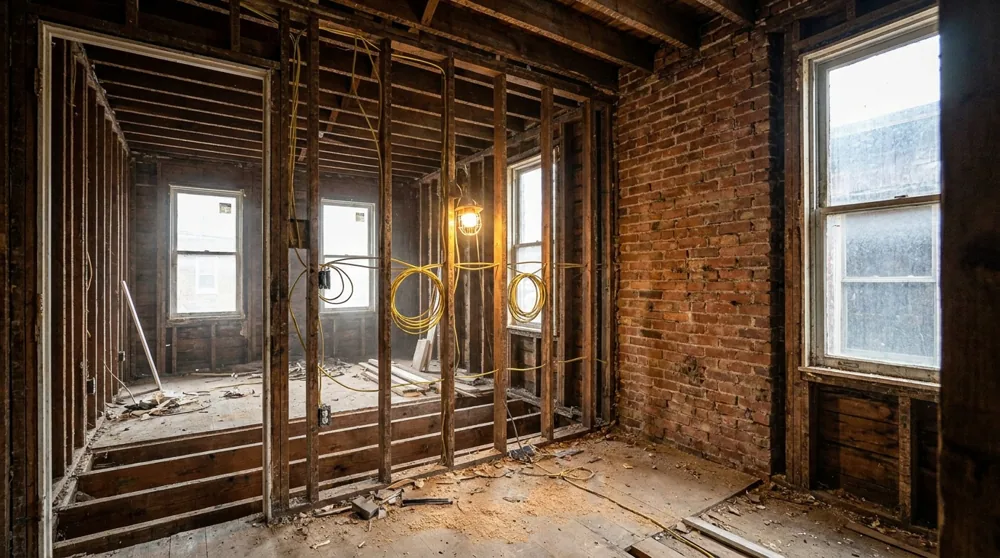
A true gut takes the house back to studs and joists. This is where the hidden mechanical and structural costs surface, and where an experienced contractor earns the fee.
Financing the Deal: BRRRR, Hard Money, and Renovation Loans
How you finance the rehab shapes how aggressively you can buy and how fast you can recycle capital. There are three common paths.
The BRRRR strategy
BRRRR is Buy, Rehab, Rent, Refinance, Repeat. You buy a distressed rowhome below market (often with cash or a short-term hard-money loan), rehab it, place a tenant, then do a cash-out refinance based on the after-repair value to pull most or all of your capital back out. Then you do it again.
BRRRR works in Baltimore precisely because the acquisition-to-ARV spread is wide and rents support the refinance in the right neighborhoods. The model is unforgiving in one specific way: it assumes you hit both your rehab budget and your ARV. Blow the rehab number and you leave capital trapped in the deal. Miss the ARV and the refinance comes up short. Both of those failure modes trace straight back to scope discipline and contractor reliability, which is the recurring theme of this guide.
A widely used underwriting guardrail is the 70% rule: don’t pay more than 70% of ARV minus your rehab cost. So a $200,000 ARV house with a $90,000 rehab pencils to a maximum purchase price around $50,000 ($200K × 0.70 − $90K). It is a starting filter, not gospel, but it keeps you from talking yourself into a thin deal.
Hard money and private lending
Most investors fund the buy-and-rehab phase with short-term hard-money loans, which lend against the deal rather than your income and release rehab funds in draws as work is completed. They are fast and flexible, but the interest clock is loud. Every extra week on site is real money, which is why a contractor who actually hits a schedule is a financial input, not a soft preference.
FHA 203k, HomeStyle, and CHOICERenovation
If you will live in the property, even temporarily by house-hacking a 2–4 unit, renovation mortgages fold the purchase and the rehab into one loan based on the as-completed value:
- FHA 203(k) is owner-occupant only, with as little as 3.5% down. The Limited 203k covers up to $35,000 in non-structural work with no HUD consultant; the Standard 203k handles larger and structural scopes, requires a HUD consultant, and carries a mandatory contingency reserve (often 10–20% of repair costs on older homes). See the FHA 203(k) guide.
- Fannie Mae HomeStyle and Freddie Mac CHOICERenovation are the conventional equivalents and, unlike 203k, do allow investment properties, typically at around 15% down for an investor purchase. They finance most projects up to 75% of as-completed value, require a 620+ credit score, and give you 12–15 months to complete the work. See the CHOICERenovation overview.
Every one of these programs requires licensed contractors and approved scopes of work. That is not red tape, it is the lender protecting their collateral, and it is one more reason unlicensed labor disqualifies your deal before you start.
Finding and Evaluating Deals
Deal flow in Baltimore comes from a handful of repeatable channels:
- Vacants to Value and the city’s open bid list for publicly held distressed properties
- Tax-sale auctions, where third-party investors buy liens on tax- and water-delinquent properties (this is a more advanced, lien-first path with its own redemption rules)
- Wholesalers, who put distressed houses under contract and assign them to you, usually 30–50% below ARV
- Direct-to-owner marketing to absentee and tired landlords
- MLS and agent relationships for the occasional distressed listing
Once you have a candidate, the underwriting reduces to three numbers: acquisition cost, rehab cost, and ARV. Get the ARV from recent, genuinely comparable sales of finished rowhomes on the same block or a near-identical one, not from a Zestimate and not from a finished house six neighborhoods away. Then get a real rehab estimate, ideally from a contractor who has walked the property, before you commit.
The neighborhoods investors keep coming back to for cash flow and clean refinances include Belair-Edison, Hamilton, Lauraville, Rosedale, Essex, and pockets of Pigtown and Highlandtown for appreciation plays near downtown. Each has its own rent ceiling and buyer profile; the right one depends on whether you are flipping or holding. Whatever the block, the rehab discipline is the same.
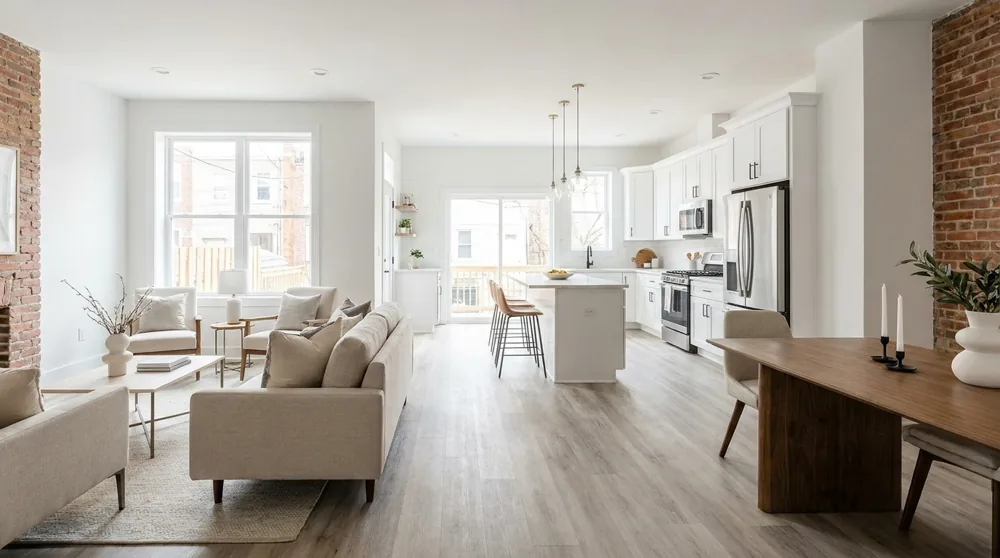
The finished product is what the appraiser and the tenant see. Clean, leasable, code-compliant, delivered on time, that is what protects the refinance and the resale.
The Scope of a Real Gut
When we say “gut,” we mean the house comes back to studs and joists and gets rebuilt as a sound, modern home. A full investor gut typically touches:
- Demolition and disposal, including dumpsters and haul-off
- Lead-safe and asbestos abatement where required (more on that below)
- Structural and framing changes: wall removal, new partitions, headers, joist sistering, and any brick or masonry repair the inspection turns up. Opening up a tight rowhome floor plan is one of the highest-impact moves you can make, and our guide to open-concept wall removal in Baltimore covers what is load-bearing and what is not
- Electrical: full rough-in and trim, almost always a 200-amp panel on an older house, with knob-and-tube fully removed
- Plumbing: full re-pipe from galvanized to PEX or copper, cast-iron drain repairs, new fixtures
- HVAC: new high-efficiency system or, at minimum, a verified-functional existing one
- Insulation, drywall, paint, trim, and doors throughout
- Kitchen and baths built to the finish tier the deal supports. Our kitchen remodel cost guide helps you right-size the kitchen spend to the rent or resale
- Flooring (LVP is the investor standard), windows on at least the front and rear, and roof if it is past life
The art of an investor gut is matching scope to exit. Over-build a rental and you bury margin you will never get back in rent. Under-build a flip and you leave it on the market. A contractor who builds for investors understands that line.
Permits, Lead Paint, and Historic Districts
Baltimore City requires permits for every major trade on a gut rehab: structural, plumbing, electrical, and mechanical, plus zoning approvals if you are changing use or adding units. Permit fees and any required drawings typically total $2,000 to $8,000 depending on scope. Pulling and managing those permits correctly is part of the job, and our Baltimore remodeling permits guide breaks down the process in detail.
Two Baltimore-specific issues catch out-of-town and first-time investors:
- Lead paint. Nearly every Baltimore rowhome predates the 1978 lead-paint ban, and Maryland law requires certified lead-safe work practices during renovation. This is not optional, and rental properties carry their own ongoing lead-registration and inspection obligations under Maryland law. We are EPA Lead-Safe certified and build the abatement into the scope. Skipping it is both illegal and a future liability you do not want attached to a property you plan to rent.
- Historic districts and CHAP. If the property sits in a designated historic district (Federal Hill, Fells Point, Mount Vernon, Bolton Hill, Canton, and others), exterior changes require approval from the Commission for Historical and Architectural Preservation (CHAP) before you can pull a building permit. That review commonly takes 30–60 days and belongs at the front of your timeline. CHAP can also dictate materials, which affects your budget. Underwrite this if the address is in a regulated district.
Realistic Timelines
An investor-tier gut rehab on a standard Baltimore rowhome runs 8 to 12 weeks of active construction, plus 2 to 4 weeks of permit time on the front end. Tighter scopes finish faster; structural work, additions, or CHAP review stretch it out.
Be honest with yourself about what drives the schedule. The two biggest risks are material lead times (cabinets, windows, and specialty tile can run weeks) and surprises behind the walls that change the scope mid-job. A good contractor manages the first by ordering long-lead items before demo and the second by inspecting hard during the walkthrough so fewer surprises happen at all. On a hard-money clock, that scheduling discipline is worth real dollars.
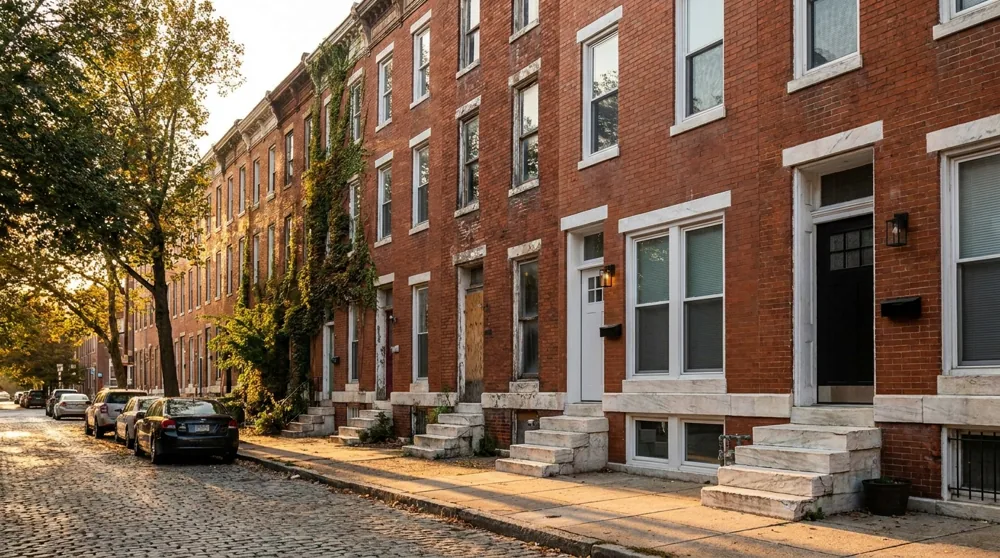
Whole blocks of rowhomes sit in the investor sweet spot. The strategy is repeatable; the execution is where deals are won or lost.
Draw Schedules: How the Money Should Flow
On any real rehab, you should never pay for work that has not been done. A draw schedule ties payments to completed, inspected milestones rather than a single upfront lump sum. A typical structure looks like:
- Mobilization / demo complete
- Rough-ins (framing, electrical, plumbing, HVAC) passed inspection
- Drywall and insulation complete
- Kitchen and bath sets, flooring, and trim complete
- Final punch list, final inspection, and walkthrough
Draws protect both sides. They protect you from paying ahead of progress, and they let a legitimate contractor fund the next phase without floating the entire job. If you are using a hard-money lender or a 203k/HomeStyle loan, the lender will usually require and inspect the draws directly, which is one more layer of accountability working in your favor. A contractor who resists a sane draw schedule, or who wants most of the money upfront, is telling you something. Listen.
Why a Licensed MHIC GC Protects the Deal
In Maryland, any home-improvement work valued at $500 or more requires a Maryland Home Improvement Commission (MHIC) license, and the law explicitly does not exempt investors. Because you renovate with intent to sell or rent, your project is squarely within MHIC’s scope. The MHIC consumer guidance is blunt about what you give up by going unlicensed:
- No MHIC Guaranty Fund protection. That fund reimburses owners when a licensed contractor does substandard work or walks off. Hire unlicensed and you cannot file a claim, ever.
- Failed inspections and code violations, which stall your timeline, blow your hard-money budget, and can force tear-out and rework.
- Disclosure and liability exposure at sale. If unlicensed work later causes problems, a buyer can argue you concealed or failed to ensure proper work, and you can be on the hook.
- No financing. As noted, 203k, HomeStyle, and CHOICERenovation all require licensed contractors. Unlicensed labor takes those loan products off the table entirely.
A licensed general contractor who specializes in rowhomes does more than keep you legal. They price the deal accurately because they know what is behind the walls before they open them. They hit the timeline because they sequence trades and order long-lead materials early. They pull and manage every permit. They build the lead-safe and CHAP requirements into the scope instead of discovering them at inspection. And they deliver a house that appraises and inspects clean, which is the entire point of the exercise when your capital is riding on the refinance or the resale.
That is the role we play for investors. Real timelines (we quote 4–7 weeks on most rehabs and hit the date), one number instead of change-order theater, built to pass inspection on the first walk, and the same rigor we bring to our Housing Authority contract work. If you want to see how we frame the investor relationship, our investors page lays it out, and if you are running a 203k or HomeStyle deal, our 203k page covers the renovation-loan workflow.
Run the Numbers With a Contractor Who Knows Rowhomes
The Baltimore opportunity is real, and it is repeatable. But every distressed rowhome is its own puzzle, and the rehab number, not the strategy, is what decides whether the deal works. A spreadsheet estimator cannot tell you the panel is undersized, the drain stack is cracked, or the front facade is CHAP-regulated. A walkthrough can.
If you have a property under contract or on your shortlist, let us walk it and give you a real, line-item rehab estimate before you commit your capital. We will tell you honestly if the math does not favor the deal.
Request your free estimate or call (443) 602-9300. Licensed Maryland contractor (MHIC #149066), Google Guaranteed, EPA Lead-Safe certified, and an active general contractor for the Housing Authority of Baltimore City.
For more on the work itself, see our full rehab cost guide, our gut rehab service page, or contact us to talk through a specific deal.
Common Questions
- How much does it cost to gut rehab a Baltimore rowhome in 2026?
- A real investor-tier gut rehab on a standard Baltimore rowhome runs roughly $80,000 to $130,000 in 2026, which works out to about $75 to $150 per square foot depending on condition and finish. The cheaper end is a clean, leasable, code-compliant rental rehab on a 1,000–1,400 sq ft house. The number climbs fast when you have to replace mechanicals (full re-pipe, 200-amp electrical, new HVAC) or do structural and masonry work. Pre-1950 masonry rowhomes that need rewires and brick repair push toward the top of the range. You won't get a real number without a walkthrough.
- What is the BRRRR strategy and does it work in Baltimore?
- BRRRR stands for Buy, Rehab, Rent, Refinance, Repeat. You buy a distressed property below market, rehab it, place a tenant, then refinance based on the after-repair value (ARV) to pull most or all of your capital back out and roll it into the next deal. It works in Baltimore because the spread between distressed acquisition prices and ARV is wide, and rent-to-price ratios in neighborhoods like Belair-Edison, Hamilton, Lauraville, Rosedale, and Essex tend to refinance cleanly. The whole model lives or dies on hitting your rehab budget and your ARV, which is exactly why the contractor you pick matters more than the strategy.
- Can I use an FHA 203k or Fannie Mae HomeStyle loan to rehab a Baltimore property?
- Yes, if you'll occupy it. The FHA 203(k) is for owner-occupants (including house-hacking a 2–4 unit), not pure investment properties, with as little as 3.5% down. Fannie Mae HomeStyle and Freddie Mac CHOICERenovation do allow investment properties, but typically require about 15% down on an investor purchase. All three roll the purchase price and the renovation cost into one mortgage based on the as-completed value. They require licensed contractors and approved scopes of work, which is one more reason unlicensed labor is a non-starter on a financed rehab.
- Do I need a licensed contractor to rehab an investment property in Maryland?
- Yes. In Maryland, any home-improvement work valued at $500 or more requires a Maryland Home Improvement Commission (MHIC) license, and the law does not exempt investors. Because you renovate with the intent to sell or rent, your project falls within the scope of MHIC regulation. Hiring unlicensed labor voids your access to the MHIC Guaranty Fund, exposes you to code violations and failed inspections, and can create liability and disclosure problems when you sell. Monarch Bay Renovations is fully licensed (MHIC #149066) and EPA Lead-Safe certified.
- How long does a Baltimore investor rehab take?
- An investor-tier gut rehab on a standard rowhome typically runs 8 to 12 weeks of active construction, plus 2 to 4 weeks of permit time on the front end. Tighter scopes move faster; structural work, additions, or CHAP review in a historic district add time. The biggest schedule risks are material lead times (cabinets, windows, specialty tile) and surprises behind the walls. We order long-lead items first and sequence the trades to keep your carry costs down, because every extra week is interest on your hard-money loan.