

Renovation Notes
Siding Replacement in Baltimore: 2026 Costs, Formstone & Material Guide
Siding is the one home improvement that everyone on your street can see. It’s also the layer doing the unglamorous work of keeping water, wind, and Maryland humidity out of your walls. If your siding is faded, dented, cracked, or you’re staring at tired formstone wondering what’s underneath it, you’re asking the right question at the right time.
This guide gives Baltimore homeowners straight answers: real 2026 costs, the honest truth about removing rowhome formstone, how vinyl, fiber-cement, and aluminum actually compare in our climate, and what to expect during the job. At Monarch Bay Renovations, we’ve re-clad rowhomes, suburban colonials, and everything between across Baltimore City and the surrounding counties, and we’ll tell you what we’d do on your house. When you’re ready to get a number, the Baltimore siding replacement page has the quick cost breakdown and a direct estimate form.
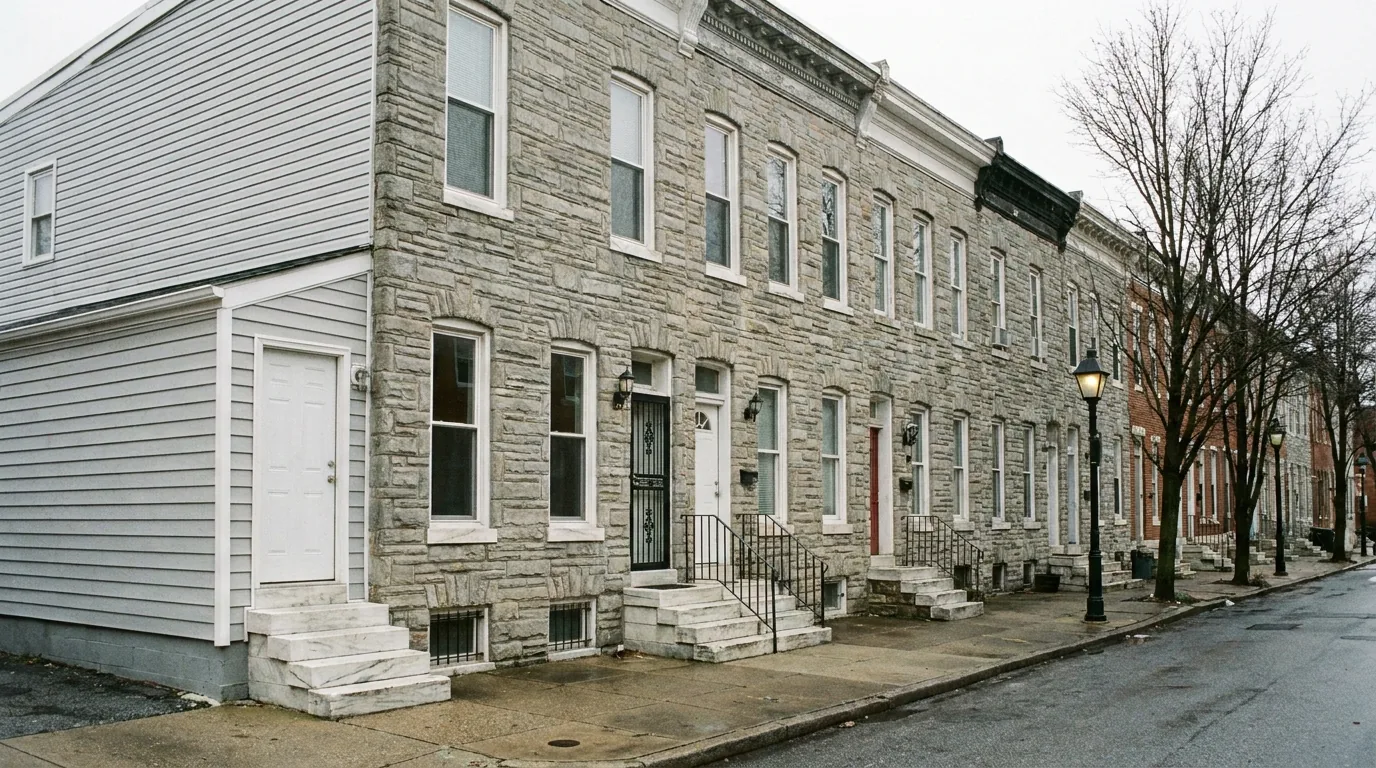
A Baltimore block in transition: original brick, aging formstone, and fresh fiber-cement siding all on the same street.
How Much Does Siding Replacement Cost in Baltimore?
Siding replacement in the Baltimore metro runs roughly $6.25 to $9.50 per square foot installed for the materials most homeowners actually choose: standard vinyl, insulated vinyl, and James Hardie fiber-cement. For a typical two-story house with around 2,000 square feet of siding, that lands the full project somewhere between $12,000 and $19,000, including tearing off the old siding, repairing sheathing, new house wrap, wrapping trim at windows and doors, and hauling everything away.
Here’s how the per-square-foot numbers break down by material:
| Material | Cost per sq ft installed | Lifespan | Best for |
|---|---|---|---|
| Standard vinyl | $4 – $7 | 20 – 40 years | Budget projects, rentals |
| Insulated vinyl | $6 – $9 | 25 – 40 years | Better R-value, mid-range |
| Fiber-cement (Hardie) | $9 – $13 | 50+ years | Forever homes, curb appeal |
| Aluminum | $5.60 – $10.30 | 30 – 40 years | Rarely chosen new today |
One important Baltimore wrinkle: a true rowhome is often cheaper to side than these whole-house numbers suggest, because shared party walls mean there’s no siding on the sides of the house. You’re typically only cladding the front facade and the rear, which can cut the material square footage roughly in half. A suburban detached home in Towson or Catonsville, with all four walls exposed, sits at the higher end.
What Drives Your Siding Cost Up or Down
- Material choice. This is the single biggest lever. The jump from builder-grade vinyl to James Hardie ColorPlus can nearly double your per-square-foot price.
- Old siding removal. Tearing off and disposing of existing vinyl or fiber-cement runs about $0.90 to $1.75 per square foot. Removing formstone or asbestos siding costs far more (more on both below).
- Sheathing and rot repair. Once the old siding is off, we sometimes find soft sheathing, rot, or water damage that has to be fixed before new siding goes on. Honest contractors flag this as a possibility upfront instead of springing a change order.
- Trim, soffit, and fascia. Wrapping window and door trim, replacing soffit, and coordinating fascia and gutters all add to a complete exterior. Done together, it looks finished; skipped, it looks half-done.
- Height and access. Three-story rowhomes and homes needing scaffolding cost more in labor than a one or two-story house a ladder can reach.
- Asbestos. A large share of Baltimore homes predate 1980, so the odds of running into asbestos-containing siding or backing are higher here than the national average. Certified abatement can push removal toward $5 to $9 per square foot when it’s present.
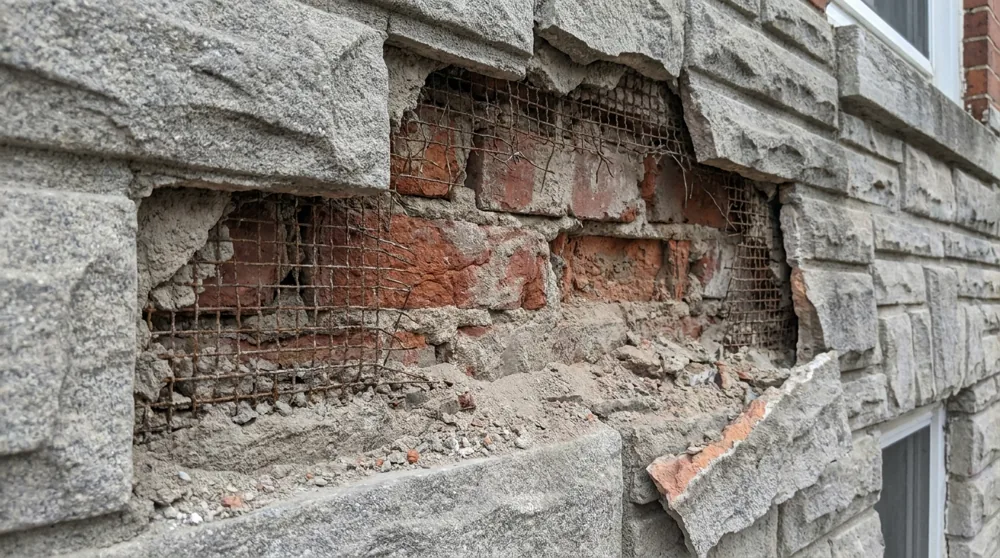
Pulling formstone reveals what’s been hiding for 70 years: original brick, wire lath, and whatever moisture has been trapped against the wall.
Baltimore’s Formstone Question
No siding conversation in Baltimore is complete without formstone. If you don’t know the term, you absolutely know the look: that grey, stamped, faux-stone shell wrapped around thousands of rowhomes across the city.
What Formstone Actually Is
Formstone was patented in 1937 by Lewis Albert Knight of Baltimore’s Lasting Products Company. It’s essentially stamped concrete troweled over a wire-mesh lath that’s nailed to the original brick, then colored and shaped to imitate cut stone. It swept through working-class neighborhoods in the 1940s through the 1960s, sold on the promise of being cheap, maintenance-free, and more modern-looking. At its peak it was a genuine status symbol. Baltimore filmmaker John Waters famously called it “the polyester of brick.”
Seventy-some years later, a lot of that formstone is cracking, staining, and pulling away from the wall, and homeowners are deciding what to do about it.
Should You Remove Formstone or Side Over It?
The short, honest answer: almost always remove it. Here’s why siding straight over formstone is a bad idea:
- It traps moisture. Formstone already holds water against the brick. Cap it with new siding and you seal that moisture in, which is how you grow mold and rot behind a wall you can no longer see.
- You can’t inspect what’s underneath. Any home over 50 years old deserves a close look at the brick and sheathing for hidden damage. Covering formstone means committing blind.
- The lath and cement are heavy and uneven. New siding wants a flat, sound substrate. Bumpy, deteriorating formstone is a poor base, and fasteners through it can crack it further.
The right sequence is to remove the formstone, then inspect, clean, and repoint the brick underneath. From there you have two good paths: restore the brick and leave it exposed (many homeowners fall back in love with the original facade), or install new siding over a proper weather-resistive barrier on a sound wall.
What Formstone Removal Costs
Plan for formstone removal and brick repointing as a separate line item from your siding. When the metal lath comes off, it leaves the old brick pocked with holes where it was anchored, and the mortar joints usually need cleaning and repointing, sometimes a few badly spalled bricks need replacing. It’s a genuinely dusty, labor-intensive job. Real-world Baltimore removal-and-repoint work has historically started around $3,400 to $3,500 for a typical rowhome facade and climbs from there depending on how rough the brick is underneath. We always quote it after seeing the actual condition, not from a photo.
A note worth making: some preservationists now argue formstone has earned its own place in Baltimore’s history. If you’re in a historic district, that view can matter to CHAP. We’ll walk you through whether removal needs approval before you commit either way.
Vinyl vs. Fiber-Cement vs. Aluminum
Once the wall is sound, the real decision is material. Here’s how the three you’ll actually consider stack up for a Baltimore home.
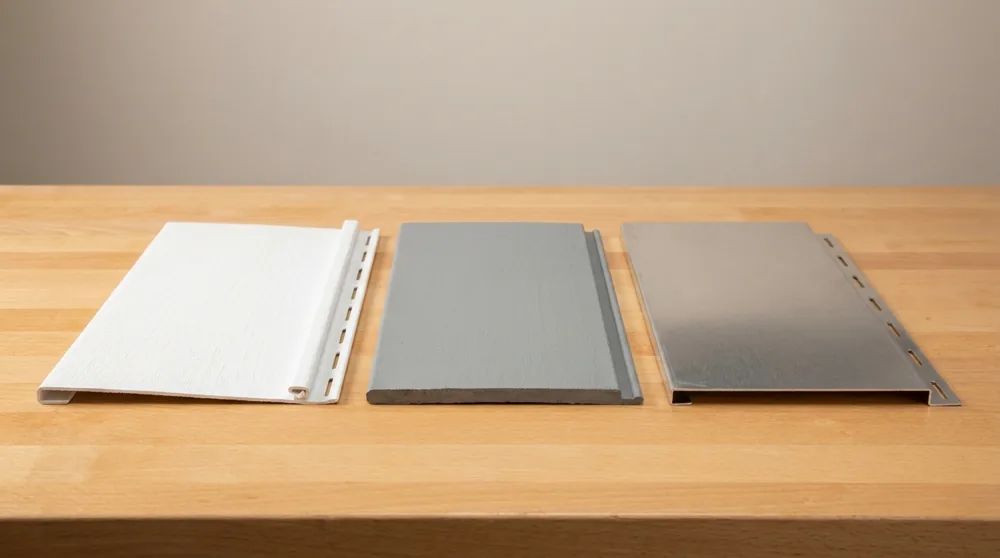
The three siding materials Baltimore homeowners weigh most often: vinyl, fiber-cement, and aluminum.
Vinyl Siding
Vinyl is the most popular siding in America for good reasons: it’s affordable ($4 to $7 per square foot installed), low-maintenance, and comes in a huge range of colors and profiles, including styles that mimic wood lap or shake. It never needs painting, and you clean it with a hose. Modern insulated vinyl adds a foam backing that improves the wall’s R-value and gives the panels a more solid, less hollow feel.
The honest trade-offs: vinyl can become brittle and crack in deep winter cold, and it can warp under extreme heat or reflected sun. The color is baked in, so you can’t repaint it down the road, if you want a different look later, you replace it. Quality varies a lot between builder-grade and premium lines, and in Baltimore’s freeze-thaw winters that difference shows up over time. For rentals, flips, and tighter budgets, good vinyl is a smart, sensible choice.
Fiber-Cement Siding (James Hardie)
Fiber-cement is a blend of cement, sand, and cellulose fiber, and it’s the material we point most clients toward when the budget allows and they’re staying put. It runs more ($9 to $13 per square foot installed for the pre-finished ColorPlus line), but you’re buying serious longevity and performance:
- It lasts 50-plus years when installed and maintained properly, often outliving two rounds of vinyl.
- It handles Maryland humidity. Fiber-cement is engineered to resist water absorption, so it doesn’t rot, swell, or feed mold and insects the way wood does. It also stands up to wind-driven rain better than standard vinyl, which matters during our summer thunderstorm season and the occasional tropical remnant.
- It holds paint. Factory ColorPlus finishes carry a 15-year warranty against peeling, cracking, and chipping, and the product itself can carry up to a 30-year limited warranty.
- It looks like real wood. The crisp shadow lines and deep grain read as painted cedar from the curb, which suits Baltimore’s traditional rowhomes and older suburbs.
The trade-offs are the higher price and a heavier, more labor-intensive install, it needs to be cut and fastened correctly, which is exactly where an experienced crew earns its keep.
Aluminum Siding
Aluminum was the standard on Baltimore homes built from the 1950s through the 1970s, and you still see a lot of it. It’s fire-resistant and rust-resistant, but it has fallen out of favor for new installs because it dents easily from hail and stray baseballs, chalks and fades over time, and insulates poorly. Vinyl and fiber-cement simply offer more durability, better insulation, and more design options for similar or less money.
If your home wears aluminum now and it’s dented, chalky, or just dated, the practical move is almost always full replacement rather than repainting. Repainting buys you a few years; new siding resets the clock for decades and fixes the insulation gap at the same time.
What Holds Up in Maryland Weather
Baltimore gives siding the full Mid-Atlantic workout: humid 90-degree summers, freeze-thaw winters in the 20s, heavy thunderstorms, and the occasional wind event off a passing storm system. That combination is hard on materials.
Humidity and wind-driven rain are where cheaper materials struggle and where fiber-cement and quality insulated vinyl pull ahead. Standard vinyl can crack in cold and warp in heat; bargain panels do it sooner. Whatever material you choose, the layer that quietly does the most work is the weather-resistive barrier behind the siding, the house wrap and flashing details around windows, doors, and penetrations. Siding sheds the bulk of the water, but the barrier behind it is your last line of defense, and a sloppy install there causes more rot than any material choice. It’s the part homeowners never see and the part we never cut corners on.
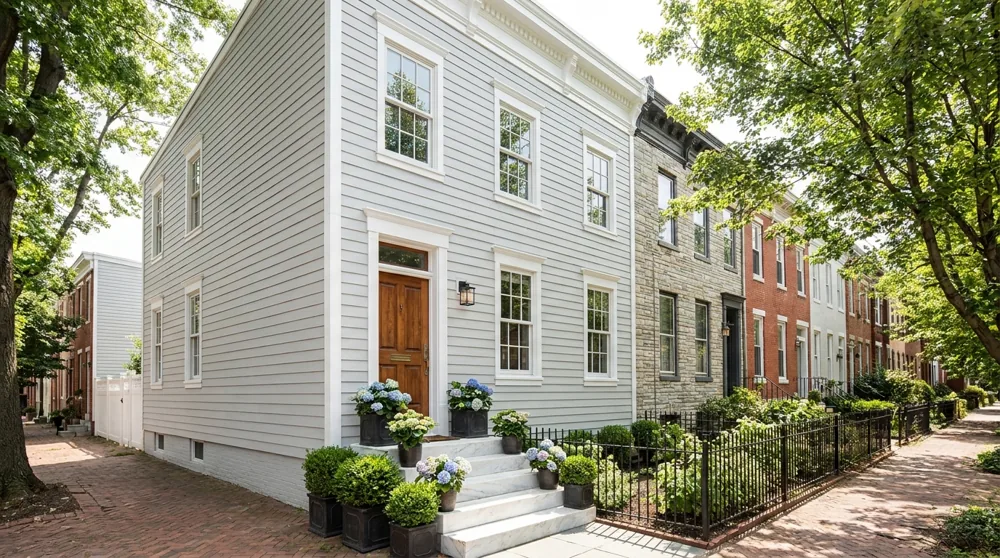
A rowhome after the formstone came off, the brick was repointed, and new fiber-cement went on over a proper weather barrier.
What to Expect During the Job
How Long Does Siding Replacement Take?
For a typical Baltimore home, a full siding replacement usually takes one to two weeks, weather permitting. A front-and-rear rowhome facade can go faster; a four-sided detached home with a lot of trim and detail takes longer. Add time on the front end if formstone removal and brick repointing are part of the scope, since that’s its own phase before any new siding goes up.
Is It Disruptive?
Less than a kitchen or bath remodel, because the work happens outside. Expect noise, a dumpster or material staging in front of the house, and crews on ladders or scaffolding. We protect landscaping and AC units, keep the site tidy day to day, and do a full cleanup, including a magnet sweep for stray nails, at the end.
Lead Paint and Older Homes
Homes built before 1978 may have lead paint on existing siding and trim. Maryland law requires certified lead-safe work practices during renovation, and we follow all EPA RRP (Renovation, Repair, and Painting) requirements. This matters most when removing old wood, aluminum, or formstone-era trim, and it’s built into how we plan the job rather than treated as an afterthought.
Permits and Historic Districts
Like-for-like siding replacement on a non-historic Baltimore property generally doesn’t require a building permit, but always confirm for your address. If your home sits in a CHAP historic district, Federal Hill, Fells Point, Mount Vernon, Bolton Hill, Canton, and others, any change to a publicly visible exterior needs a Certificate of Approval before the work, and that review can take 30 to 60 days. We handle the submissions and inspections so the timeline doesn’t surprise you. Learn how we run projects start to finish on our process page.
Does New Siding Pay Off at Resale?
Siding is one of the highest-return exterior projects you can do, and not only at sale. New siding instantly modernizes curb appeal, removes the “deferred maintenance” red flag buyers and inspectors look for, and on older Baltimore homes it can meaningfully cut drafts and energy loss. For a homeowner staying put, that shows up as a more comfortable, better-insulated house. For a seller, it shows up as a faster sale and fewer inspection headaches. Either way, a sound exterior protects everything behind it, which is the real reason to do it.
Why Choose Monarch Bay Renovations for Siding
- Baltimore expertise. We know rowhomes, formstone, brick facades, and the realities of what’s hiding behind 70-year-old cladding.
- Honest scoping. We flag rot, asbestos risk, and formstone repointing upfront and quote them as their own line items, no surprise change orders.
- Licensed and insured. Fully licensed Maryland Home Improvement Contractor (MHIC #149066) and a Google Guaranteed business.
- Permit and CHAP handling. We manage permits, historic-district approvals, and inspections so you don’t have to chase them.
- Clean, careful installs. We treat the weather barrier behind your siding as seriously as the siding you can see.
- Free, transparent estimates. Detailed, line-item quotes with no allowance games.
Thinking about new siding, or finally ready to deal with that formstone? Call us at (443) 602-9300 or request a free estimate online. We’ll come look at your home, tell you honestly what’s worth doing, and put real numbers on paper.
Frequently Asked Questions
How much does it cost to replace siding on a Baltimore rowhome?
A true rowhome is often cheaper than a detached house because shared party walls mean you’re only siding the front and rear, roughly half the square footage. Expect a front-and-rear facade in quality vinyl to start in the mid-single-digit thousands, with fiber-cement running higher. Formstone removal and brick repointing, if needed, are quoted separately and typically add $3,500 or more. Get a free estimate for an exact number on your home.
Should I remove formstone or side over it?
Remove it. Siding over formstone traps moisture against the brick and hides any rot you can’t otherwise see on a 70-year-old wall. The right path is to remove the formstone, repoint the brick, and then either keep the brick exposed or install new siding over a proper weather barrier.
Is vinyl or fiber-cement siding better for a Baltimore home?
Both perform well here. Vinyl is the affordable, low-maintenance choice (20-40 year lifespan) but can crack in cold and warp in heat. Fiber-cement costs more but lasts 50-plus years, resists humidity and wind-driven rain, holds paint for 15 years, and won’t rot. For a forever home, fiber-cement is usually the better long-term value; for a rental or shorter hold, quality vinyl makes sense.
Why is aluminum siding no longer used?
Aluminum was standard on Baltimore homes from the 1950s-1970s but dents easily, chalks and fades, and insulates poorly. Vinyl and fiber-cement offer better durability, insulation, and looks for similar or less money. If your home has tired aluminum, replacing it usually beats repainting.
How long does siding replacement take?
Most Baltimore homes take one to two weeks, weather permitting. Front-and-rear rowhomes can go faster; detached homes with lots of trim take longer. Formstone removal and brick repointing add a separate phase before new siding goes up.
Do I need a permit to replace siding in Baltimore?
Like-for-like replacement on a non-historic property generally doesn’t require a building permit, but homes in a CHAP historic district need a Certificate of Approval before any visible exterior change. Pre-1978 homes may also trigger lead-safe or asbestos handling requirements. We confirm what your address needs and handle the paperwork.
Get Your Free Siding Estimate
Whether you’re replacing tired aluminum, finally tackling formstone, or choosing between vinyl and fiber-cement, Monarch Bay Renovations delivers expert installation backed by years of Baltimore experience. We serve Baltimore City, Baltimore County, Howard County, Anne Arundel County, and the surrounding areas.
Call (443) 602-9300 or fill out our online form to schedule your free in-home consultation. We’ll assess your home, talk through your options honestly, and provide a detailed written estimate, no pressure, no obligation.
Explore our full range of exterior renovation services to see how new siding fits into a complete home upgrade, or reach us through our contact page with any questions about your project.
Common Questions
- How much does siding replacement cost in Baltimore in 2026?
- For a typical Baltimore home, siding replacement runs about $6.25 to $9.50 per square foot installed, which works out to roughly $12,000 to $19,000 for an average two-story house. Vinyl sits at the lower end ($4-$7/sq ft), fiber-cement like James Hardie at the higher end ($9-$13/sq ft for ColorPlus). Rowhomes are usually cheaper than that because shared party walls mean you're only siding the front and rear. Old siding removal, sheathing repair, and any formstone or asbestos work are added on top.
- Should I remove formstone or side over it?
- Almost always remove it. Formstone is a wire-lath-and-cement shell that traps moisture against the brick, and siding directly over it locks that moisture in. On a home over 50 years old you also can't see what's rotting behind it until you pull it off. The honest path is to remove the formstone, inspect and repoint the brick, then either keep the brick exposed or install new siding over a proper weather barrier. Budget removal and brick repointing separately — it's a dusty, labor-heavy job that typically adds $3,500 or more.
- Is vinyl or fiber-cement siding better for a Baltimore home?
- Both work well here; it comes down to budget and how long you plan to stay. Vinyl is the affordable, low-maintenance choice and lasts 20-40 years, but it can crack in deep cold and warp in extreme heat. Fiber-cement (James Hardie) costs more upfront but lasts 50-plus years, holds paint for 15 years, shrugs off humidity and wind-driven rain, and won't rot or feed insects. For a forever home in Baltimore's humid Mid-Atlantic climate, fiber-cement is usually the better long-term value. For a rental or a shorter hold, quality insulated vinyl makes more sense.
- Why is aluminum siding no longer used on Baltimore homes?
- Aluminum siding was everywhere on Baltimore homes from the 1950s through the 1970s, but it fell out of favor because it dents from hail and stray baseballs, chalks and fades over time, and insulates poorly. Vinyl and fiber-cement arrived offering lower maintenance, better insulation, and more color and texture options at a similar or lower price. We still see plenty of aluminum on older homes, and when it's tired the right move is almost always to replace it rather than repaint.
- Do I need a permit to replace siding in Baltimore?
- Like-for-like siding replacement on a non-historic property generally does not require a building permit in Baltimore City, but homes in a CHAP historic district need a Certificate of Approval before any visible exterior change, and that review comes before the permit. Removing formstone or aluminum on a pre-1978 home can also trigger lead-safe and, in some cases, asbestos handling requirements. We confirm what your specific address needs and handle the paperwork as part of the job.