

Renovation Notes
House Painting in Baltimore: Interior & Exterior Costs and Local Realities (2026)
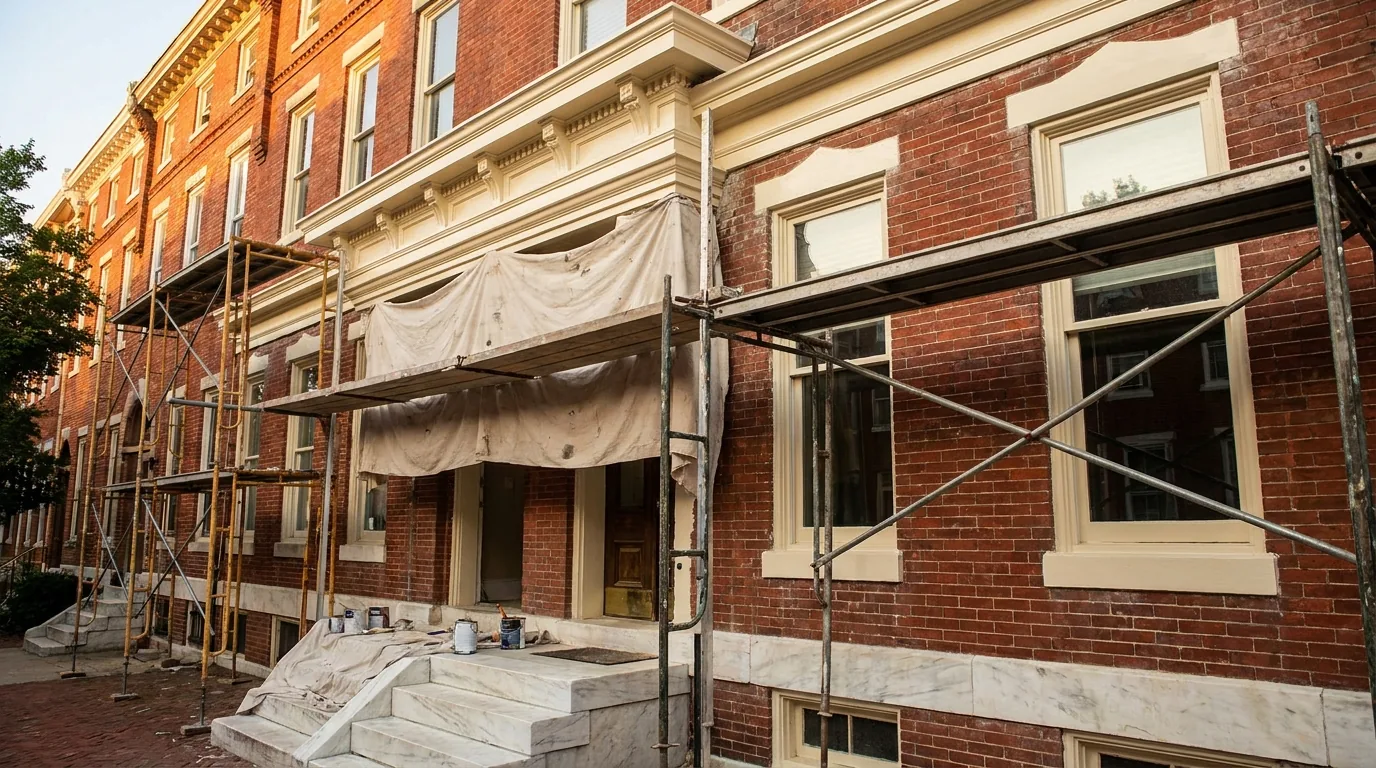
If you are a Baltimore homeowner staring at a tired living room or a peeling rowhouse facade, the first question is almost always the same: what is this going to cost, and who do I trust to do it right? Painting looks simple from the curb. In a hundred-year-old Baltimore home, it rarely is.
At Monarch Bay Renovations we have painted plaster walls in Federal Hill rowhomes, sprayed cabinets in Hampden kitchens, and brushed trim on formstone facades in Highlandtown. This guide is the honest version of what we have learned: real 2026 costs, the Baltimore-specific quirks that catch homeowners off guard, and how to tell a real paint job from a quick coat that fails in two winters.
A proper exterior repaint on a Baltimore rowhouse is mostly prep, the paint is the easy part.
How Much Does House Painting Cost in Baltimore? (2026)
Let’s start with the numbers, because that is what you came for. Painting prices in Baltimore in 2026 are driven far more by prep and surfaces than by the paint itself. Two homes the same size can differ by thousands of dollars depending on the condition of the walls and how much trim is in play.
Interior Painting Costs
Interior painting in the Baltimore metro generally runs $3 to $6 per square foot of floor area, with labor making up 75% to 95% of the bill. Here is how that breaks down in practice:
| Project | Typical Baltimore Range (2026) |
|---|---|
| Single room (12x14, walls only) | $900 – $2,200 |
| Room with walls, ceiling, trim & doors | $1,400 – $2,800 |
| Whole-house interior repaint (rowhome) | $4,800 – $8,600 |
| Kitchen cabinet painting (sprayed) | $1,500 – $4,000 |
| Single accent or feature wall | $300 – $600 |
A budget whole-interior refresh on a smaller rowhome can come in under $4,000 if it is mostly clean walls and minimal trim. A larger county home with high ceilings, lots of doors, and detailed trim climbs quickly. The variable that surprises people most is trim: cutting in around ornate Baltimore baseboards, crown, window casings, and paneled doors is slow, careful work, and it can be a third of the labor on an older home.
Exterior Painting Costs
Exterior painting in Baltimore generally runs $2.50 to $6.00 per square foot, with masonry sitting at the higher end:
| Surface | Typical Baltimore Range (2026) |
|---|---|
| Trim, soffits & fascia only | $1,800 – $4,500 |
| Wood or fiber-cement siding (full) | $4,000 – $9,000 |
| Painted brick rowhouse facade | $3.00 – $6.00 / sq ft |
| Formstone facade + trim | $5,000 – $11,000 |
| Full rowhome exterior (front, rear, trim) | $6,000 – $12,000 |
| Large county home, full exterior | $15,000 – $18,000 |
Brick and formstone cost more for a simple reason: masonry is porous. It absorbs more paint, it needs a masonry-specific primer and a breathable topcoat, and getting the prep wrong traps moisture inside the wall. We will come back to that, because in Baltimore it matters more than almost anywhere.
Why Prep Drives the Price
When a quote comes in dramatically lower than the others, prep is almost always what got cut. On Baltimore’s older housing stock, real prep means patching plaster cracks (figure $0.50 to $0.75 per square foot just for patching on a rough wall), scraping failing exterior paint, caulking gaps, spot-priming stains, and sanding glossy trim so the new coat actually bonds. Architectural details, archways, tall ceilings, decorative trim, add another 20% to 30% to time and materials. None of that shows up in a photo, but all of it shows up in whether the job still looks good in five years.
Painting Baltimore Rowhome Interiors: Plaster and Trim
Most Baltimore rowhomes were built with plaster-and-lath walls, not modern drywall, and plaster changes how interior painting has to be done.
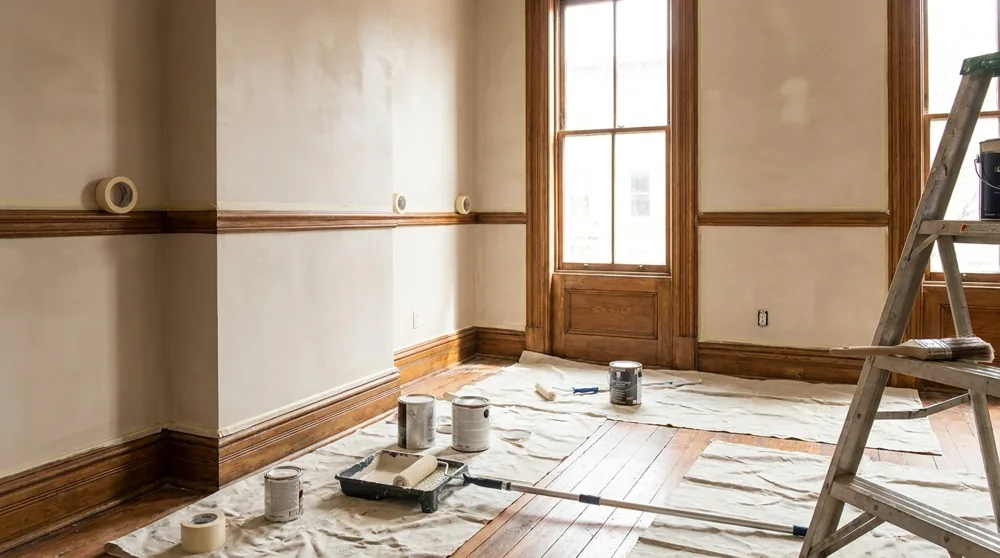
Plaster walls need different prep than drywall, hairline cracks and chalky surfaces have to be addressed before the first coat.
Old plaster brings a few realities a good painter plans for:
- Hairline and settlement cracks. A century of seasonal movement leaves spider cracks, especially above doors and windows. They need to be raked out, filled, and often reinforced with mesh, not just rolled over, or they telegraph right back through the fresh paint.
- Chalky, distempered, or previously oil-painted surfaces. Older walls and trim may have surfaces that modern latex won’t grip. The fix is a bonding primer, not more topcoat. Skip it and the paint peels in sheets.
- Layered trim with decades of buildup. Baltimore baseboards, casings, and doors often carry many coats. Heavy buildup gets sanded or, where it has chipped, scraped and feathered smooth so the new finish looks crisp instead of lumpy.
- High ceilings and tall stairwells. Many rowhomes have 9-foot-plus ceilings and a narrow stairwell that is genuinely tricky to reach safely. That is labor and staging, and it is reflected in the price.
This is also where a salaried, experienced crew earns its keep. The difference between an amateur cut line along ornate trim and a clean, sharp one is the difference between “freshly painted” and “did someone actually paint this?”
Exterior Painting: Brick, Formstone, and Wood Trim
Baltimore’s facades are unlike most of the country, and each one paints differently.
Should You Paint Your Brick?
Painted brick rowhouses are everywhere in Baltimore, and they can look sharp. But painting brick is close to permanent, once it is coated, you can’t realistically strip it back, and you commit to repainting every 7 to 10 years. If your brick is solid and the mortar joints are in good shape, the honest advice is often to leave the brick natural and just freshen the trim and cornice, which is where the eye goes anyway. If the brick is mismatched from past repairs or you simply want the painted look, it is doable, it just needs the right breathable masonry coating so the wall can still release moisture.
Formstone Facades
Thousands of Baltimore rowhomes wear formstone, the stamped faux-stone cladding applied over brick from the 1940s through the 1960s. You generally don’t repaint the formstone itself, but the wood trim, window frames, soffits, and fascia around it almost always need paint, and the seams where formstone meets wood are exactly where water sneaks in.
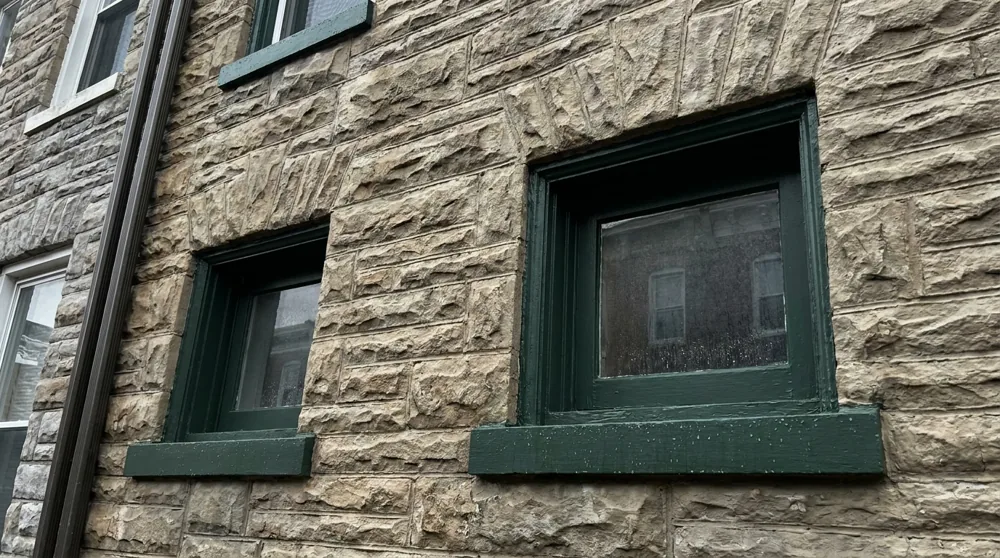
On a formstone home, the trim and seams are the whole job, that is where paint protects the structure from water.
The trap with formstone is moisture. Because it sits over brick and can hold water against the wall, sloppy caulking or the wrong sealant turns into water behind the facade and, eventually, damaged plaster inside. Any painter working a formstone home should be able to tell you specifically how they will prep and seal those transitions.
Wood Trim and Maryland Humidity
Whatever the facade, Baltimore’s hot, humid summers and freeze-thaw winters are brutal on exterior paint. Moisture is the enemy of adhesion. That is why exterior timing and product choice matter:
- We avoid painting in the heat of a humid afternoon or when rain is hours away, paint that can’t cure properly fails early.
- South- and west-facing walls take the most sun and weather and tend to fail first; they often need the most prep on a repaint.
- 100% acrylic latex is the workhorse for Baltimore exteriors because it stays flexible through the freeze-thaw cycle and breathes better than old oil coatings.
- Spring and fall are the ideal exterior windows here, but with planning we paint well into the warmer and cooler months, we just watch the dew point, not the calendar.
Lead Paint: The Baltimore Reality Nobody Can Skip
In practice, lead-safe work adds roughly $500 to $2,000 to a typical job, and more on a heavy-prep exterior where a lot of old paint is being scraped. That covers containment, careful surface handling, and proper cleanup so lead dust doesn’t end up in your home or yard, which matters enormously if you have kids. If a painter quoting your pre-1978 home doesn’t mention lead-safe practices at all, that is a red flag, not a bargain. Monarch Bay Renovations is a licensed MHIC contractor and follows EPA RRP requirements on every qualifying home.
How to Tell a Real Paint Job From a Cheap One
The paint on the wall looks the same on day one. The difference shows up later. A real Baltimore paint job includes:
- Honest prep, patching, sanding, scraping, and caulking written into the scope, not “we’ll see when we get there.”
- Spot-priming and full primer where needed, over stains, bare plaster, glossy trim, and masonry.
- Two full coats as the standard, not one coat stretched thin to hit a number.
- Clean protection, floors, furniture, and landscaping covered, and a thorough cleanup at the end of each day.
- Quality product, Benjamin Moore or Sherwin-Williams grade, matched to the surface (masonry paint on masonry, cabinet-grade enamel on cabinets).
- A crew, not a rotating cast of day labor, the same trained people from start to finish, so quality and accountability stay consistent.
If a quote is far below the others, ask what was left out. Usually it is the prep, the second coat, or the lead-safe compliance, and all three are exactly what you are paying a professional to handle.
Neighborhoods We Paint
We paint across Baltimore City and the surrounding counties, and we know how the housing stock changes block to block. We regularly work in Canton, Federal Hill, Fells Point, Hampden, Highlandtown, Locust Point, Charles Village, Roland Park, and Hamilton, along with Towson, Catonsville, Pikesville, and communities throughout Baltimore County. A 1920s formstone rowhome in Highlandtown and a center-hall colonial in Roland Park need very different approaches, we tailor the prep, the products, and the schedule to the home in front of us.
Get a Free Painting Estimate
Whether you want one room freshened, a whole interior repainted, or an exterior brought back to life, Monarch Bay Renovations gives you a detailed, line-item estimate with no allowance games and no surprise change orders. As a licensed Maryland Home Improvement Contractor (MHIC #149066) and a Google Guaranteed business, we stand behind every number we put in writing.
Explore our interior renovation services or our Baltimore painting service to see how painting fits into a full home refresh.
Call us at (443) 602-9300 or request a free estimate online. We will walk your home, talk through the realities of your plaster, trim, or facade, and give you an honest quote, no pressure, no obligation.
Common Questions
- How much does it cost to paint a house interior in Baltimore in 2026?
- Interior painting in Baltimore runs roughly $3 to $6 per square foot of floor area in 2026, or about $900 to $2,200 for a single 12x14 room. A whole-house interior repaint on a typical 3-bedroom rowhome usually lands between $4,800 and $8,600, depending on ceiling height, how much trim and door work is involved, and how much wall prep your plaster needs. At Monarch Bay Renovations a whole-house interior repaint typically falls in the $3,500 to $8,000 range.
- How much does it cost to paint a house exterior in Baltimore?
- Exterior painting in Baltimore generally runs $2.50 to $6.00 per square foot. For a rowhome where you are mostly painting the front and rear facades plus all the trim, expect roughly $6,000 to $12,000. Larger county homes with full siding and heavy prep can reach $15,000 to $18,000. Painted brick and formstone sit at the higher end because masonry is porous, drinks more paint, and needs breathable masonry-specific coatings.
- Does lead paint add to the cost of painting an older Baltimore home?
- Yes. Most Baltimore homes were built before 1978, so any painting work that disturbs old painted surfaces must follow EPA RRP (Renovation, Repair and Painting) lead-safe practices by law. The containment, HEPA cleanup, and extra labor typically add $500 to $2,000 on a straightforward job and more on heavy-prep exteriors. It is not an upsell — it is a federal requirement, and Maryland's MHIC enforces it. Always hire an RRP-certified firm for a pre-1978 home.
- Should I paint my brick or formstone rowhouse?
- You can, but it is a one-way door — once brick is painted it needs repainting roughly every 7 to 10 years, because you can't easily strip it back to bare masonry. If your brick is sound and the mortar is in good shape, many homeowners are happier leaving it natural and just painting the trim. Formstone is different: the trim and any exposed wood almost always need paint, and the seams need attention to keep water out. We will give you the honest read for your specific facade.
- How long does it take to paint a house in Baltimore?
- A single room takes a crew most of a day with prep, priming, and two coats. A whole-house interior repaint on a rowhome usually runs 3 to 6 working days. A full exterior with proper prep, scraping, and two coats is typically 4 to 8 days depending on size, height, and how much wood repair turns up. Humidity and rain are the wild cards on exteriors — we plan around Baltimore's summer weather rather than fighting it.