

Renovation Notes
Flooring Installation in Baltimore: 2026 Costs, Materials & Rowhome Realities
If you own a Baltimore rowhome, you already know the floors tell a story. Original pine that has been painted and sanded a dozen times. A kitchen that someone tiled over linoleum over hardwood in 1985. A basement that smells faintly of the harbor every August. Picking the right flooring here is not the same as picking it for a builder-grade townhouse in the suburbs, and the cost depends a lot more on what is hiding under your feet than on the planks you put on top.
At Monarch Bay Renovations we install flooring across Baltimore City and the surrounding counties every week, and we publish real numbers because that is how we earn trust. This guide walks through what flooring installation actually costs in 2026, which materials hold up in our climate and our housing stock, and the rowhome-specific gotchas that turn a “simple” floor job into a surprise.
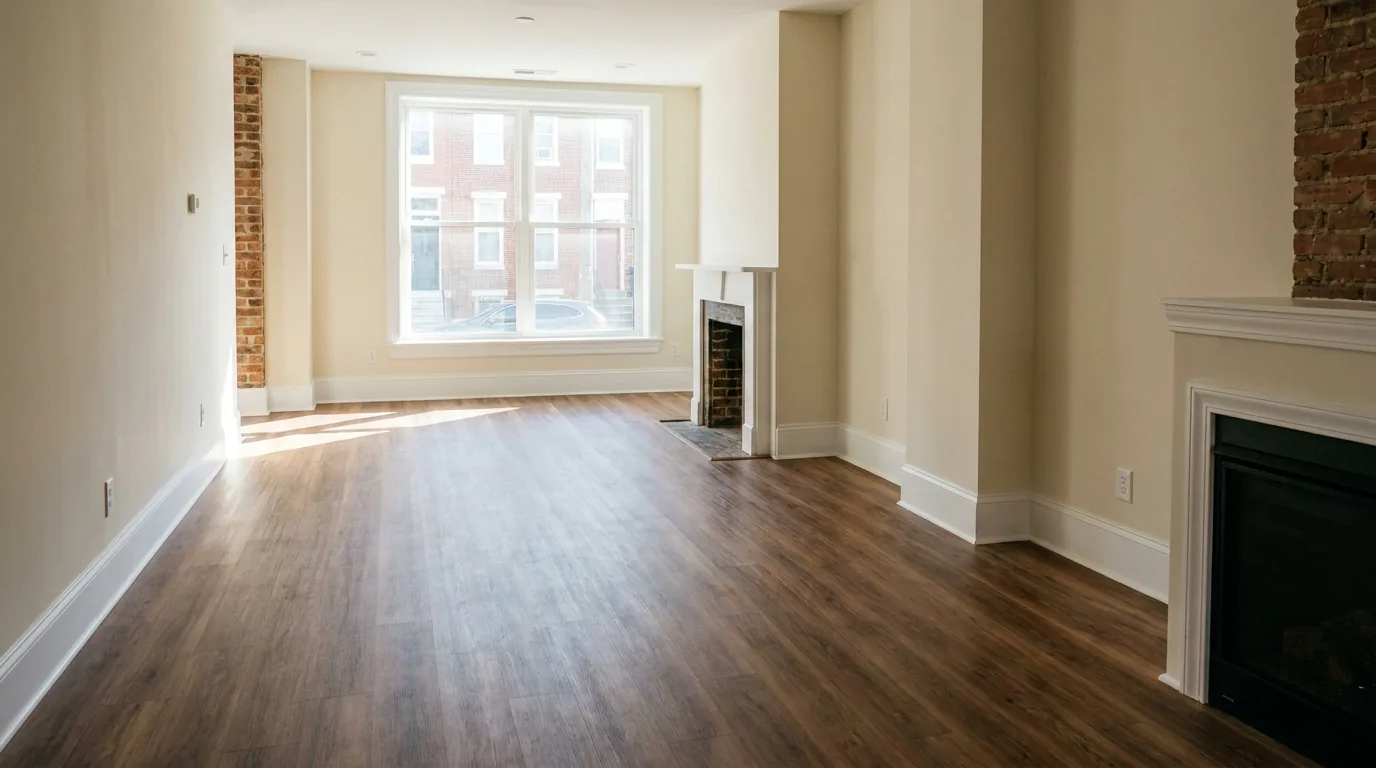
Luxury vinyl plank gives Baltimore rowhomes a warm hardwood look with waterproof durability that holds up to humidity and uneven subfloors.
How Much Does Flooring Installation Cost in Baltimore?
Installed flooring prices in the Baltimore metro generally land in these ranges for 2026, materials and labor combined:
| Flooring type | Installed cost per sq ft | 1,000 sq ft installed |
|---|---|---|
| Carpet | $4 – $8 | $4,000 – $8,000 |
| Luxury vinyl plank (LVP) | $4 – $10 | $4,000 – $10,000 |
| Laminate | $5 – $12 | $5,000 – $12,000 |
| Engineered hardwood | $8 – $16 | $8,000 – $16,000 |
| Solid hardwood | $10 – $20 | $10,000 – $20,000 |
| Tile (ceramic / porcelain) | $12 – $30+ | $12,000 – $30,000+ |
Those are honest mid-market ranges, not the rock-bottom “starting at” numbers you see on big-box installer ads, and not the luxury-showroom ceiling either. Where your project lands inside the range comes down to three things: the material you choose, the square footage (bigger jobs cost less per foot), and the condition of what is underneath.
That last one is where Baltimore homes get interesting.
What Drives Your Flooring Cost
- The material itself. Carpet and LVP sit at the affordable end. Hardwood and tile carry a premium for both the product and the labor skill required to install them well.
- Subfloor condition. This is the number-one cost variable in older Baltimore homes. Replacing or repairing a rotted, sagging, or out-of-level subfloor runs roughly $2 to $5 per square foot on top of the flooring. We have opened up floors in Federal Hill and found three layers of old material and a joist that needed sistering. We document it with photos and tell you before we proceed, never as a surprise change order.
- Tearing out the old floor. Demolition and disposal of existing flooring typically adds $1 to $2 per square foot. Old glued-down tile and pulled-up carpet tack strips take longer than a clean floating-floor removal.
- Floor prep and leveling. Almost no rowhome floor is dead flat. Self-leveling compound, plywood underlayment, or grinding down high spots adds labor but is the difference between a floor that looks tight for 20 years and one that telegraphs every dip.
- Stairs, transitions, and trim. Stair treads, thresholds between rooms, and new baseboard or quarter-round all add up. Stairs in particular are labor-intensive and priced separately.
- Room layout. Lots of small rooms, closets, and angles mean more cuts and more waste than one big open space, so a 1,200-square-foot job split across eight rooms costs more per foot than the same footage in three.
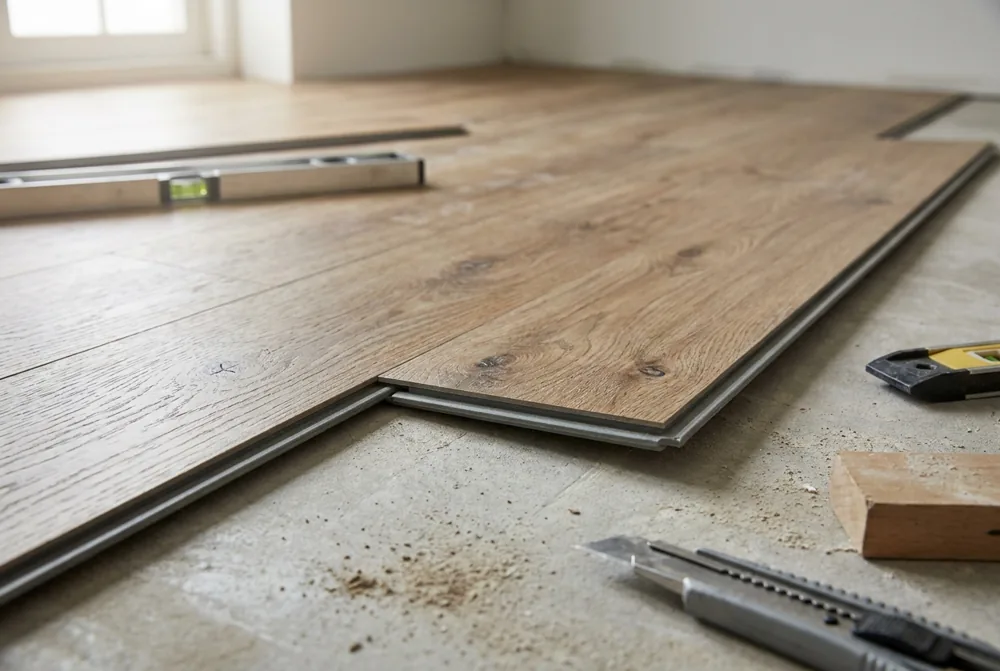
Click-lock LVP installs as a floating floor over a leveled subfloor, the prep underneath matters as much as the plank on top.
Why We Push LVP for Most Baltimore Homes
If you call us and ask “what should I put down,” the honest answer for most Baltimore rowhomes is luxury vinyl plank, and we generally specify MSI products for their consistency, wear layers, and warranty. Here is the reasoning, not the sales pitch.
It is genuinely waterproof. Not water-resistant, waterproof. In a city full of below-grade basements, summer humidity off the Chesapeake, and rowhomes that share walls and the occasional plumbing surprise, a floor that shrugs off water is worth a lot. A burst supply line or a kid’s overflowing bathtub will not destroy an LVP floor the way it would laminate or hardwood.
It floats over imperfect subfloors. Most quality LVP installs as a click-lock floating floor, meaning it is not nailed or glued to the substrate. That is exactly what you want over the unpredictable subfloors in 100-year-old Baltimore homes. As long as we get the floor reasonably flat and dry, the planks lock together into one continuous surface that handles minor movement.
It looks like wood and wears like iron. Modern LVP has deep embossing and realistic grain. The wear layer (the clear top coat) is what determines durability, for a busy household or a rental we spec a 20-mil or thicker wear layer that handles dogs, kids, and furniture without scratching through.
It is quick and clean to install. A single room is often a one-day job, and there is no sanding dust or days of finish off-gassing. For occupied homes, that matters.
The honest trade-off: LVP is a vinyl product, so it will not refinish like real wood, and the very cheapest LVP looks and feels cheap. We do not install bargain-bin planks. There is a real floor under the showroom samples and a junk floor that fails in three years, and the price gap between them is small enough that it is never worth going cheap.
Hardwood: Still the Right Call for Some Baltimore Homes
LVP is the value pick, but it is not always the right pick. In a Roland Park colonial, a Bolton Hill brownstone, or any home where original hardwood is part of the character (and the resale value), real wood wins.
Refinish before you replace. Plenty of Baltimore rowhomes have original heart pine or oak hiding under carpet or vinyl. If the boards are sound, refinishing runs about $3 to $8 per square foot, far less than new flooring, and it preserves something you cannot buy anymore. We will pull up a corner of your carpet and tell you honestly whether what is underneath is worth saving.
Solid vs. Engineered. Solid hardwood ($10–$20/sq ft installed) can be sanded and refinished four to six times over its life, so it can outlast you. Engineered hardwood ($8–$16/sq ft installed) has a real-wood veneer over a stable plywood core, which makes it more forgiving of humidity swings and a better choice on concrete or over radiant heat. For a main floor in a stable, well-conditioned home, either works beautifully.
Where hardwood struggles in Baltimore. Below grade and in full bathrooms. Wood and standing moisture do not coexist. If your home runs humid or you are flooring a space that touches the ground, this is where we steer you back toward LVP or tile.
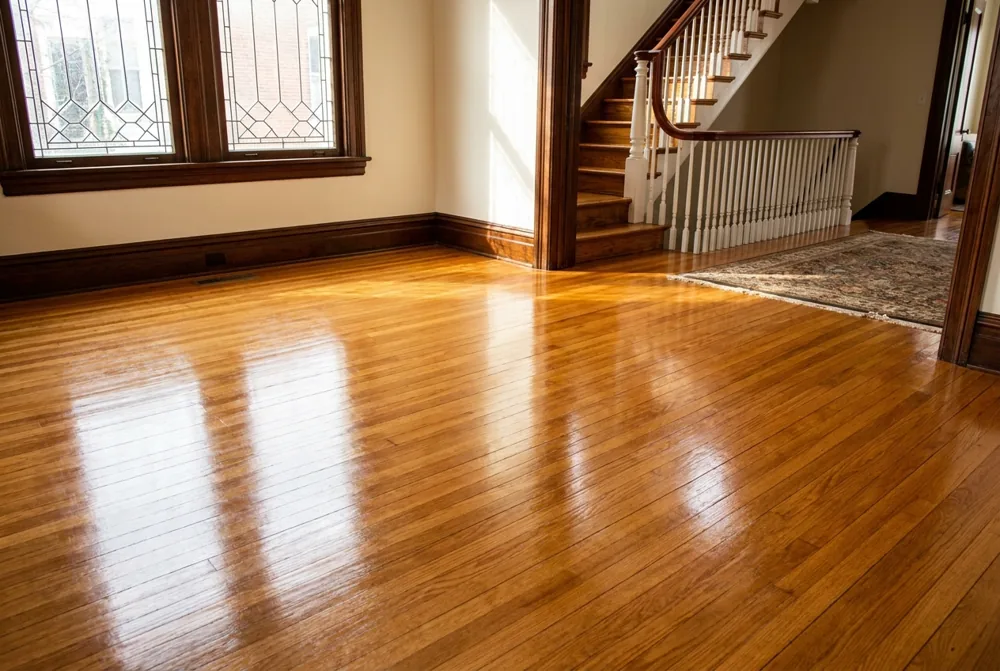
Original hardwood is often worth refinishing rather than replacing, at $3 to $8 per square foot it preserves character you cannot buy new.
Laminate, Tile, and Carpet: Where They Fit
Laminate ($5–$12/sq ft installed). Laminate has come a long way and the better water-resistant lines look sharp. But in a head-to-head with LVP, LVP usually wins in Baltimore because laminate’s fiberboard core can swell if water sits on it. We will install laminate when a client prefers it, but for most rowhome and basement jobs we would rather put your money into a quality LVP.
Tile ($12–$30+/sq ft installed). Tile is the durability champion and the right choice for full bathrooms, mudrooms, and entryways that catch Baltimore’s winter slush and salt. It is the most expensive to install because it is the most labor-intensive, proper substrate prep, mortar, and grout cure time cannot be rushed. Large-format porcelain that looks like wood or stone is a popular pick for high-traffic, high-moisture rooms. For a full kitchen or whole floor, tile is usually overkill on budget.
Carpet ($4–$8/sq ft installed). Carpet still has a place: bedrooms, upper-floor hallways, and finished attic spaces where warmth and quiet matter and moisture does not. It is the most affordable option and the fastest to install. Where we steer clients away from carpet is anywhere near the ground floor of a humid rowhome, in basements, or in homes with pets and allergy concerns, where a hard surface is healthier and lasts longer.
Baltimore-Specific Flooring Realities
Rowhome Subfloors Are the Wild Card
This is the single biggest difference between flooring a Baltimore rowhome and flooring new construction. Many city homes have been renovated repeatedly over a century, and what is under your current floor can be anything: original tongue-and-groove pine, plank subfloor with gaps, plywood, particleboard, or two or three layers of all of the above. Some of it has cupped, some has gaps, some hides a soft spot over a bad joist.
We never quote a floor sight-unseen for exactly this reason. A floating LVP floor is forgiving, but it still needs a flat, solid, dry base. The leveling and prep is where the real craftsmanship (and sometimes the real cost) lives. A floor that looks perfect on day one but was laid over an unaddressed dip will show that dip within a year.
Basements and Moisture
Baltimore basements sit below grade, and many take on humidity or the occasional bit of water, especially the older ones with stone or block foundations. The rule below grade is simple: assume moisture exists and choose a floor that does not care. That means waterproof LVP (often over a vapor barrier) or tile, never solid hardwood, and standard laminate only with caution. If you have an active water problem, the floor is the last step, not the first; we will tell you to fix the water source before we put anything down, because no flooring survives a wet slab.
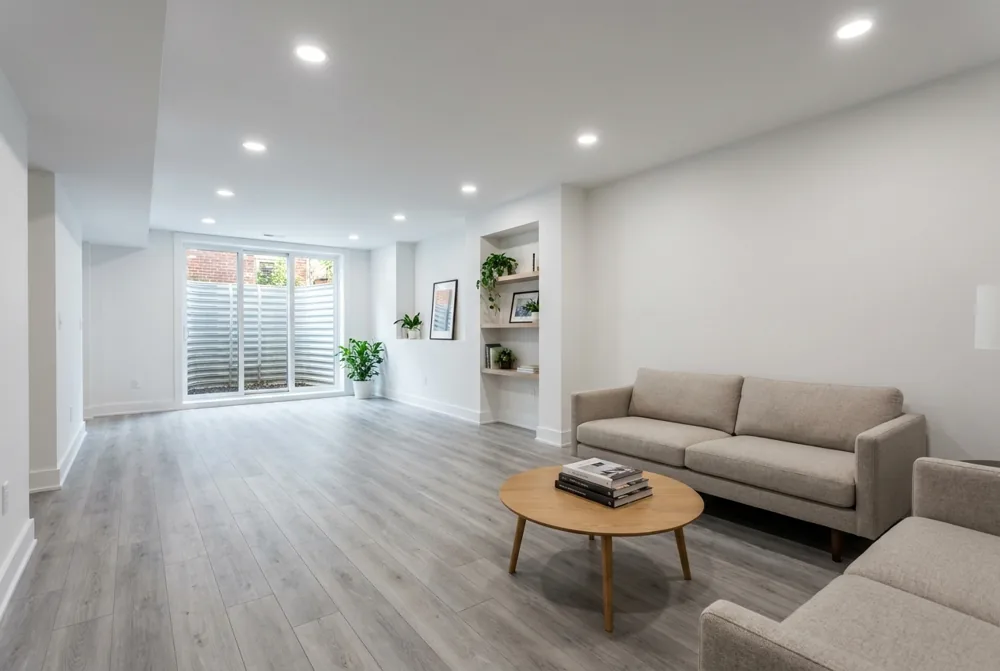
Waterproof LVP over a vapor barrier is the safest flooring for a below-grade Baltimore basement.
Historic Districts and Original Floors
If your home is in a CHAP or Maryland Historical Trust district, Federal Hill, Fells Point, Mount Vernon, Bolton Hill, Canton, parts of Charles Village, original hardwood floors are often a protected part of the home’s character, and refinishing rather than replacing is both the cheaper and the more appropriate move. Most interior floor work does not trigger historic review the way windows or facades do, but if you are changing materials in a visible way it is worth checking. We work in these neighborhoods constantly and can guide you.
Going Over the Existing Floor
One way Baltimore homeowners save real money: floating a new LVP or laminate floor directly over an existing flat, solid floor. If your old ceramic tile or hardwood is sound and level, we can often install right over it, skipping demolition and disposal. We will not do this over a cracked, hollow, or moisture-affected floor, because that just buries a problem. But when the conditions are right, it is faster, cleaner, and cheaper, and we will tell you honestly whether your floor qualifies.
Our Flooring Installation Process
We keep it straightforward and surprise-free.
- Free in-home assessment. We measure, and we actually look under your floor where we can, pulling up a vent, a closet corner, or a threshold to check the subfloor. You get a detailed, line-item written estimate, with prep and demolition broken out so you see exactly where the money goes.
- Material selection. We help you pick the right product for each room based on moisture, traffic, and budget, not just the one with the best margin. See the options on our flooring page.
- Prep and demolition. We protect your home, tear out the old floor, haul it away, and level and repair the subfloor. This is the unglamorous step that determines whether your floor looks right in five years.
- Installation. Our crews install the floor, transitions, and trim cleanly and on schedule.
- Walkthrough. We walk every room with you and do not call it done until you are satisfied, then leave you with care instructions for your specific floor.
You can read more about how we run projects on our process page, and see what our clients say about working with us.
Get a Real Number for Your Floors
Flooring is one of the highest-impact upgrades you can make to a Baltimore home, and it is one where the right material choice and honest subfloor prep matter more than the brand on the box. We will give you straight pricing, point you to the floor that actually fits your home, and stand behind the work as a licensed Maryland Home Improvement Contractor (MHIC #149066) and Google Guaranteed business.
Call us at (443) 602-9300 or request a free estimate. We serve Baltimore City, Baltimore County, Howard County, Anne Arundel County, and the surrounding areas. You can also reach us through our contact page, we typically respond within one business day.
Common Questions
- How much does flooring installation cost in Baltimore in 2026?
- Installed flooring in Baltimore runs roughly $4 to $10 per square foot for luxury vinyl plank (LVP), $8 to $16 for hardwood, $5 to $12 for laminate, $12 to $30+ for tile, and $4 to $8 for carpet. For a typical 1,000-square-foot main floor, LVP lands around $4,000 to $9,000 installed, including subfloor prep. The biggest swing factor in older Baltimore rowhomes is the condition of the subfloor underneath.
- What is the best flooring for a Baltimore rowhome?
- For most Baltimore rowhomes, luxury vinyl plank (LVP) is the best all-around value. It is 100% waterproof, handles humidity and the occasional basement seepage, and installs as a floating floor over the uneven, century-old subfloors common in city homes. We use MSI products for their consistency and warranty. Hardwood is the right call for higher-end homes and historic districts where original wood floors are worth preserving.
- Can you put LVP or laminate over an existing tile or hardwood floor?
- Often, yes. LVP and laminate are floating floors, so if the existing tile or wood is flat, solid, and dry, we can usually install right over it after leveling and prep. This saves on demolition and disposal. We never float over a floor that is cracked, hollow-sounding, or moisture-affected — that just hides a problem you will pay for later. We check every subfloor before quoting.
- What flooring works in a Baltimore basement?
- Waterproof luxury vinyl plank is the safest choice for Baltimore basements, which sit below grade and are prone to humidity and occasional water intrusion. We avoid solid hardwood and standard laminate below grade because moisture from the slab will eventually swell or cup them. If moisture is a known issue, we pair LVP with a vapor barrier or recommend tile, and we address the water source first.
- How long does flooring installation take?
- A single room of LVP or laminate is usually a one-day job. A full main floor of 800 to 1,200 square feet typically takes two to four days, including subfloor prep and trim. Hardwood takes longer because of acclimation, nailing, and finishing — plan on several days to a week. Tile is the slowest due to mortar and grout cure times. We give you a firm schedule before we start.