

Renovation Notes
Deck Building in Baltimore: 2026 Cost & Design Guide
If you live in Baltimore and you’ve got even a sliver of usable outdoor space, a flat rowhome roof staring at the skyline, a postage-stamp backyard hemmed in by brick, or a real lot out in the county, a deck is one of the most satisfying upgrades you can make. It turns dead square footage into a place you actually use.
But “how much does a deck cost?” is one of those questions where the internet hands you a number that’s either wildly low or padded for a McMansion in the suburbs. Baltimore is its own thing. A deck here might be a 12-foot backyard platform between two party walls, or it might be a rooftop oasis that needs a structural engineer before anyone picks up a hammer. Those are not the same project, and they shouldn’t carry the same price.
This guide gives you the honest version: real 2026 cost ranges, the rooftop-deck reality unique to Baltimore rowhomes, composite versus wood, permits and CHAP, and what actually drives your number. We’re Monarch Bay Renovations, a licensed Maryland contractor (MHIC #149066) and Google Guaranteed business, and we build these across the city. Here’s what we’ve learned.
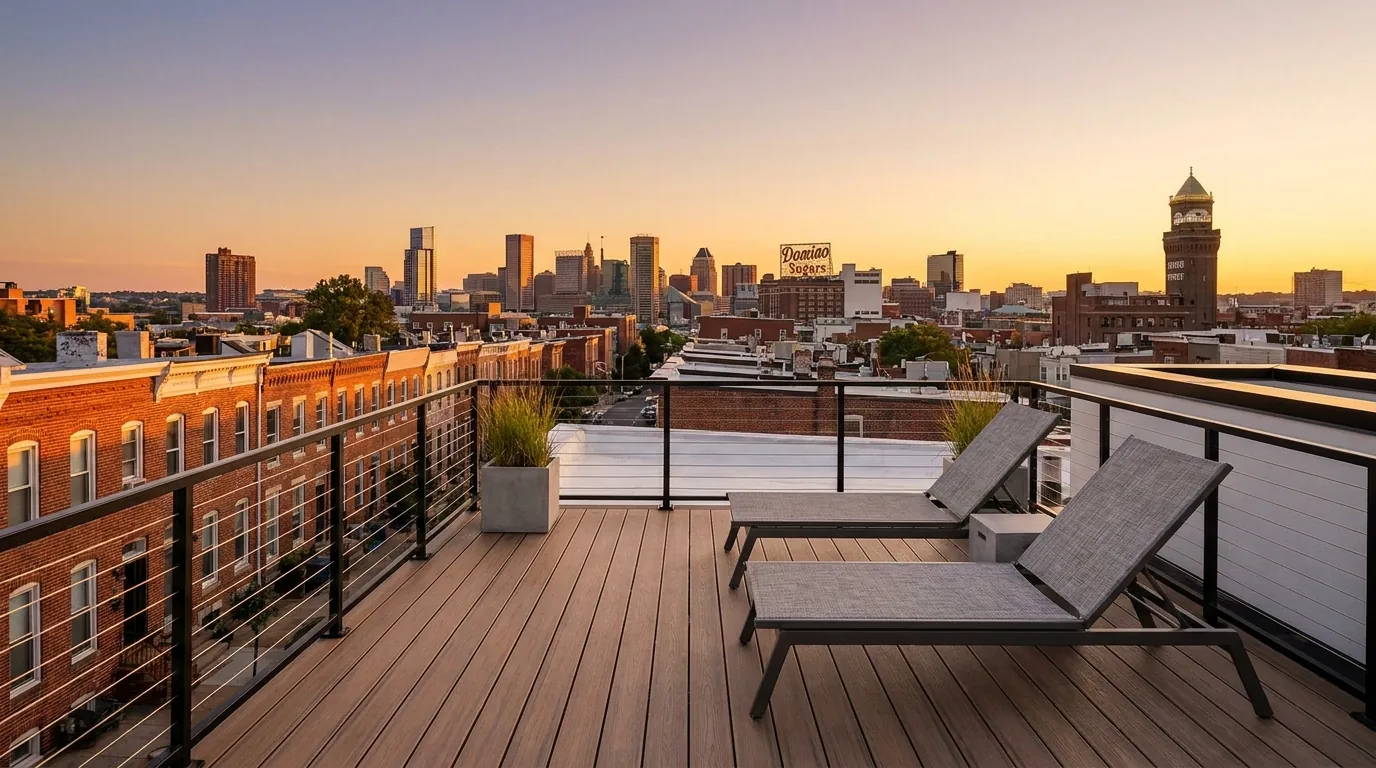
A rowhome rooftop deck turns an unused flat roof into the best seat in Baltimore.
How Much Does a Deck Cost in Baltimore? (2026)
Deck pricing comes down to two things: the size and the type. In the Baltimore metro, a higher-cost-of-living market than the national average, here’s where 2026 numbers actually land, installed:
| Deck type | Cost per sq ft (installed) | Typical 300 sq ft project |
|---|---|---|
| Pressure-treated, ground-level | $30 – $50 | $9,000 – $15,000 |
| Composite, ground-level / attached | $45 – $75 | $13,500 – $22,500 |
| Premium composite + railings/lighting | $70 – $100 | $21,000 – $30,000 |
| Rooftop deck (rowhome) | $60 – $130+ | $20,000 – $45,000 |
A few honest caveats before you anchor on a number. Square footage is the biggest lever, but it isn’t linear, a small deck carries fixed costs (mobilization, permits, footings, railing corners) spread over fewer square feet, so a tiny 80-square-foot backyard deck can run $50+ per foot even in pressure-treated wood. And the rooftop range is wide on purpose, because the cost lives in what’s under the deck boards, not the boards themselves. More on that below.
Baltimore’s Signature: The Rowhome Rooftop Deck
This is the deck that makes Baltimore Baltimore. Drive through Canton, Fells Point, Federal Hill, Locust Point, or parts of Brewers Hill and you’ll see them everywhere, flat-roofed rowhomes with a deck perched on top, catching the harbor breeze and a skyline view you can’t buy any other way. When you’ve got no side yard and a 14-foot-wide lot, up is the only direction left to expand your living space.
Here’s the part people underestimate: on a rooftop deck, the deck is the cheap part. The composite boards and railing might be 30% of your bill. The other 70% is everything that keeps your top-floor ceiling dry and your deck legally standing.
What actually drives rooftop deck cost
- Structural engineering and reinforcement. A flat roof was designed to hold a roof, not a roof, plus furniture, plus a dozen people at a summer party. A structural engineer (typically $100–$220/hour) has to confirm your joists, beams, and the masonry party walls can carry the new load, and you’ll often need sistered joists or new support posts. This is non-negotiable and it’s the line item DIY-minded owners try to skip. Don’t.
- Waterproofing and the roof membrane. You’re putting a deck on top of the surface that’s keeping rain out of your house. A proper rooftop build uses a waterproof membrane and pedestal-mounted or sleeper-system decking so water can drain underneath the deck, with flashing tied into the parapet walls. Cut corners here and you’re not buying a deck, you’re buying a slow leak. Membrane and flashing work commonly adds several thousand dollars.
- Roof access. Getting onto the roof safely and to code usually means a roof hatch, a “bilco”-style door, or an interior stair penetration through the top floor. A simple hatch is a few thousand; a full stair build is more and eats interior square footage.
- Railings to code. Rooftop railings have to meet height and load requirements, and on a visible front elevation they may also have to satisfy CHAP (see below). Cable, aluminum, and glass panel systems all read differently in cost and look.
Add it up and most Baltimore rowhome rooftop decks land between $20,000 and $45,000. A modest deck with a hatch on a roof that’s already structurally friendly can come in lower; a large deck with a stair tower, premium glass railing, and a tricky membrane detail can go higher. The honest move is to get the structural assessment early so your budget is built on facts, not hope.
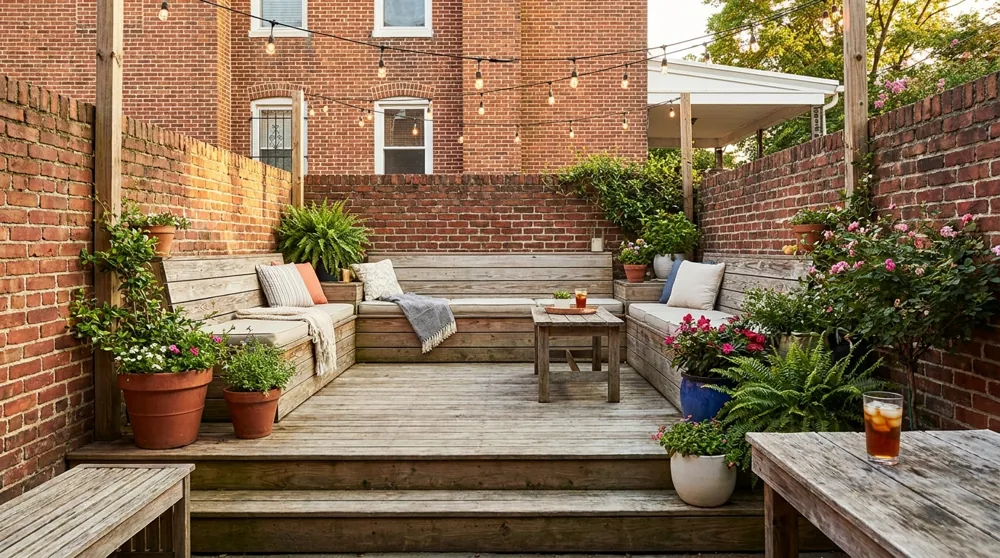
A small urban backyard deck makes a tight Baltimore lot feel like an outdoor room.
Small Urban Backyard Decks
Not every Baltimore deck climbs to the roof. Plenty of the best ones we build are low, ground-level platforms in the narrow backyards behind rowhomes, the kind of space that’s currently cracked concrete, a patch of weeds, or a parking pad nobody loves.
A small backyard deck (think 100–250 square feet) is the most budget-friendly way to add real outdoor living. Because it’s close to grade, you often avoid the railing requirements and deep footings that drive up a raised deck, and a deck under a certain height may need only a lighter permit. Built-in bench seating along the brick party walls, a couple of planters, and string lights turn a forgotten gap into the room everyone gravitates to in summer.
The catch with Baltimore backyards is access and drainage. Many lots back to a narrow alley with no equipment access, so material gets carried through the house or over a wall, that’s labor, and it’s real. And because these yards are boxed in by brick, you have to make sure the new deck doesn’t trap water against the foundation or the neighbors’ walls. We grade and detail for drainage so your deck isn’t the reason your basement gets damp.
Composite vs. Pressure-Treated Wood in Baltimore’s Climate
Baltimore weather is hard on decks. Humid, 90-degree summers; freeze-thaw winters that swing across the freezing line dozens of times; and enough rain to keep wood damp. Your material choice is really a choice about how you want to spend the next 20 years, in dollars up front, or in weekends with a sander.
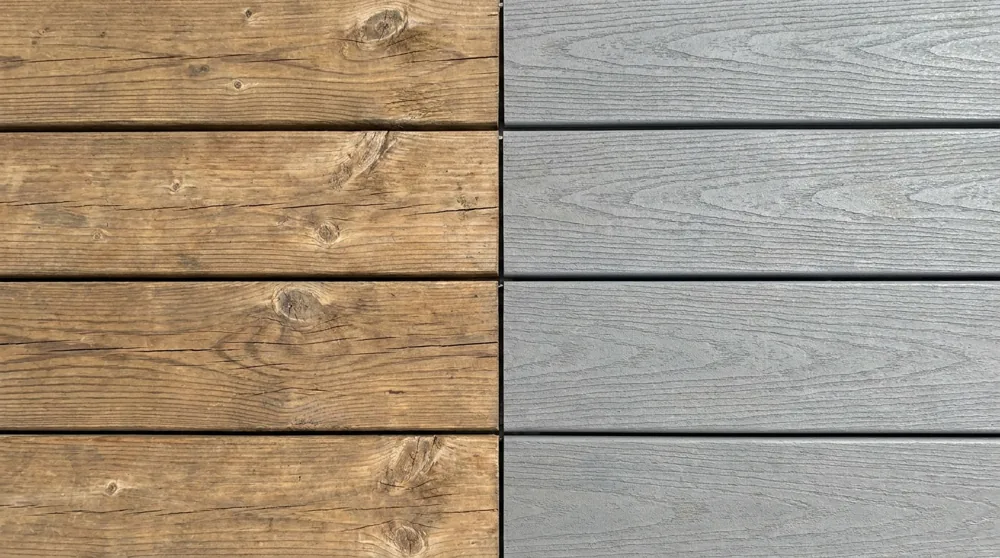
Pressure-treated wood (left) costs less up front; composite (right) costs more but shrugs off Baltimore humidity for decades.
Pressure-treated wood
The traditional, budget-friendly choice, roughly $30–$50 per square foot installed in our market. It’s strong, easy to repair board-by-board, and every contractor in town knows how to build with it. The trade-off is maintenance: to survive Baltimore humidity and freeze-thaw, pressure-treated decks really do need cleaning and re-sealing every year or two, plus the occasional warped or splintered board swapped out. Budget roughly $300–$500 a year in materials and time if you DIY the upkeep, or more if you hire it out. Skip the maintenance and a wood deck here can look tired in five years.
Composite (Trex and similar)
Composite decking runs $45–$90 per square foot installed depending on the product line. It costs more up front, but it doesn’t rot, splinter, or need staining, a rinse with soap and water is the whole maintenance program. Over a 20-year life, the maintenance you don’t do on composite often makes up much of the price difference versus wood. In Baltimore’s wet climate, and especially on a rooftop where getting up there to re-stain is a chore, composite’s water resistance and low upkeep are a genuine advantage. It also comes in colors and grain patterns that read like real wood without the maintenance tax.
Our honest take: for a ground-level backyard deck on a budget, pressure-treated wood built well is a perfectly good answer. For a rooftop deck, a deck you plan to keep for decades, or anyone who’d rather not spend a Saturday sanding, we usually recommend composite, the math and the climate both favor it over time.
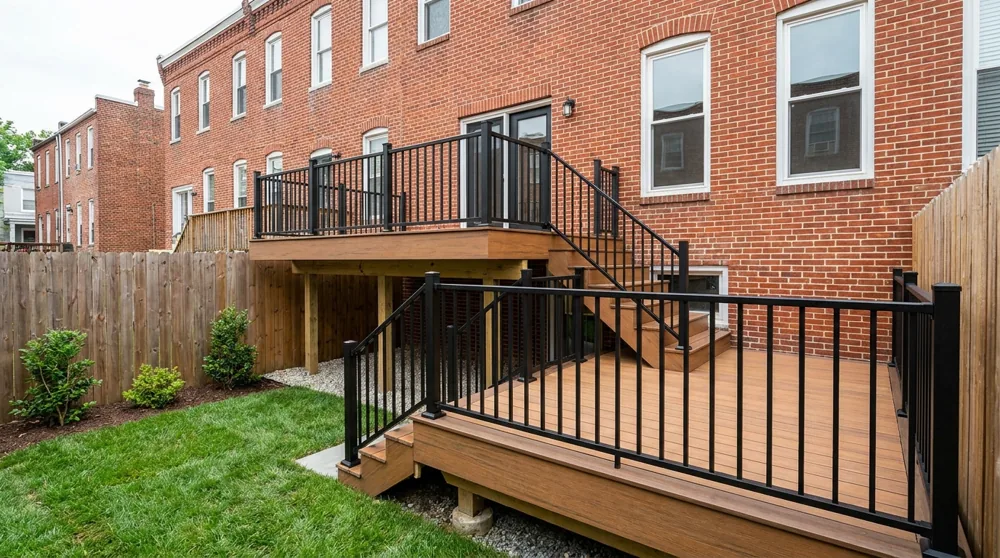
A multi-level composite deck off the back of a rowhome, low maintenance and built to handle Baltimore’s freeze-thaw winters.
Maryland & Baltimore Deck Permits
Skipping the permit is the most expensive shortcut in decking. Here’s how it works locally.
- Most decks need a building permit. In Baltimore City, a deck attached to your home, or any deck raised more than a low height off the ground, requires a building permit. Rooftop decks always require a permit and a structural review. Very low ground-level platforms below the threshold may be exempt, but check before you build, “I thought it was exempt” is not a defense at inspection.
- Historic districts mean CHAP first. If your home is in a designated historic district, Federal Hill, Fells Point, Canton, Mount Vernon, Bolton Hill, Union Square and many more, a deck visible from the public street typically needs approval from the Commission for Historical and Architectural Preservation (CHAP) before you can pull your building permit. That review can take weeks, so it belongs at the front of your timeline. A rooftop deck that peeks over the front parapet is exactly the kind of thing CHAP weighs in on; a deck hidden behind the roofline often gets more latitude.
- Setbacks and lot coverage. Baltimore’s tight lots mean zoning setbacks and lot-coverage limits come into play, especially for backyard decks that push toward the alley or a property line. We check this before designing so you’re not redrawing the deck after the fact.
- Inspections. Footings, framing, and final all get inspected. A deck built to code and inspected is also a deck that won’t blow up your home sale later, unpermitted decks are a classic closing-table headache.
We handle the permit applications, CHAP submissions where required, and all the inspections as part of the project. It’s tedious, it’s local, and it’s exactly the kind of thing a licensed Maryland contractor should be taking off your plate.
What Drives Your Deck Cost (Beyond Size)
Two decks of the same square footage can price hundreds or thousands apart. Here’s where the money moves:
- Height and footings. A ground-level deck is cheap to support. The moment you go up, second-story access, a raised deck over a sloped yard, you add posts, deeper footings, stairs, and railing, all of which add cost.
- Railings and stairs. Code-required railing on a raised or rooftop deck is a real line item, and the upgrade from basic pressure-treated railing to aluminum, cable, or glass can swing the number meaningfully. Stairs add framing and labor per run.
- Site access. Baltimore’s alleys and party walls make material handling harder than a suburban lot with a driveway. Carrying lumber through a house or hoisting it to a roof is labor you’re paying for.
- Add-ons. Built-in benches, planters, deck lighting, a pergola, or a privacy screen each add cost, and each one is also what turns a plain deck into a space you love. We help you prioritize so the budget goes where it matters to you.
- Hidden conditions. Older rowhomes hide surprises: a roof that needs more reinforcement than expected, rotted framing where an old deck used to be, or a parapet wall that needs repointing before flashing. We flag these honestly in the estimate rather than burying them in change orders later.
Baltimore Neighborhoods We Build In
We’ve built decks across the city’s distinctive neighborhoods. Rooftop decks are most common in the flat-roofed rowhome belts, Canton, Fells Point, Federal Hill, Locust Point, Brewers Hill, and Patterson Park. Backyard and ground-level decks show up everywhere, from Hampden and Remington bungalows to Charles Village and Bolton Hill rowhomes, out to fuller lots in Roland Park, Mount Washington, and across Baltimore County in Towson, Catonsville, and Parkville.
Each pocket has its own quirks, historic-district review here, alley-only access there, a roof structure that’s friendly or fussy. Knowing the local housing stock is half the job, and it’s why a Baltimore-based crew beats a generic deck franchise on these projects.
Why Build With Monarch Bay Renovations
- Baltimore specialists. We build for this city’s housing stock, rowhomes, brick, flat roofs, tight lots, and historic districts.
- Rooftop deck experience. We coordinate the structural engineering, waterproofing, and roof access so your rooftop deck protects the house instead of leaking into it.
- Licensed, insured, and Google Guaranteed. Maryland MHIC #149066, fully insured, with the reviews to back it up.
- We handle the paperwork. Permits, CHAP submissions, and inspections are ours to manage, not yours.
- Self-performing crews. Our in-house teams build the deck, which means tighter quality control and a single point of accountability.
- Honest estimates. Transparent, line-item pricing with the Baltimore-specific surprises addressed up front.
You can see the full range of our outdoor work on our decks and patios page. Ready to get a quote? The Baltimore deck builder page lays out what’s included, the process, and the common questions answered before you call.
Get Your Free Deck Estimate
Whether you’re dreaming about a rooftop deck with a skyline view in Canton or just want to make that scrappy backyard usable, we’ll give you real numbers, not a guess off a national calculator.
Call (443) 602-9300 or request a free estimate online. We’ll visit your home, look at your roof or yard, talk through wood versus composite, and hand you a detailed written estimate with no pressure and no obligation. Questions first? Reach us through our contact page and we’ll usually respond within a business day.
Frequently Asked Questions
How much does it cost to build a deck in Baltimore in 2026?
A standard ground-level or attached backyard deck in Baltimore runs about $30 to $60 per square foot installed for pressure-treated wood and $45 to $90 per square foot for composite. A typical 300-square-foot backyard deck lands around $9,000 to $18,000. Rooftop decks on rowhomes are a different animal, figure $60 to $130+ per square foot once you add structural reinforcement, waterproofing, and roof access, which puts most rowhome rooftop decks in the $20,000 to $45,000 range.
How much does a rooftop deck cost on a Baltimore rowhome?
Most Baltimore rowhome rooftop decks run $20,000 to $45,000, or roughly $60 to $130 per square foot. The deck boards are the cheap part. The cost lives in the structural engineering to confirm the roof and walls can carry the load, the waterproof membrane and proper flashing, the roof hatch or stair penetration, and railings that meet code. Skipping any of those is how you end up with leaks into your top floor, so this is not a job to bargain-shop.
Do I need a permit to build a deck in Baltimore?
Yes, in almost every case. Baltimore City requires a building permit for a deck attached to your home or any deck more than a foot or so off the ground, and rooftop decks always require a permit plus structural review. Decks on publicly visible elevations in a historic district (Federal Hill, Fells Point, Canton, Mount Vernon and others) also need CHAP approval before the permit. We handle the permitting and inspections as part of the job.
Is composite or pressure-treated wood better for a Baltimore deck?
Both work well in Baltimore’s climate. Pressure-treated wood costs less up front and is easy to repair, but it needs cleaning and re-sealing every year or two to survive our humid summers and freeze-thaw winters. Composite (Trex and similar) costs more up front but needs almost no maintenance and won’t rot, splinter, or fade much over 25-plus years. For a rooftop deck where re-staining is awkward and water intrusion is the enemy, we usually steer clients toward composite.
How long does it take to build a deck in Baltimore?
A straightforward backyard deck typically takes one to two weeks once permits are in hand. A rooftop deck takes longer, usually two to four weeks, because of the structural work, waterproofing cure times, and the extra inspections. Permit and CHAP review timelines run separately and should be added to the front of your schedule, not the build window.
Will a deck add value to my Baltimore home?
Generally yes, and a rooftop deck especially. In neighborhoods like Canton and Federal Hill, a skyline-view rooftop deck is a sought-after feature that helps a rowhome stand out and can shorten time on market. Even a modest backyard deck adds usable living space buyers notice. As with any improvement, build it permitted and to code, an unpermitted deck can become a liability at the closing table instead of an asset.
Common Questions
- How much does it cost to build a deck in Baltimore in 2026?
- A standard ground-level or attached backyard deck in Baltimore runs about $30 to $60 per square foot installed for pressure-treated wood and $45 to $90 per square foot for composite. A typical 300-square-foot backyard deck lands around $9,000 to $18,000. Rooftop decks on rowhomes are a different animal — figure $60 to $130+ per square foot once you add structural reinforcement, waterproofing, and roof access, which puts most rowhome rooftop decks in the $20,000 to $45,000 range.
- How much does a rooftop deck cost on a Baltimore rowhome?
- Most Baltimore rowhome rooftop decks run $20,000 to $45,000, or roughly $60 to $130 per square foot. The deck boards are the cheap part. The cost lives in the structural engineering (to confirm the roof and walls can carry the load), the waterproof membrane and proper flashing, the roof hatch or stair penetration, and railings that meet code. Skipping any of those is how you end up with leaks into your top floor — so this is not a job to bargain-shop.
- Do I need a permit to build a deck in Baltimore?
- Yes, in almost every case. Baltimore City requires a building permit for a deck attached to your home or any deck more than a foot or so off the ground, and rooftop decks always require a permit plus structural review. Decks on publicly visible elevations in a historic district (Federal Hill, Fells Point, Canton, Mount Vernon and others) also need CHAP approval before the permit. We handle the permitting and inspections as part of the job.
- Is composite or pressure-treated wood better for a Baltimore deck?
- Both work well in Baltimore's climate. Pressure-treated wood costs less up front and is easy to repair, but it needs cleaning and re-sealing every year or two to survive our humid summers and freeze-thaw winters. Composite (Trex and similar) costs more up front but needs almost no maintenance and won't rot, splinter, or fade much over 25-plus years. For a rooftop deck where re-staining is awkward and water intrusion is the enemy, we usually steer clients toward composite.
- How long does it take to build a deck in Baltimore?
- A straightforward backyard deck typically takes one to two weeks once permits are in hand. A rooftop deck takes longer — usually two to four weeks — because of the structural work, waterproofing cure times, and the extra inspections. Permit and CHAP review timelines run separately and should be added to the front of your schedule, not the build window.