

Renovation Notes
Bathroom Remodel Cost in Baltimore: 2026 Pricing Guide
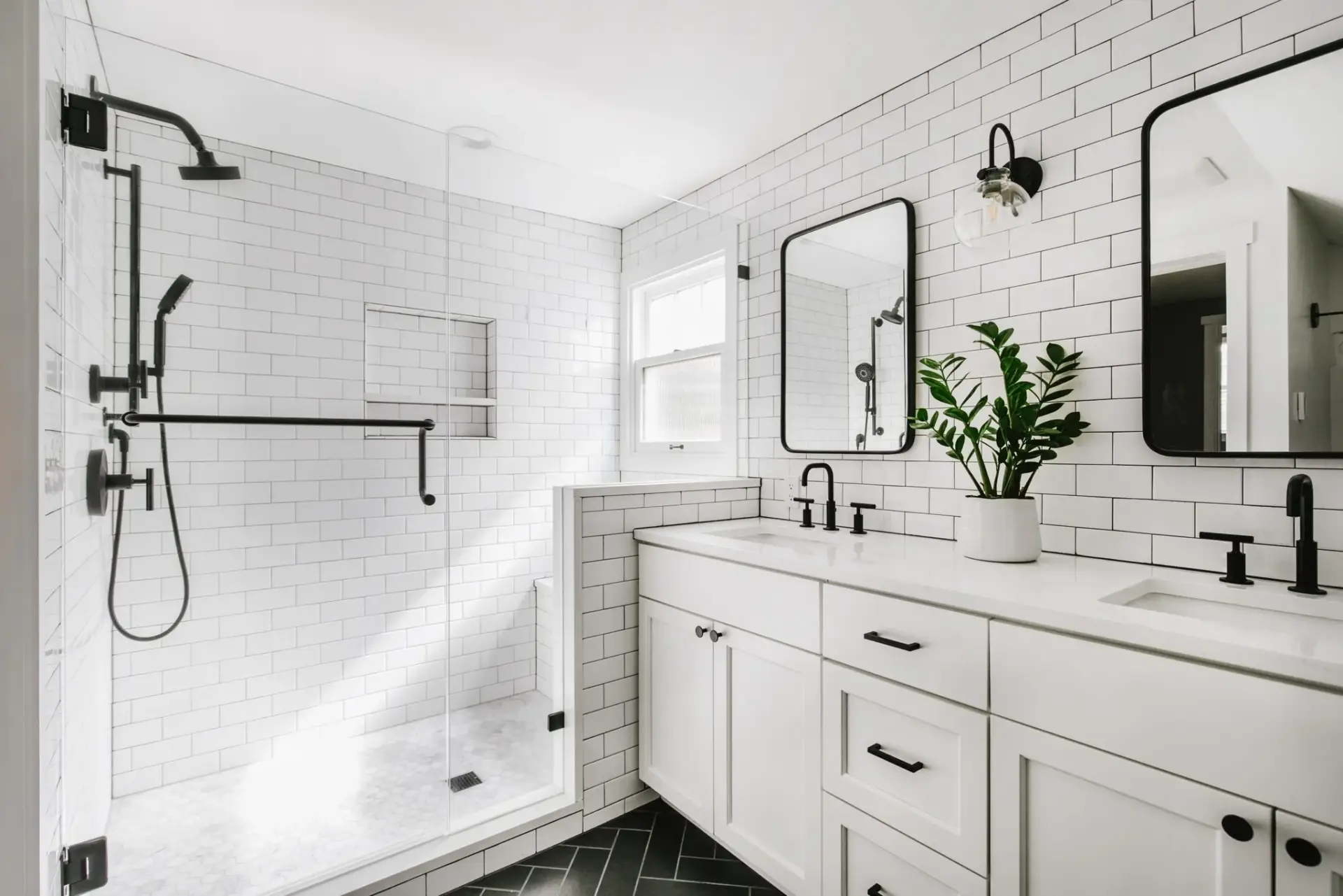
If you’re a Baltimore homeowner trying to figure out what a bathroom remodel actually costs in 2026, here is the straight version: a full mid-level bathroom at Monarch Bay Renovations runs $15,000 to $19,000. Half baths come in lower. Primary-suite remodels with a soaking tub and walk-in shower run higher. The number swings on how much we touch behind the walls and whether we are moving plumbing.
We publish these ranges because vague estimates waste everyone’s time. As a Maryland licensed contractor (MHIC #149066) and Google Guaranteed business, we write real numbers on paper before anyone signs anything.
This guide breaks down every tier, what drives the cost, what we include by default, what most Baltimore homeowners actually spend, and the design decisions, tub versus shower, tile, vanity, storage, lighting, that shape both the number and how the room feels to live in.
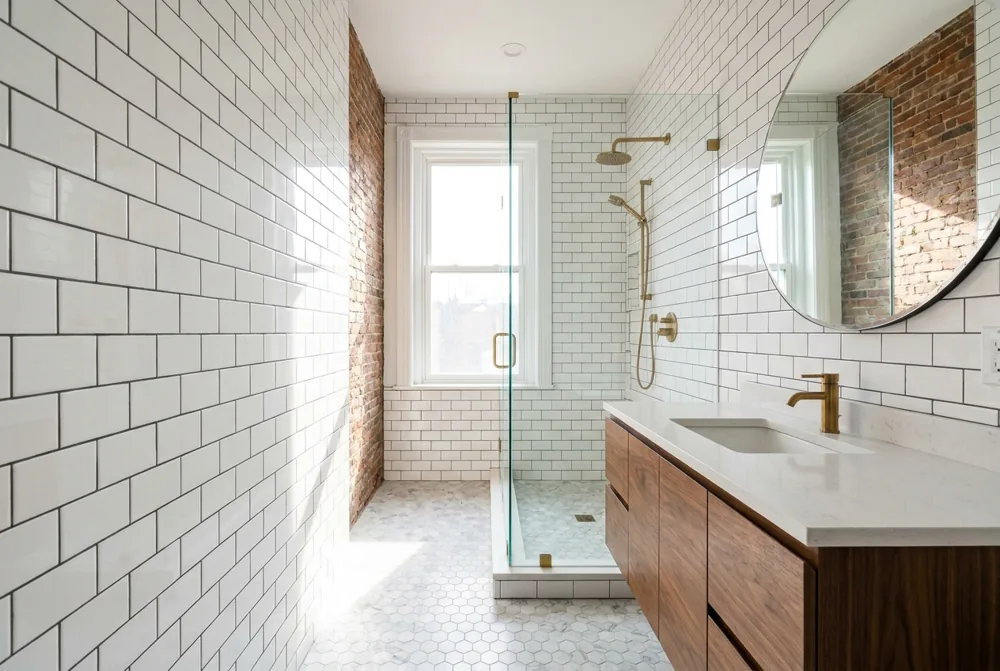
A gut-and-rebuild rowhome bath: white tile, frameless glass, and a floating vanity that makes a narrow footprint read larger.
Average Bathroom Remodel Costs in Baltimore (2026)
Bathroom renovation costs in Baltimore depend on three things: size of the room, whether we are moving plumbing, and the level of finish. Here is how it breaks down in 2026.
Half Bath / Powder Room: $6,000 – $9,000
A powder room remodel is the smallest scope we quote. Typical scope:
- New vanity and faucet
- New toilet
- New flooring (LVP or tile)
- Fresh paint, trim, baseboard
- New light fixture and GFCI outlet
Powder rooms are usually 20 to 30 square feet. If the layout stays the same and we are not moving the supply or drain, $6K–$9K covers it. Most clients pick this tier when they are prepping a house for sale or doing a quick freshener before guests arrive.
Mid-Level Full Bath: $15,000 – $19,000
This is the MBR sweet spot and the range where most of our Baltimore bathroom remodels land. A full bath remodel at this tier takes the room down to studs and puts it back together properly:
- Tile on the floor, shower walls, and surround
- New vanity, toilet, tub or shower with fixtures installed
- Glass enclosure available as a $2,200 add-on (most clients take it)
- Waterproofing behind the tile, proper pan slope, backer board not greenboard
- GFCI outlets, new exhaust fan vented to the outside, updated lighting
- Drywall, paint, trim, baseboard
- Permits pulled and inspections handled
A full bath at this level looks completely new and is built to last 20+ years if you don’t have a moisture or substrate problem. We do not cut corners on what you can’t see, that’s where bathroom remodels fail in five years.
ADA / Aging-in-Place Bath: $18,000 – $24,000
If we are converting a tub to a curbless walk-in shower, adding grab bars, a fold-down bench seat, and widening clearances, you are usually $3K–$5K above the mid-level range. The materials are not exotic; it is the time and the layout planning that adds cost. These are not harder jobs, they just need to be scoped right on day one.
Primary Suite / High-End Bath: $22,000 – $40,000+
Primary suite remodels with separate tub and shower, double vanity, custom tile work, niches, heated floors, or layout changes typically run $22K–$40K and can go higher depending on materials. At this tier, expect:
- Freestanding soaking tub plus separate walk-in shower
- Frameless glass enclosure, often with linear drain
- Custom tile work, large-format, herringbone layouts, full wet-wall tile
- Double vanity with quartz top and undermount sinks
- Heated tile floor (adds $1,500–$2,500)
- Plumbing relocation, sometimes wall removal
- Better fixtures (Kohler, Brizo, Hansgrohe)
If you are gutting a Baltimore rowhome primary bath and re-routing supply and drain, you are at the top of this range or above. We tell you that on the first walkthrough, no surprises mid-job.
What Drives Bathroom Remodel Costs in Baltimore
Three things drive the number more than anything else: tile work, plumbing changes, and the condition of what is behind the walls.
Tile and Waterproofing: 30%+ of Your Budget
Tile is the single biggest variable. Stock 12x24 ceramic at $2–$4/sq ft is one number; large-format porcelain or marble mosaic at $12–$20/sq ft is a completely different one. Labor scales with cuts and pattern complexity, a straight-stack layout installs fast; a herringbone or chevron with a niche and a curb adds days.
We waterproof every shower with proper membrane, not just plastic sheeting. We use backer board, not greenboard, on every wet wall. That stuff is not visible after install but it is the difference between a 20-year shower and a 5-year mold problem.
Plumbing: $1,500 – $6,000+
If we are keeping fixtures in the same location, plumbing is on the low end, supply lines, shutoffs, drain rough-in, set fixtures. If we are moving the toilet, relocating the vanity, or repositioning the shower drain, you are looking at $3K–$6K extra for the rough-in plus patch-back of whatever floor or wall we open up. Older Baltimore homes with galvanized supply or cast-iron drain often need partial line replacements that add another $1K–$3K.
Electrical
Modern code requires GFCI on every bathroom outlet and a properly vented exhaust fan. Older Baltimore baths frequently have neither. Bringing the electrical to current code runs $400–$1,500 depending on what we find in the panel.
Baltimore-Specific Cost Factors
The Baltimore housing stock creates real cost variability that doesn’t apply to newer construction:
- Rowhouse layouts, narrow second-floor baths with limited access for materials and tile cuts add labor time
- Plaster walls, demoing original plaster and replacing with drywall takes longer than tearing into modern construction
- Galvanized supply lines, common in pre-1970 homes, frequently need replacement once we are in the wall
- Cast-iron drain stacks, heavier to cut, sometimes need partial replacement
- Lead paint, homes built before 1978 require certified lead-safe practices; we are EPA Lead-Safe certified
- Permits, Baltimore City requires permits for plumbing and electrical; we pull and handle them
What’s Included in Our Standard Bath Quote
When you get a bathroom estimate from MBR, this is what is in the line items by default at the mid-level tier:
- Demo and dumpster
- Backer board on all wet walls
- Waterproofing membrane in shower
- New supply lines and shutoffs
- Drain rough-in
- Tile (in your selected range)
- Vanity, top, faucet, drain assembly
- Toilet (Toto or Kohler standard)
- Shower or tub fixtures
- New exhaust fan, properly vented
- GFCI outlets, updated lighting
- Drywall, paint, trim, baseboard
- Final cleanup and walkthrough
- Permits and inspections
Glass enclosure is an add-on. Heated floor is an add-on. Custom tile patterns add labor. We tell you which line items are flex on the first visit so you can dial the budget to where it needs to be.
Bathroom Design Ideas for Baltimore Homes
Cost tells you what a remodel runs. Design decides whether you actually like the room for the next twenty years. Here is how we think about the big choices on a Baltimore bath, with the local realities, narrow rowhome footprints, original plaster, galvanized and cast-iron plumbing, baked in. These are the same conversations we have on the first walkthrough.
Tub or Shower? The Rowhome Answer
This is the first question on almost every bath, and the right answer depends on whether it’s your only full bath.
If the bathroom you’re remodeling is the only full bath in the house, keep a tub. Most buyers in Baltimore still expect at least one tub, and selling a single-bath rowhome with no tub anywhere usually costs you on resale and time on market. In a tight footprint, a single tub-shower combo, tub with a tiled surround and a glass panel or curtain rod above, is the workhorse that keeps the house family- and resale-friendly.
If you’re working on a primary suite or a second full bath, and there’s already a tub elsewhere, a curbless walk-in shower is almost always the better call. It reads larger in a small room, there’s no curb to step over (which matters for aging in place), and it’s far easier to keep clean than a tub surround. A frameless glass enclosure adds about $2,200 but opens the room up visually, which is exactly what a cramped rowhome bath needs.
The trap to avoid: ripping out the only tub in the house for a glamour shower and discovering at resale that buyers wanted the tub back. We’ll tell you which way your layout and your resale picture point before anything comes out.
Make a Small Bath Feel Bigger
Most Baltimore rowhome baths are small, often a narrow second-floor room with the fixtures already lined up along one wall. You don’t fix small by cramming; you fix it with a handful of moves that recover space and trick the eye:
- Float the vanity. A wall-mounted vanity shows more of the floor, which makes the whole room read larger. It also makes cleaning the floor trivial.
- Build storage into the walls, not onto them. A recessed medicine cabinet and a recessed shower niche give you real storage without stealing an inch of floor. Bolt-on shelves after the fact always look like an afterthought, plan the storage into the tile layout instead.
- Go bigger on the tile, fewer grout lines. Large-format floor tile and a continuous wall tile make a small room feel less busy and less chopped up than tiny mosaics everywhere.
- Light colors, lots of reflection. White or pale tile, a large mirror, and a glass shower panel instead of a solid wall all bounce light around a room that usually only has one small window.
- Use the vertical. Over-toilet shelving and a taller mirror draw the eye up and put the height of the room to work.
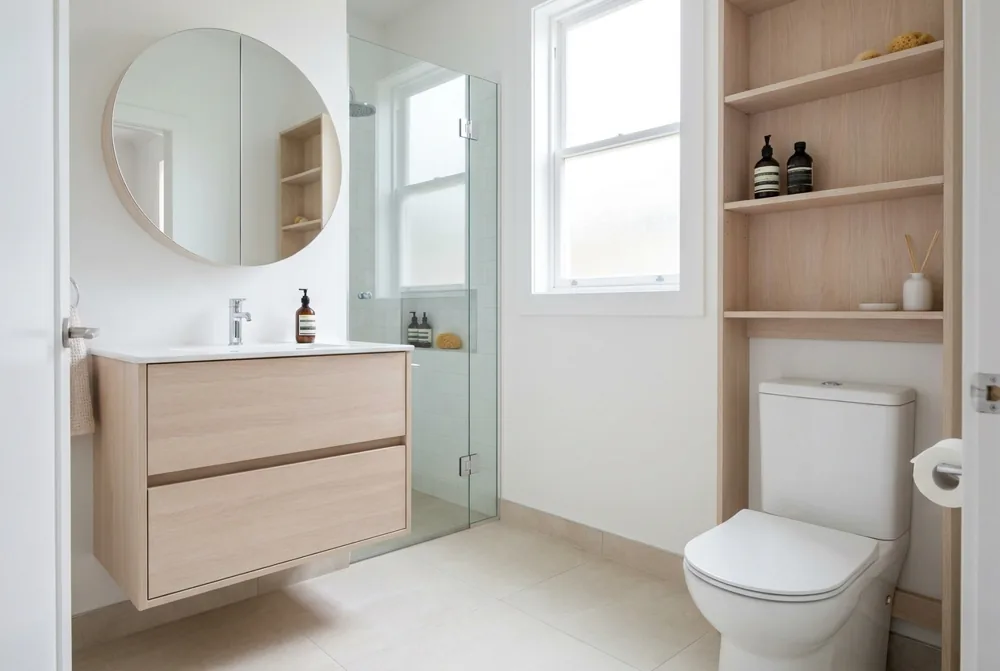
In a tight rowhome bath, built-in storage, a recessed niche, a floating vanity, a recessed cabinet, beats bolt-on shelving every time.
Tile: Where the Room Comes Together (and the Budget Goes)
Tile is the single biggest design lever and, as covered above, the single biggest cost variable. A few guidelines we give clients:
- Floor: Porcelain in a larger format (12x24 and up) for fewer grout lines, in a slip-rated finish. Save the delicate honed marble for walls, not the wet floor.
- Shower walls: A clean stacked or running-bond subway holds up visually for decades and installs efficiently. Herringbone, chevron, and full-height patterned walls look fantastic but add days of labor, budget for it if that’s the look you want.
- One accent, not five. A single feature, a niche in a contrasting tile, a patterned floor, or a tiled bench, gives a small room personality without making it feel like a showroom.
Whatever the tile, we waterproof the wet walls properly behind it, membrane in the shower, backer board not greenboard. The prettiest tile in the world fails in five years if the substrate underneath it wasn’t built right.
Vanity, Fixtures, and Lighting
- Vanity: Drawers beat doors for everyday storage in a bath. In a small room a wall-mounted vanity buys you visual floor space; in a primary suite a double vanity with a quartz top and undermount sinks is the standard. Quartz is the easy-care default, non-porous, no sealing, holds up to toothpaste and makeup.
- Fixtures: You don’t need the most expensive faucet in the catalog, but the bath is a wet, daily-use room, so buy quality where it counts. Solid-brass valve bodies and name-brand cartridges (Kohler, Delta, Moen at the mid-level; Brizo, Hansgrohe at the high end) are the difference between a fixture that’s still smooth in ten years and one that drips in three.
- Lighting: This is the cheapest upgrade that changes a bath the most. Put the task light at the mirror, sconces beside or above it at face height, not a single fixture on the ceiling casting shadows down your face. Add a layer of ambient light (recessed cans or a ceiling fixture) for the room itself, and a dimmer so the same bath can be bright at 7 a.m. And calm at 10 p.m. Every bathroom outlet needs GFCI and every fan needs to vent to the outside, both code, both things older Baltimore baths usually lack.
Spa Feel Without the Spa Budget
You don’t need a primary-suite budget to make a bath feel calm. The moves that read “spa” are mostly restraint plus a couple of targeted upgrades: a dimmer and warm-temperature bulbs, a single continuous tile rather than busy patterns, a frameless glass panel, a niche to keep clutter off the ledges, and, if the budget allows, a heated tile floor ($1,500 to $2,500) so the room is warm underfoot on a Baltimore January morning. Those few choices do more for the feel of the room than any amount of decorative add-ons.
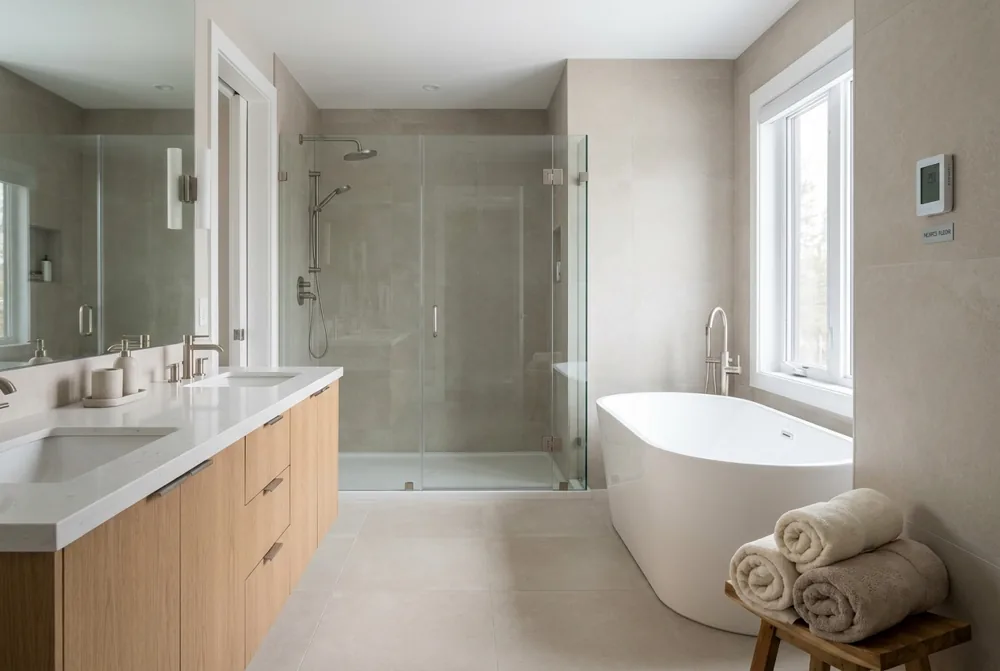
A primary-suite layout: freestanding tub, separate walk-in shower, and a double vanity with a quartz top.
Adding or Relocating a Bath in a Rowhome
Two questions come up constantly, and the answer to both is “yes, with planning”:
Can I add a new bathroom? Often, yes, a powder room under a stair, or a second-floor full bath carved out of an existing bedroom or hall, can genuinely change how a rowhome lives and what it’s worth. The driver is plumbing access: the closer we can tie into existing supply and drain stacks, the more affordable it is. A new bath far from the existing stacks means more rough-in and more cost. We scope the realistic options on the walkthrough.
Can I change the layout? Yes. Moving the vanity or shower is usually manageable. Moving the toilet is the pricey one because it relocates the drain, and in a pre-1970 Baltimore home that can mean cutting into cast-iron or galvanized lines that were on their last decade anyway. That’s not a reason to avoid it, just a reason to know the number going in. We price layout changes honestly rather than discovering them mid-job.
Remodeling an Older Bath with Tired Plumbing
A lot of Baltimore baths sit on top of original galvanized supply and cast-iron drain. Once we open the wall, we’ll show you what’s actually there. Galvanized supply that’s choking down your water pressure, or a cracked cast-iron drain, is best dealt with while the wall is already open, doing it now is a fraction of what it costs to come back later. We don’t tile over a known problem to hit a number; that’s exactly how a bathroom fails in five years. If we find it, we tell you, price the fix, and let you decide with full information.
Bathroom Remodel Timeline
A typical mid-level full bath at MBR takes 2 to 3 weeks start to finish. ADA conversions add 3 to 5 days for layout work. Primary suite remodels with custom tile and plumbing relocation run 4 to 6 weeks. We tell you the start date in writing and we hit it.
For a phase-by-phase breakdown, read our bathroom remodeling timeline guide.
Our Bathroom Remodeling Process
We follow the same five-step process on every job:
- Free walkthrough and estimate, we measure, check the panel, look at what’s behind the access panel if there is one, and write a real number on paper within 48 hours
- Material selection, we guide you through tile, vanity, fixtures within your budget
- Demo, protect the rest of the house, pull everything out, dumpster on site
- Build, our self-performing crew handles framing, waterproofing, tile, drywall, paint; licensed plumbing and electrical subs we have worked with for years
- Final walkthrough, punch list complete, you sign off, we leave you with care instructions
Get Your Free Bathroom Remodel Estimate
Ready for real numbers on your Baltimore bathroom? We provide free, no-obligation estimates with line-item pricing.
Request your free estimate or call (443) 602-9300. As a licensed Maryland contractor (MHIC #149066) and Google Guaranteed business, we stand behind every number we write.
For more on what we do, see our bathroom remodeling service page or our bathroom remodel landing page.
Common Questions
- How much does a bathroom remodel cost in Baltimore in 2026?
- A bathroom remodel in Baltimore costs between $6,000 and $40,000+ in 2026, depending on the type of bath, scope, and material selections. A powder room runs $6,000 to $9,000, a mid-level full bath runs $15,000 to $19,000 (the most common range), an ADA or aging-in-place bath runs $18,000 to $24,000, and a primary suite or high-end bath with custom tile and plumbing relocation can run $22,000 to $40,000 or more.
- How long does a bathroom remodel take in Baltimore?
- A standard mid-level full bath takes 2 to 3 weeks from demo to final walkthrough. Powder rooms can be done in under a week. Primary suite remodels with custom tile work and plumbing relocation typically take 4 to 6 weeks. Material lead times, especially custom vanities or specialty tile, are the most common factor affecting the schedule.
- Do I need a permit for bathroom remodeling in Baltimore?
- Yes, in most cases. Baltimore City and Baltimore County require permits for any work involving plumbing or electrical, which covers nearly every bathroom remodel beyond cosmetic refreshes. Permit fees typically run $200 to $600. At Monarch Bay Renovations, we pull and handle the entire permitting process on your behalf.
- Should I get a glass shower enclosure?
- Most of our clients do, and we recommend it. A standard frameless glass enclosure adds about $2,200 to a mid-level bath remodel. It opens the room up visually, eliminates curtain mildew, and lasts 15+ years with normal care. Custom configurations (corner showers, steam showers, oversized panels) cost more and require longer lead times.
- Does a bathroom remodel increase home value?
- Yes. A mid-range bathroom remodel typically recoups 55% to 70% of its cost at resale, and a complete primary suite remodel can recoup even more in competitive Baltimore neighborhoods. Beyond resale, an updated bathroom is one of the top features prospective buyers look for, and a single primary bath remodel often shortens the time a Baltimore home spends on the market.
- Tub or shower: which should I put in a Baltimore rowhome bath?
- If it's your only full bath, keep at least one tub in the house, because most buyers expect one and resale takes a hit without it. In a tight rowhome footprint, a single tub-shower combo usually makes the most sense. In a primary suite or a second full bath where you already have a tub elsewhere, a curbless walk-in shower feels larger, is easier to clean, and is the better long-term choice for aging in place. We'll tell you which way the layout and your resale picture point on the first walkthrough.
- How do I get more storage out of a small Baltimore bathroom?
- The best storage gains come from things we build in during the remodel, not bolt-on shelves afterward. A recessed tiled niche in the shower, a vanity with real drawers instead of a pedestal sink, a mirrored medicine cabinet recessed into the wall, and over-toilet shelving recover usable space without eating into a narrow footprint. A wall-mounted floating vanity also makes a small rowhome bath read larger because you see more of the floor.
- Can I move the toilet, sink, or shower to a new spot during my remodel?
- Yes, and homeowners do it all the time to make a cramped rowhome bath work better. Moving a sink or shower is usually straightforward. Moving the toilet is the expensive one, because it means relocating the drain, and in an older Baltimore home that can mean opening a cast-iron or galvanized line. Expect roughly $1,500 to $6,000 for plumbing relocation depending on how far things move and what we find behind the wall. We price the layout change honestly before you commit.