

Renovation Notes
Basement Finishing Cost in Baltimore: 2026 Pricing Guide
If you own a Baltimore rowhome and you are trying to figure out what it actually costs to finish your basement in 2026, here is the honest version: all-in for an underpinned, finished basement with one room plus a bath, you are looking at $45,000 to $65,000. That is the real Baltimore number. Not the national average. Not a retail estimator. What it costs to do it here without cutting corners.
If your basement already has 7 feet of headroom and a dry floor, you skip the underpinning and the all-in drops fast, usually $25K–$40K for a finished room, bath, and egress. If you are starting with 5’8” of headroom and a dirt floor with a sump, you are dig-down territory and the number lives in the $45K–$65K range or higher.
This guide breaks down every line item, what drives the number up and down, and what most Baltimore homeowners actually spend on basement finishing in 2026.
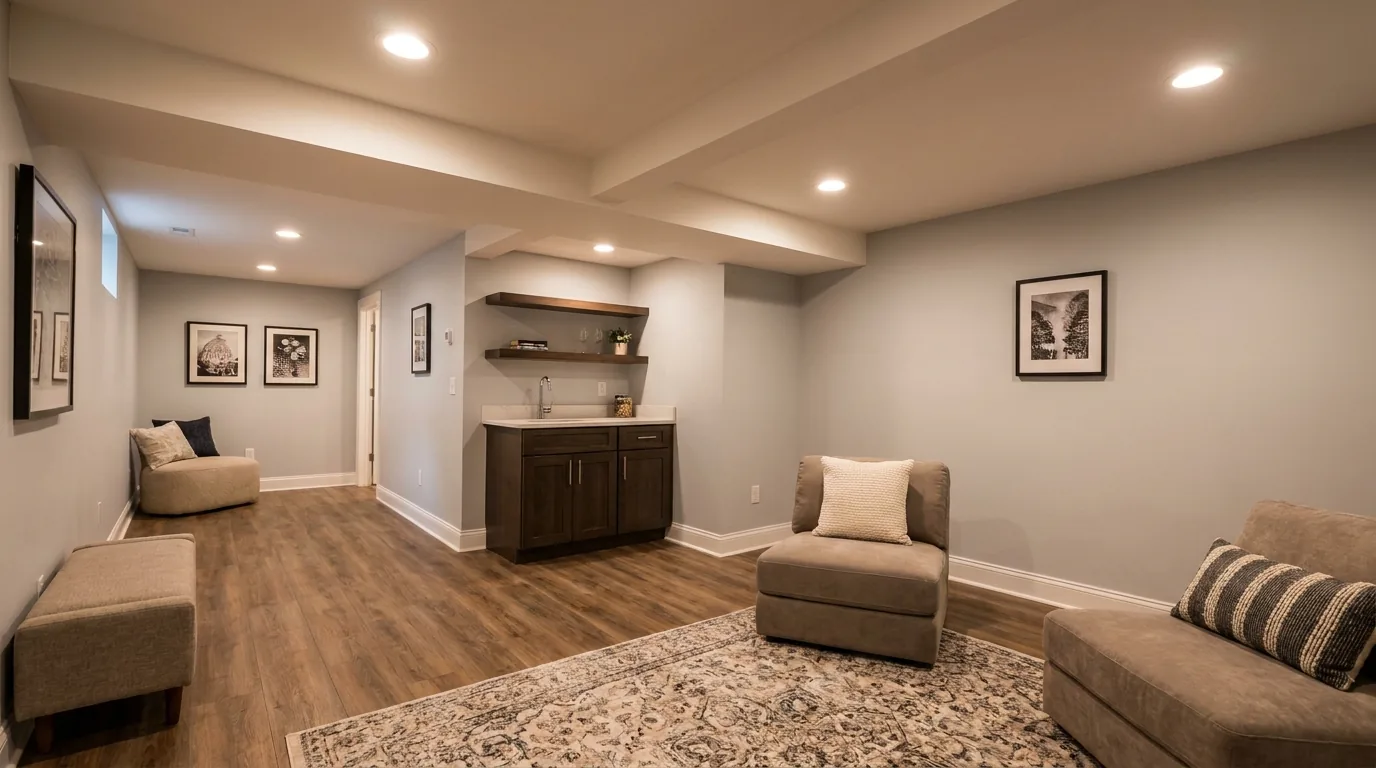
A finished Baltimore rowhome basement: recessed lighting, LVP flooring, and a built-in wet bar in what used to be a damp, low-ceiling storage cellar.
Average Basement Finishing Costs in Baltimore (2026)
Baltimore basements are not like basements in newer suburban construction. The classic rowhome basement is 6 feet of headroom, dirt floor, a sump, and a stone-and-mortar foundation that has been there since 1920. Finishing it requires more than drywall and paint.
Here is how the costs break down by scope.
Scope 1: Cosmetic Finish (Existing 7’+ Headroom): $15,000 – $25,000
If you already have 7 feet of headroom, a dry concrete floor, and no moisture problems, you can finish the room out without major structural work. Typical scope:
- Framing perimeter walls and any interior partitions
- Insulation (vapor barrier, batt or foam)
- Drywall, mud, sand, paint
- LVP flooring or carpet over subfloor
- Recessed lighting, outlets, switches
- Trim, baseboard, doors
- Egress if a bedroom is included (code-required)
This is the cheap path. It works for the minority of Baltimore rowhomes with usable headroom, but most do not have it.
Scope 2: Underpinning + Finished Room + Bath (Most Common): $45,000 – $65,000
This is the MBR sweet spot and the scope most Baltimore rowhome owners actually need. Here is what is in the number:
- Underpinning to roughly 7 feet of finished ceiling height, $20K–$30K
- Finished room (framed, insulated, drywalled, floored, painted), $8K–$12K
- Full basement bathroom (tiled, fixtured, ejector pump), ~$15K
- Egress window cut and installed where code requires, ~$5K
- Waterproofing and drainage as part of the underpin
- Permits and inspections
We have to underpin most Baltimore rowhomes because the original foundation was poured shallow. Underpinning is the process of digging down beside the existing foundation in sections, pouring new concrete underneath, and then excavating the basement floor down to the new level. It is slow, dirty, and the single biggest line item.
If you skip the bath, drop $15K. If you skip the egress, drop $5K. If you have an existing exterior basement entrance and don’t need a new egress cut, drop the $5K.
Scope 3: Full Basement Apartment / Rental Unit: $70,000 – $110,000+
If you are converting your basement to a legal rental unit (we have a full guide on whether you can convert a Baltimore basement to a rental), the scope jumps significantly. You need:
- Underpinning to full code headroom (often 7’6”+)
- Separate entrance (existing exterior or new bilco/walk-up cut)
- Full kitchen or kitchenette
- Full bathroom
- Sleeping area with egress window
- Separate HVAC zone or dedicated mini-split
- Sound-attenuated ceiling between units
- Separate electrical sub-panel (sometimes)
- Zoning approval and proper permits
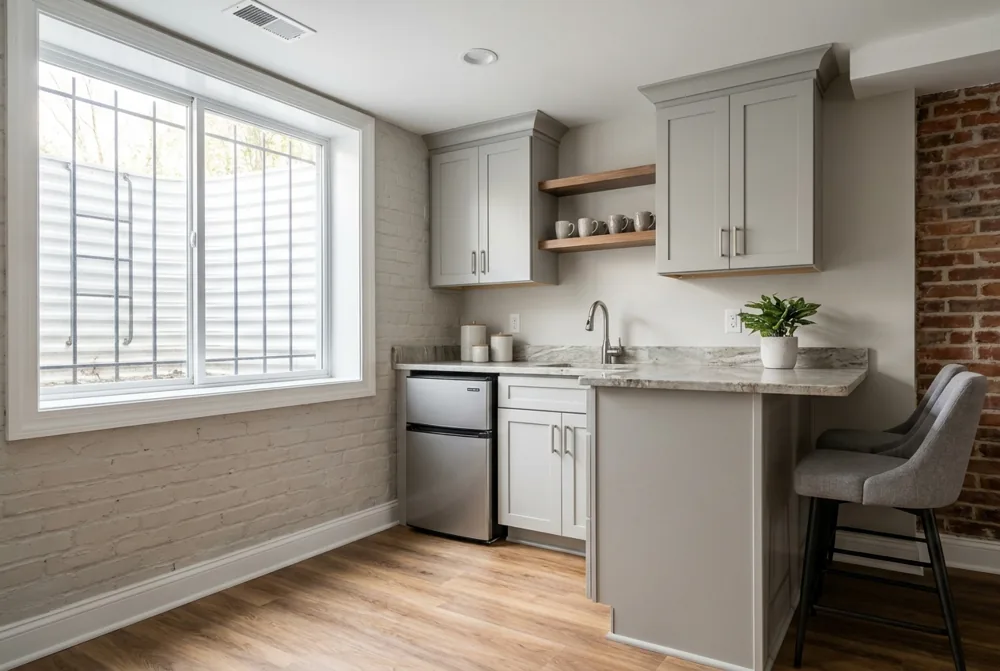
A basement in-law suite or rental kitchenette with a code-required egress window. In Baltimore, a separate entrance plus egress is what makes the space legally rentable, not just finished.
These are 4 to 6 month projects and they often involve coordination with Baltimore City zoning. Numbers above $110K are not unusual on these.
Is a basement apartment worth it in Baltimore? For investors and house-hackers, often yes. A legal basement unit in a desirable neighborhood, Canton, Hampden, Federal Hill, Patterson Park, can rent for $1,100-$1,600/month, which covers a big chunk of a mortgage and adds resale value. The catch is the word legal. An unpermitted basement apartment is a liability: it can’t be insured properly, it tanks an appraisal, and Baltimore City can order it vacated. If the rental income is the whole point, do it permitted or don’t do it. We pull the zoning and rental-unit permits as part of the scope.
What Drives Basement Finishing Costs in Baltimore
Five things move the number more than anything else: headroom, moisture, the foundation, the plumbing situation, and whether you need an egress cut.
Underpinning: $20,000 – $30,000 (When You Need It)
This is the biggest single variable. If your existing headroom is under 6’8”, you almost certainly need to underpin to get to a usable finished height. The cost depends on the length of foundation we are excavating, the soil conditions, and whether we hit anything unexpected (old footings, buried utilities, water).
Underpinning is not optional if you want a code-compliant finished basement with reasonable headroom. You can sometimes get a permit for a “low-headroom finish” but it kills the resale story and most homeowners regret it.
Egress Windows: $4,000 – $6,000 Each
If your finished basement includes a bedroom, or sometimes any habitable room, Baltimore code requires an egress window. That means cutting through the foundation wall, installing a window well, and setting a fire-rated window. Cost varies based on whether you are cutting through stone-and-mortar foundation (slower) or poured concrete (faster).
Basement Bathroom: ~$15,000
A basement bath is almost always more expensive than an upstairs bath because the drain has to go up, not down. That means an ejector pump, which adds $1,500–$2,500 to the plumbing line. Otherwise the scope is similar to a mid-level full bath upstairs, tile, vanity, toilet, shower, GFCI, exhaust, drywall, paint.
Waterproofing and Drainage
This is non-negotiable in Baltimore. If your basement is actively wet, we will not finish it until the water problem is fixed. Interior French drain plus sump pump runs $4K–$8K. Exterior waterproofing is more expensive but more durable. We discuss the options on the first visit and price them in.
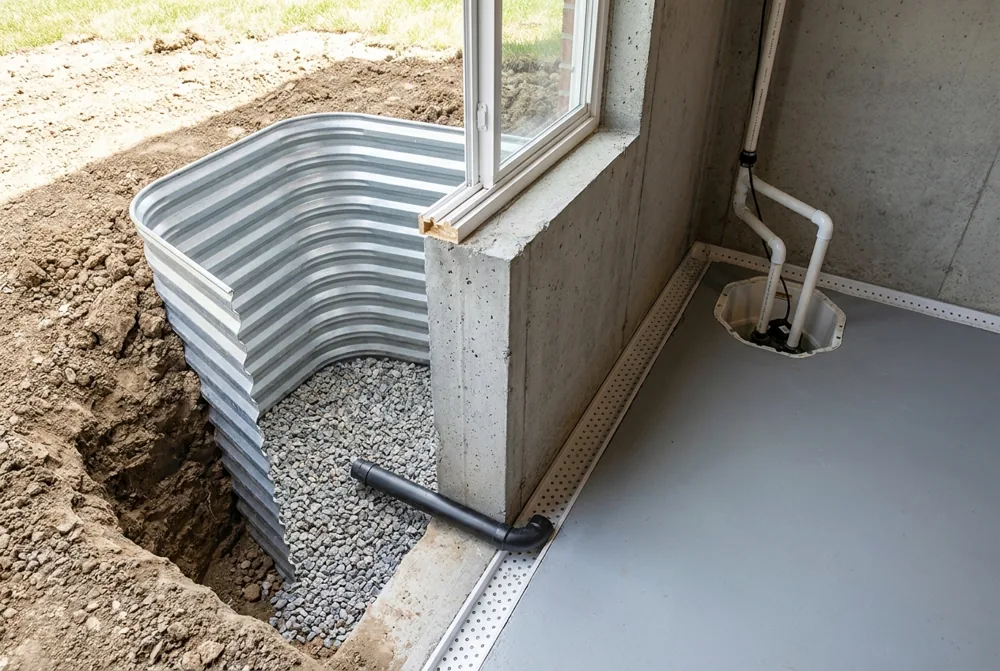
Two Baltimore basement essentials in one shot: an egress window with a window well, and an interior drainage channel feeding a sump pump. Water management and a code egress are where below-grade rowhome budgets live or die.
Baltimore’s high water table and clay soil mean below-grade water is the rule, not the exception. The order matters: we fix bulk water (drainage and sump) before sealing anything, because trapping moisture behind a new vapor barrier or rigid-foam wall is how a beautifully finished basement turns into a mold problem in its first wet spring. A working sump with a battery backup is cheap insurance against a single bad summer storm that would otherwise flood a $50,000 finish.
Baltimore-Specific Cost Factors
- Stone foundations, common in pre-1920 rowhomes; harder to underpin than poured concrete
- Shared party walls, underpinning a rowhome means coordinating with neighbors and being careful not to undermine the adjacent unit
- Tight access, most Baltimore basements have one narrow stair down and no exterior entrance; getting equipment and material in/out adds labor time
- Old plumbing stacks, cast-iron drain stacks often need partial replacement once we are working at the basement level
- Permits, Baltimore City requires permits for underpinning, structural, plumbing, electrical, and egress; we pull and manage all of them
Beyond the Big Numbers: Getting the Build-Out Right
Once the structural money, underpinning, drainage, egress, is spent, the difference between a basement you love and one that feels like a finished cave comes down to four things: insulation, ventilation, lighting, and how the space is laid out. These don’t move the headline price much, but they decide whether the room is actually comfortable year-round.
Insulation: Rigid Foam on the Walls, Not Fiberglass
This is the single most common mistake we fix in Baltimore basements. Fiberglass batts pressed against a cold masonry foundation wall trap moisture, lose their R-value when damp, and feed mold. The right approach below grade is rigid foam board (or closed-cell spray foam) directly against the foundation, which acts as both insulation and a vapor barrier, then framing and any additional batt insulation inboard of that. Foundation-wall insulation in the R-10 to R-15 range is typical. Insulating the rim joist, the gap where the floor framing meets the foundation up top, is a cheap, high-impact detail most DIYers skip and it’s a major source of cold drafts. Budget roughly $1,500–$4,000 for a properly insulated basement depending on size and method.
Ventilation and Humidity: The Part That Keeps It Healthy
A finished basement is a sealed-up box below grade, so it needs a deliberate air strategy or it gets stuffy and damp. Three workable approaches in Baltimore:
- Tie into the home’s HVAC with a supply and a return run into the basement, the simplest path when the furnace is already down there.
- A dedicated mini-split, which handles both heating and cooling and is the go-to for basement apartments that need their own zone.
- A dedicated dehumidifier, often non-negotiable in Baltimore regardless of the heating choice. Keeping relative humidity under 50% is what actually prevents mold; air conditioning alone won’t get you there in a humid Mid-Atlantic summer.
Any bathroom gets its own exhaust fan vented to the outside, never just into the joist bay.
Lighting: Recessed LED Is Doing the Heavy Lifting
Basements have little or no natural light, so lighting is what makes the space feel like a real room instead of a cellar. Low ceilings rule out hanging fixtures in most of the space, which makes recessed LED can lights the default in Baltimore basements, they don’t eat any of your hard-won headroom. Plan for layered light: general recessed lighting on a dimmer, plus task lighting over a bar or workspace and a bit of accent or wall lighting to add warmth. Egress and any larger windows we can fit are worth chasing not just for code but for the daylight. A typical recessed-lighting package runs $1,500–$3,500 installed depending on the number of cans and circuits.
Layout, Ceiling Height, and What People Actually Build
The most popular Baltimore basement build-outs are, in rough order: a family room or rec room, a guest bedroom (which triggers the egress requirement), a home office, a home gym, a media or theater room, and the full apartment or in-law suite. Open-plan layouts read bigger and feel less boxed-in, which matters more down here than upstairs. Because every inch of headroom counts, we keep ductwork tight, use low-profile trim, and run a drop ceiling only where access to plumbing or wiring genuinely requires it, otherwise drywall to the joists buys you a couple of inches.
Should You DIY Any of It?
Honest answer: the finish-out, yes; the structure and mechanicals, no. If your basement already has dry, code-height headroom, a handy homeowner can frame partitions, hang drywall, lay LVP, and paint and save real money. But underpinning sits next to a shared rowhome party wall, egress cuts go through stone-and-mortar foundation, and basement plumbing needs an ejector pump and an inspection, get any of those wrong and you’ve got a failed inspection, a flooded floor, or an undermined foundation. The common Baltimore split is to let a licensed contractor pull and execute the structural, drainage, plumbing, and electrical scope under permit, then DIY the cosmetic layer if you’ve got the time and the skills.
What’s Included in Our Standard Basement Quote
A typical underpinned-finished-with-bath estimate from MBR includes:
- Underpinning (sectional, to ~7’ headroom)
- New concrete floor slab with vapor barrier
- Interior drainage and sump (if needed)
- Framing all walls, soffits, ceiling chases
- Insulation (rigid foam on foundation walls, batt on partitions)
- Drywall, mud, sand, paint
- Flooring (LVP standard, carpet on request)
- Egress window cut and install (where required)
- Full basement bath (tile, fixtures, ejector pump)
- Electrical (outlets, lighting, sub-panel if needed)
- HVAC tie-in or dedicated mini-split
- Trim, baseboard, doors
- Permits and all inspections
Basement Finishing Timeline
A standard underpin-plus-finish-plus-bath project runs 4 to 7 weeks at MBR. Underpinning alone takes 2–3 weeks because it is done in sections. The finish-out phase adds another 2–4 weeks. Egress cut adds 2–3 days. Permits typically add 1–2 weeks on the front end before we can swing a hammer.
Full basement apartments run 4 to 6 months including zoning review.
Our Basement Finishing Process
- Walkthrough and headroom measurement, we measure floor-to-joist before quoting because it drives everything
- Moisture and foundation assessment, we check the sump, the foundation walls, the stack, and any visible water issues
- Written estimate, line-item breakdown within 48 hours, with options for skipping the bath or egress if budget is tight
- Permits, we pull underpinning, structural, plumbing, electrical, and egress permits
- Build, underpinning first, then floor pour, then framing, then mechanicals, then finishes
- Final inspection and walkthrough, city signs off, you sign off, you get care instructions
Get Your Free Basement Finishing Estimate
Ready for real numbers on your Baltimore basement? Every basement is different, your number depends on existing headroom, moisture conditions, and scope. We come measure before we quote.
Request your free estimate or call (443) 602-9300. Licensed Maryland contractor (MHIC #149066), Google Guaranteed, EPA Lead-Safe certified.
For more on what we do, see our Baltimore basement finishing page and the basement service page. If your scope goes beyond the basement and into a full gut rehab, the 2026 Baltimore full rehab cost guide covers the whole-home numbers.
Common Questions
- How much does it cost to finish a basement in Baltimore in 2026?
- Basement finishing in Baltimore costs between $15,000 and $110,000+ in 2026 depending on scope. The most common scenario, underpinning to get usable headroom, plus one finished room, plus a full basement bathroom, plus an egress window, runs $45,000 to $65,000 all-in. If you already have 7+ feet of headroom and just need to finish the space, expect $15,000 to $25,000. A full basement apartment with kitchen and separate entrance can run $70,000 to $110,000 or more.
- Do I need to underpin my Baltimore basement?
- Most Baltimore rowhomes built before 1950 have basement headroom of 5'8" to 6'6", which is below the code minimum for habitable space. Underpinning, digging down beside the foundation in sections and pouring new concrete underneath, is the standard way to get to 7 feet of finished ceiling height. Underpinning typically costs $20,000 to $30,000 depending on the length of foundation and soil conditions. If you already have 7+ feet, you can skip it.
- How long does basement finishing take in Baltimore?
- A standard underpin-plus-finished-room-plus-bath project takes 4 to 7 weeks of active construction, plus 1–2 weeks of permit time on the front end. Underpinning takes 2–3 weeks on its own because it is done in sections. Full basement apartment conversions run 4 to 6 months including zoning review.
- Do I need a permit to finish my basement in Baltimore?
- Yes. Baltimore City requires permits for underpinning, structural work, plumbing, electrical, and egress windows, which covers nearly every basement finishing project. Permit fees typically range from $500 to $1,500 depending on scope. At Monarch Bay Renovations, we pull and manage all permits, including any zoning approval required for legal rental units.
- What if my basement is actively wet?
- We will not finish a basement that has active moisture problems, it will fail. We address the water first: French drain and sump for interior drainage ($4,000–$8,000), exterior waterproofing if the problem is exterior infiltration, or grading changes outside the foundation. Once the basement is dry and stays dry through a wet season, we can finish it. The fix is part of the estimate when we walk the space.
- Can I finish my Baltimore basement myself, or do I need a contractor?
- Cosmetic work, painting, trim, even some framing, is DIY-able if you already have 7 feet of dry, code-height headroom. But the parts that make a Baltimore rowhome basement livable are not: underpinning is structural work next to a shared party wall, egress cuts go through stone-and-mortar foundation, and basement plumbing needs an ejector pump and a permit. Get those wrong and you have failed inspections, a wet floor, or worse, an undermined foundation. Most Baltimore basements need at least the structural and mechanical scope pulled and permitted by a licensed contractor; the finish-out is where DIY can save real money.
- What is the minimum ceiling height for a finished basement in Baltimore?
- Baltimore follows the IRC: habitable basement space needs 7 feet of finished ceiling height (6'8" is allowed under beams, ducts, and girders). Most pre-1950 rowhomes start at 5'8" to 6'6", which is why underpinning is so common here. Measure floor-to-joist before you budget, because that one number decides whether you are in the $15K-$25K cosmetic range or the $45K-$65K underpin range.
- How do I keep a finished Baltimore basement from getting moldy?
- Below-grade basements are humid, so mold control is mechanical, not cosmetic. The stack that works in Baltimore: fix bulk water first (drainage and sump), seal the slab and foundation with a vapor barrier, insulate the foundation walls with rigid foam instead of fiberglass against the masonry, run mechanical ventilation or tie the space into the home's HVAC with a return, and keep relative humidity under 50% with a dedicated basement dehumidifier. Skip any one of these and you are growing mold behind new drywall within a year.