

Renovation Notes
A Homeowner's Guide to Baltimore Rowhouse Styles
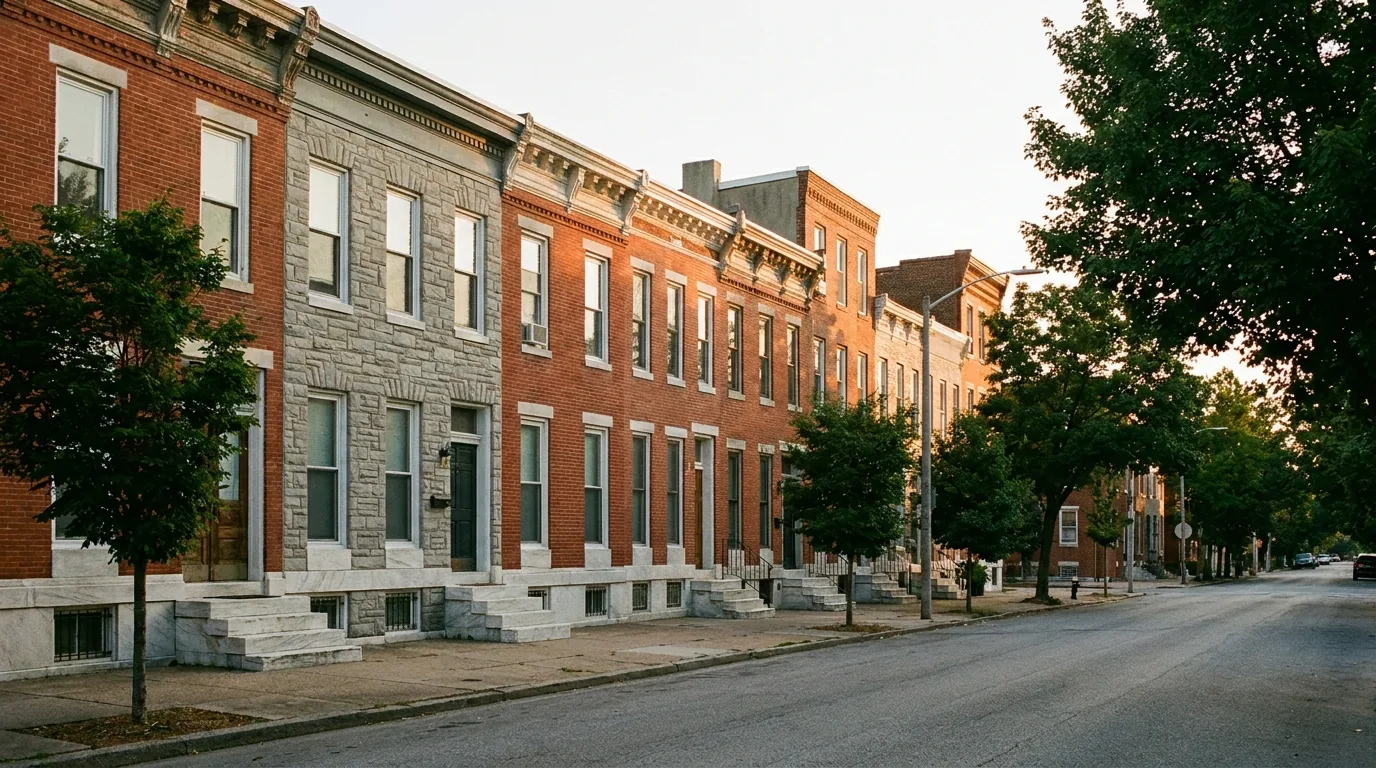
Baltimore has more rowhouses than almost any city in America, and they are not all the same house. Walk a single block in Canton, Hampden, or Charles Village and you can pass four or five genuinely different building types, each from a different decade, each built for a different budget, each hiding a different set of surprises behind the plaster. Knowing which one you own is the first real step in renovating it well.
This is a homeowner’s field guide to the major Baltimore rowhouse styles, and, just as importantly, what each one means when you decide to renovate. We wrote our complete guide to renovating a Baltimore rowhome to cover the systems, permits, and costs that apply across all of them. This page goes deeper on one question that comes before all of that: what style is my house, and what does that tell me about the project ahead? At Monarch Bay Renovations we have renovated rowhouses of every era across Baltimore City, and the style on the front almost always predicts the work behind the walls. We are a licensed Maryland home improvement contractor (MHIC #149066) and a Google Guaranteed business.
A single Baltimore block often mixes several rowhouse eras: brick and formstone facades, marble steps, and flat roofs, each renovating differently.
Why Style Equals Strategy
Before the styles themselves, here is the core idea that makes this guide useful rather than just pretty: the era of your rowhouse predicts the systems inside it.
A house built in 1840 and a house built in 1925 are different not only in how they look but in what they were wired and plumbed with, how the rooms are arranged, how tall the ceilings are, and how much of the original fabric is still buried in the walls. When we walk a rowhouse for the first time, the front facade and the floor plan tell us, before we open a single wall, roughly what we are likely to find: whether to expect knob-and-tube wiring, galvanized supply lines, plaster-and-lath, lead paint, or a flat roof at the end of its life. Style is the first honest signal of cost and scope.
So as you read, keep one eye on the architecture and one eye on the renovation note attached to each type. That pairing is the whole point.
The Five Big Families of Baltimore Rowhouse
Architectural historians generally sort Baltimore rowhouses into five broad families that map roughly onto eras: Federal, Italianate, Artistic (the expressive late-Victorian houses, including swell-fronts and porch-fronts), Daylight, and Postwar. Layered across several of these is the city’s most famous renovation wildcard, formstone, which is a cladding, not a house type, and can appear over almost any older row. Let’s walk through them in order.
Federal and the Early Alley House (roughly 1790-1850)
The oldest rowhouses, the ones in Fells Point, Federal Hill, Jonestown, and the old West Side, are Federal style. They are tall, brick, and stately but plain, typically two-and-a-half stories with a pitched roof rather than the flat roof most people picture, and usually 12 to 16 feet wide. Builders followed a strict pecking order: large, fine Federal houses on the main streets, smaller versions on the side streets, and the tiniest of all, the alley houses, packed onto the inner-block alleys with names like Strawberry Alley. Alley houses were often just 11 to 12 feet wide and two rooms deep, the cheapest housing in the city.
This is also the era of Baltimore’s two famous quirks: shared party walls between every house, and ground rent, the old arrangement where you owned the house but leased the land beneath it.
What it means for renovating. These are the houses with the most original fabric still in place, which is both their charm and their cost. Expect to find knob-and-tube wiring, galvanized steel and even older plumbing, plaster-and-lath walls, low ceilings on the upper floors, and, because anything pre-1978 is presumed to contain it, lead paint. Many early facades used soft, porous “salmon brick” that needed regular painting, which is exactly why so many of these houses were later clad in formstone. A Federal alley house can be a wonderful renovation, but price it as a house where almost every system may need to be touched.
Italianate: Baltimore’s Most Common Rowhouse (roughly 1850-1900)
If you picture a “typical” Baltimore rowhouse, brick, three stories, with a tall decorative cornice along the roofline and tall, narrow windows, you are picturing an Italianate. This is the most common type in the city, and the post-Civil-War building boom threw up thousands of them in Highlandtown, Locust Point, Patterson Park, Canton, and across the east and southeast. Compared with the reserved Federal style, Italianate rows read as more connected and more ornate: projecting bracketed cornices (often pressed metal), heavy projecting window lintels, and frequently cast-iron details. This era also moved decisively to the flat roof and to harder, machine-made pressed brick with thin mortar joints.
What it means for renovating. Italianate houses usually have taller ceilings than the Federal era (a real advantage for open-concept layouts and for hiding modern ductwork or a dropped soffit). You are still very likely to meet plaster, aging wiring, and galvanized plumbing, but the bones are a notch newer than a 1840 house. The decorative cornice and any cast iron are character features worth preserving and repairing rather than stripping, and if the house is in a historic district, that cornice is exactly the kind of street-facing detail CHAP will ask you to keep.
The Artistic Era: Swell-Fronts, Bay-Fronts, and Porch-Fronts (roughly 1870-1915)
As the city grew more prosperous and builders competed for buyers, rowhouses got expressive. Historians call this the Artistic period, and it produced the most photogenic streets in Baltimore: swell-front (or bay-front) houses with rounded, curved brick facades that bow outward; porch-front rows with covered front porches, some still painted in cheerful colors; and large, decorated houses with second-story bay windows, stained-glass transoms, stamped-metal cornices, decorative brickwork, and cupolas. You see these in Bolton Hill, Charles Village, Butcher’s Hill, Reservoir Hill, Union Square, and the grander parts of Patterson Park and Hampden. Some builders swelled the fronts partly to break the monotony of a long block and partly to give the front parlor a little extra room.
What it means for renovating. Inside, these houses renovate much like other 19th-century rows, plaster, tall ceilings, old systems, but the exterior detail is where the money and the rules live. The curved glass of a true swell-front is custom window work, not a stock size, and matching a bay or a decorative cornice on a historic block can mean custom fabrication. Our window replacement guide covers what that means for cost and for CHAP approval. The porch on a porch-front row is also a maintenance item in its own right: posts, decking, and roof that live outdoors and need periodic attention.
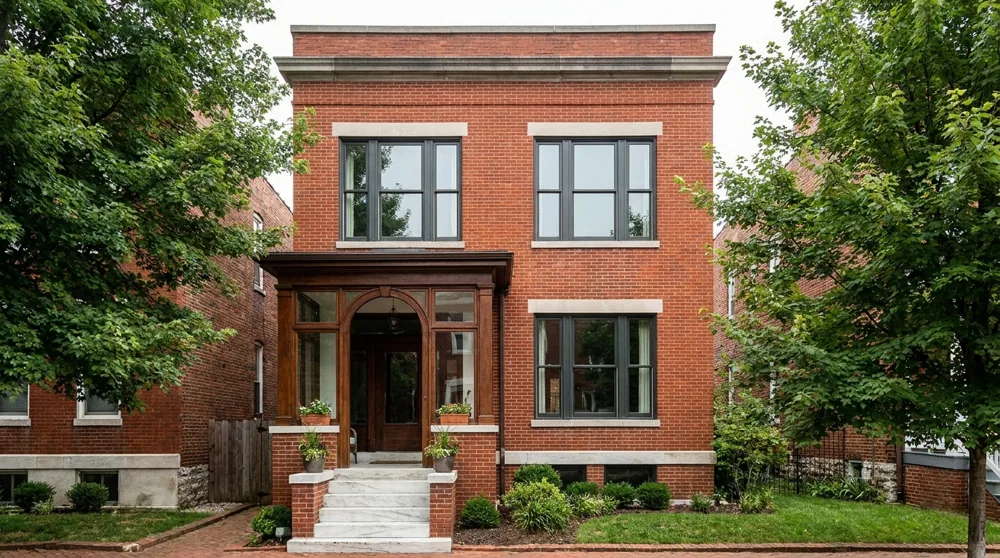
The daylight rowhouse widened the house to about 20-21 feet so every room got a window, the layout that renovates most easily into an open, modern main floor.
The Daylight Rowhouse: The Renovator’s Favorite (1915 onward)
Around 1915, the rowhouse faced a competitor: the suburbs, with their detached houses, yards, and garages. Baltimore builders answered with one of the smartest housing designs the city ever produced, the daylight rowhouse. The problem with older rows was the dark, airless middle room in a house that was one room wide and three rooms deep. The fix was to widen the house from the old 12-to-16-foot footprint to about 20 or 21 feet and switch to a roughly square two-room-wide by two-room-deep (“2x2”) plan, often with skylights over the central stair and hall. The result lived up to its name: a window in nearly every room, light and air all the way through, at a price middle-income families could afford. You find them in Waverly, Remington, Greater Govans, Northwood, and across the streetcar suburbs.
What it means for renovating. This is the easiest of the classic rowhouses to modernize, and the extra width is the reason. There is finally room for a proper kitchen island, a comfortable open-concept main floor, and modern systems without fighting a skinny footprint. Just as important, many daylight rowhouses were built with radiator heat and indoor plumbing from day one, so the systems are often a generation newer than in a 19th-century house, though by 2026 the original wiring and galvanized supply are still usually due for replacement. If you want to open up the first floor, the wider daylight plan gives a beam more to work with; our open-concept wall removal guide walks through the structure and permits.
Postwar Rowhouses (roughly 1945-1960)
After World War II, the rowhouse got wider, shallower, and plainer still, the last gasp of the form before suburban development took over for good. These houses, found in places like Belair-Edison, Lauraville, Pimlico, and Westgate, kept the daylight idea of windows throughout but dropped most of the decorative flourish. Many are brick-faced or use mixed materials and sit on slightly more generous lots.
What it means for renovating. Postwar rows are typically the most straightforward to renovate: newer systems, often some original drywall rather than plaster, simpler rooflines, and layouts already closer to modern living. They reward cosmetic-to-mid-level updates, kitchens, baths, flooring, and a refreshed exterior, more than gut rehabs. They are also the least likely to fall inside a historic district, which simplifies the permit path.
Formstone: The Cladding That Hides the Style Underneath
No discussion of Baltimore rowhouse “styles” is complete without formstone, even though it is technically a coating rather than a building type. Patented in 1937 by Albert Knight, formstone is a cementitious faux-stone skin troweled over brick and scored to imitate cut stone. It was sold as permanent, waterproof, and maintenance-free, and Baltimoreans embraced it so thoroughly that filmmaker John Waters called it “the polyester of brick.” It can sit over a Federal alley house, an Italianate, or an Artistic-era row, which is exactly why it complicates style identification: the real house is underneath.
What it means for renovating. A lot of formstone went over soft salmon brick that was already failing, and it genuinely sheltered that brick for decades. Removing it is keyed into the brick with wire lath and deep scoring, so it frequently chips and scars the face beneath, and it earned a reputation for trapping moisture against the wall. The honest approach is always the same: open a test patch first. If the brick beneath is sound and handsome, removal and repointing can restore a beautiful original facade (and is often encouraged in historic districts). If the brick is poor, keeping sound formstone, or finishing with stucco or quality masonry paint, may be the smarter, cheaper call. Anyone who promises to “just rip the formstone off” without a test section does not understand the material.
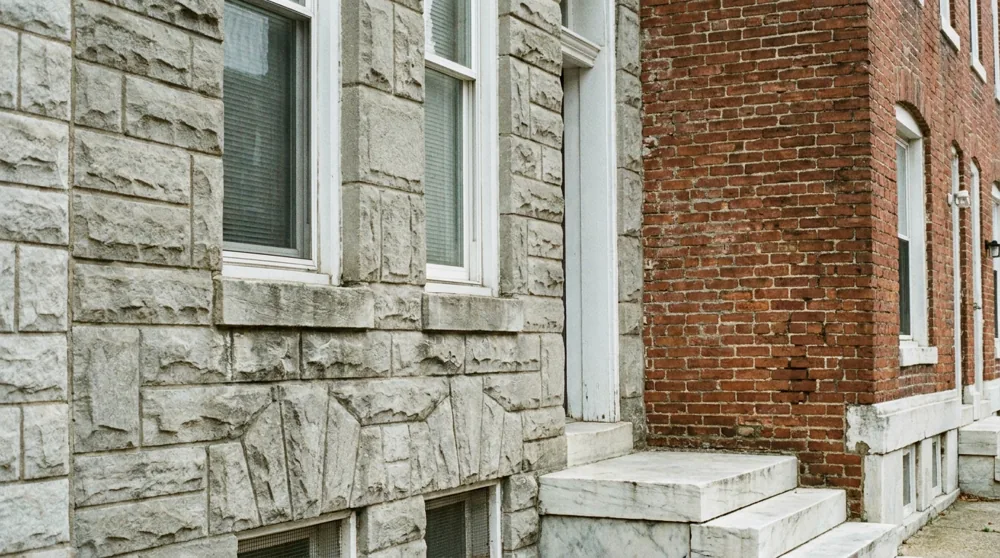
Formstone, patented in 1937, was troweled over brick across every rowhouse era, the house underneath could be Federal, Italianate, or Artistic.
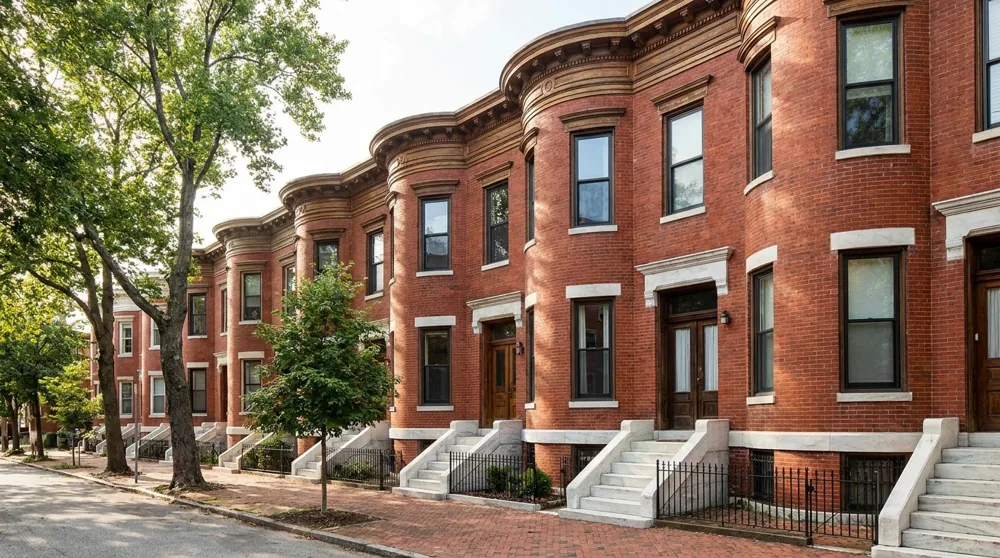
Swell-front rows bow outward in curved brick. The look is gorgeous, but curved windows and cornices are custom work in any renovation.
A Quick Field Guide: Naming Your House
Standing on the sidewalk, you can usually narrow it down in under a minute. Use this as a cheat sheet:
| Clue | What it suggests |
|---|---|
| Narrow (12-16 ft), pitched roof, plain trim | Federal / early alley house (pre-1850) |
| Three stories, tall bracketed cornice, tall narrow windows, flat roof | Italianate (1850-1900), the most common type |
| Rounded curved brick front | Swell-front / bay-front (Artistic, 1870-1915) |
| Covered front porch, decorative brick, bay windows, stained glass | Porch-front / Artistic (1870-1915) |
| Wide (20-21 ft), a window in every room, often an enclosed porch | Daylight rowhouse (1915+) |
| Wide, shallow, plain, mixed materials, slightly bigger lot | Postwar (1945-1960) |
| Grey, stone-look cement skin scored into blocks | Formstone cladding (1937+) over an older house |
Two refinements help when the facade is ambiguous. First, width is the single most reliable tell: the jump from roughly 16 feet to roughly 20-21 feet is the line between the 19th-century house and the daylight era. Second, the brick itself dates the house: soft, often-painted salmon brick points to a pre-1850 origin, while harder pressed brick with thin mortar joints points to the 1850s and later. And remember the Baltimore icon tying nearly all of them together, the white Cockeysville marble front steps, roughly 60% of which came from the Beaver Dam quarry in Baltimore County before it closed in 1934.
How Each Style Translates Into a Renovation Budget
Once you know your style, you can set realistic expectations, because style is a proxy for how much of the house is original. The biggest cost driver in any rowhouse renovation is not the finishes you can see; it is how much of the electrical, plumbing, and structure has to be replaced versus reused.
- The older the house, the more systems you touch. A Federal alley house or an early Italianate is most likely to hide knob-and-tube wiring, galvanized supply, and undersized 60- or 100-amp panels, the kind of finds that turn a refresh into a rewire-and-replumb.
- The wider the house, the easier the modern layout. A daylight or postwar row gives you room for an island, an open main floor, and ductwork without contortions.
- The more decorative the exterior, the more the front facade drives cost and rules. Swell-fronts, porch-fronts, and ornate Italianate cornices carry custom window and masonry work, and they are the details CHAP cares about in a historic district.
For real 2026 numbers by project, our cost guides break it down: a mid-level Baltimore kitchen runs $19,000 to $35,000, opening up the first floor is covered in our open-concept wall removal guide, windows are detailed in the window replacement guide, and a top-to-bottom gut of a vacant or distressed row is laid out in our full rehab cost guide. The single best thing you can do before signing anything is to have a contractor who knows these houses open a few test sections so the estimate reflects your actual house, not a guess.
The Historic-District Overlay
One last point that cuts across every style: whether you need CHAP approval depends on where the house sits, not what style it is. Baltimore’s local historic districts, Fells Point, Federal Hill, Mount Vernon, Bolton Hill, Union Square, Canton, parts of Charles Village, and many more, put exterior changes under the review of the Commission for Historical and Architectural Preservation. Because the most distinctive styles cluster in exactly those districts, style and historic review tend to travel together in practice. The rule to remember is that approval comes before the building permit, so any work on windows, doors, cornices, steps, roofing, or formstone visible from the street belongs at the front of your timeline. The upside: approved historic rehab can qualify for the 20% Maryland Historic Revitalization Tax Credit, which is real money worth planning around.
Your Style, Your Next Step
Whatever you own, a plain Federal alley house in Fells Point, a bracketed Italianate in Canton, a curved swell-front in Charles Village, a light-filled daylight rowhouse in Waverly, or a formstone-clad mystery whose real face is still underneath, the style tells you where to start. The next step is turning that read into a plan and a real number.
At Monarch Bay Renovations we renovate rowhouses of every era across Baltimore, and we will tell you honestly what your specific house needs, what is worth preserving, and what it will cost, no sales pitch. We are licensed (MHIC #149066), Google Guaranteed, and we handle the permits, the CHAP review, and the lead-safe work.
Get started: request a free estimate, contact us, or call (443) 602-9300. Tell us your neighborhood and your house, and we will help you read it, and renovate it, right. For the full systems-and-cost picture across all of these styles, start with our complete guide to renovating a Baltimore rowhome.
Sources: Baltimore Heritage, Anatomy of a Rowhouse; Baltimore Magazine, Anatomy of a Baltimore Rowhome; Neighborhoods.com, A Guide to Baltimore Rowhouses; The Baltimore Chop, A Reference Guide to Baltimore Rowhouse Types; McMansion Hell, Rowhouses: Urban Living at its Best by Jackson Gilman-Forlini.
Common Questions
- How do I tell what style my Baltimore rowhouse is?
- Start with three clues: width, roofline, and front facade. A narrow house (12-16 feet wide) with a pitched roof and plain trim is usually an early Federal or alley house. A three-story house with a tall, bracketed cornice and tall narrow windows is Italianate, the city's most common type. A wide house (20-21 feet) where every room has a window, often with a front porch and built-in radiator heat, is a daylight rowhouse from after 1915. A rounded, curved brick front is a swell-front. And a grey, stone-look cement skin troweled over the brick is formstone, applied from the late 1930s onward over an older house underneath.
- Does my rowhouse style change how much it costs to renovate?
- Yes, significantly. The era of the house predicts the systems you will have to touch. An older, narrow Federal or alley house almost always hides knob-and-tube wiring, galvanized plumbing, plaster-and-lath walls, and lead paint, so it carries more hidden cost. A 1920s daylight rowhouse is wider, was often built with radiator heat and indoor plumbing from day one, and is easier to lay out a modern kitchen in. The style is your first honest signal of how much of the house is original versus how much was already modernized.
- What is a daylight rowhouse and why does it renovate so well?
- The daylight rowhouse appeared around 1915 when Baltimore builders widened the house from the old 12-to-16-foot footprint to about 20 or 21 feet and switched to a two-room-wide by two-room-deep plan so every room got a window. That extra width is a gift in a renovation: there is finally room for a real kitchen island, a comfortable open-concept main floor, and modern systems. Many daylight rowhouses also came with radiator heat and indoor plumbing originally, so the bones tend to be newer than in a 19th-century row.
- Should I remove the formstone from my rowhouse?
- Only after you open a test patch and see what is underneath. Formstone was troweled over brick starting in the late 1930s, often over soft salmon brick that was already failing. Removing it usually scars the brick and means repointing, patching, or a new finish. If the brick beneath is sound and handsome, removal can restore a beautiful original facade and is often encouraged in historic districts. If the brick is poor, keeping sound formstone or finishing with stucco may be the smarter call. Never let a contractor quote a flat 'rip the formstone off' without a test section first.
- Are older or rounded swell-front rowhouses harder to renovate?
- The swell-front (the rounded, curved brick bay on the front of many Charles Village, Bolton Hill, and Patterson Park rows) is mostly an exterior feature, so it rarely complicates the interior gut itself. Where it matters is window replacement and any masonry repair: curved openings and curved sash are custom work, not stock sizes, and in a historic district CHAP will care how the front reads from the street. Inside, these Artistic-era houses (1870-1915) renovate like other 19th-century rows, expect plaster, old wiring, and tall ceilings.
- Does my rowhouse style affect whether I need historic (CHAP) approval?
- The style does not trigger CHAP, the location does. If your house sits in a Baltimore local historic district (Fells Point, Federal Hill, Mount Vernon, Bolton Hill, Union Square, Canton, parts of Charles Village, and others), CHAP reviews changes to the exterior regardless of architectural style, including windows, doors, cornices, steps, roofing visible from the street, and formstone removal. Many of the most distinctive styles, Federal, Italianate, and swell-front, cluster in exactly those districts, so style and historic review often go together in practice. Approval comes before the permit, so plan it early.