

Renovation Notes
The Iconic Details of a Baltimore Rowhome: Marble Steps, Painted Screens & Brick
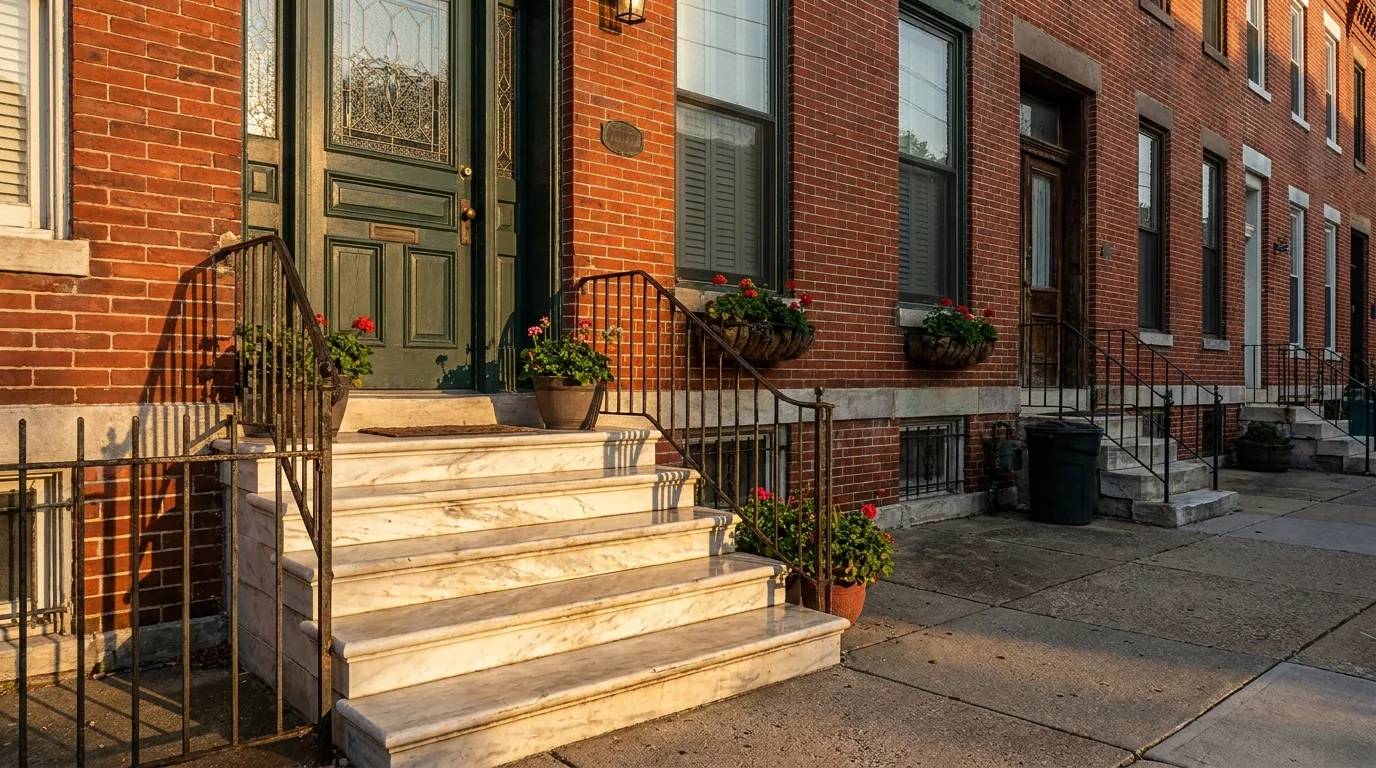
There is a reason you can recognize a Baltimore rowhome in a single photograph, even with no skyline behind it. It is not just the long unbroken rows or the flat roofs. It is the details: a set of gleaming white marble steps scrubbed bright on a Saturday morning, a window screen hand-painted with a little red-roofed bungalow, an ornate brick cornice crowning the roofline. These are not generic features you find in every American city. They are specifically, unmistakably Baltimore, and they tell the story of the people who built and lived in these houses.
At Monarch Bay Renovations we work on rowhomes all over Baltimore, and the parts of these houses our clients love most are almost always these character details. So this is a guide to the iconic ones, where they came from, why they matter, and how to clean, repair, and restore them rather than lose them. We are a licensed Maryland home improvement contractor (MHIC #149066) and a Google Guaranteed business, and we publish this because the homeowners who understand what makes their house special are the ones who make the best decisions about it.
The single most Baltimore thing about a Baltimore rowhome: a set of white marble steps, scrubbed bright, set against red brick.
White Marble Steps: A Little Piece of the Washington Monument on Your Stoop
Start with the steps, because nothing says Baltimore quite like them. Those bright white stoops are not painted concrete and they are not just any stone. They are genuine marble, and the story of where they came from is better than most people expect.
Just north of the city, in Cockeysville, sits a quarry that produced a white marble fine enough to rival Italian Carrara. Quarrying began there around 1815, and the stone turned out to be some of the best in the country. It was good enough to build national monuments with: Cockeysville marble was used for the upper 390 feet of the Washington Monument and for the 108 columns of the United States Capitol. That is the same stone that ended up on rowhome stoops all over Baltimore.
Because the quarry was local and its marble had become nationally famous, the stone was both affordable to bring into the city and loaded with prestige. By the early 1900s, a set of marble front steps had become a genuine status symbol for working-class Baltimoreans. It was a way to put a piece of monumental stone in front of an ordinary brick house, and the look caught on until it spread across whole neighborhoods, especially around Fells Point and the Inner Harbor.
The Saturday Scrubbing Tradition
The marble was only half the story. The other half was the ritual of keeping it white.
For generations, scrubbing the marble steps was a Saturday-morning institution. Women, and it was usually women, would be out on the sidewalk with a bucket of warm water, a pumice rubbing powder like Bon Ami, and a stiff brush or a pumice stone, working the soft marble back to a bright gleam. The sidewalks in front of Baltimore’s rowhouses were once crowded with people doing exactly this, every weekend, up and down the block. Clean white steps were a point of neighborhood pride and a visible marker of a well-kept home. The crowds of scrubbers have thinned over the decades, but plenty of Baltimoreans still keep the tradition alive.
That tradition also tells you exactly how to care for marble steps today, which matters because the stone is soft and easy to ruin.
How to Clean and Restore Marble Steps the Right Way
The right way is the old way:
- For routine cleaning, use warm water with a pumice rubbing powder or a neutral-pH stone cleaner, scrubbed with a brush. This is the traditional method, and it is gentle enough to use over and over without wearing the stone down.
- For tougher grime or algae, a mild alkaline solution (think a dilute ammonia-based cleaner) is safe where acid is not. Rinse well.
- For weathering, dullness, cracks, or worn treads, this moves from cleaning into restoration. Eroded steps can be professionally honed to take off the damaged surface, cracks can be stabilized with color-matched epoxy, and the stone can be resealed to slow future wear. Severely fractured or worn-through treads can sometimes be replaced with compatible Maryland marble or a close match.
The reason we walk clients through this is simple: marble steps are one of the most valuable and least replaceable features of a Baltimore rowhome, and they are far cheaper to maintain than to recreate. Treat them gently and they outlive everyone.
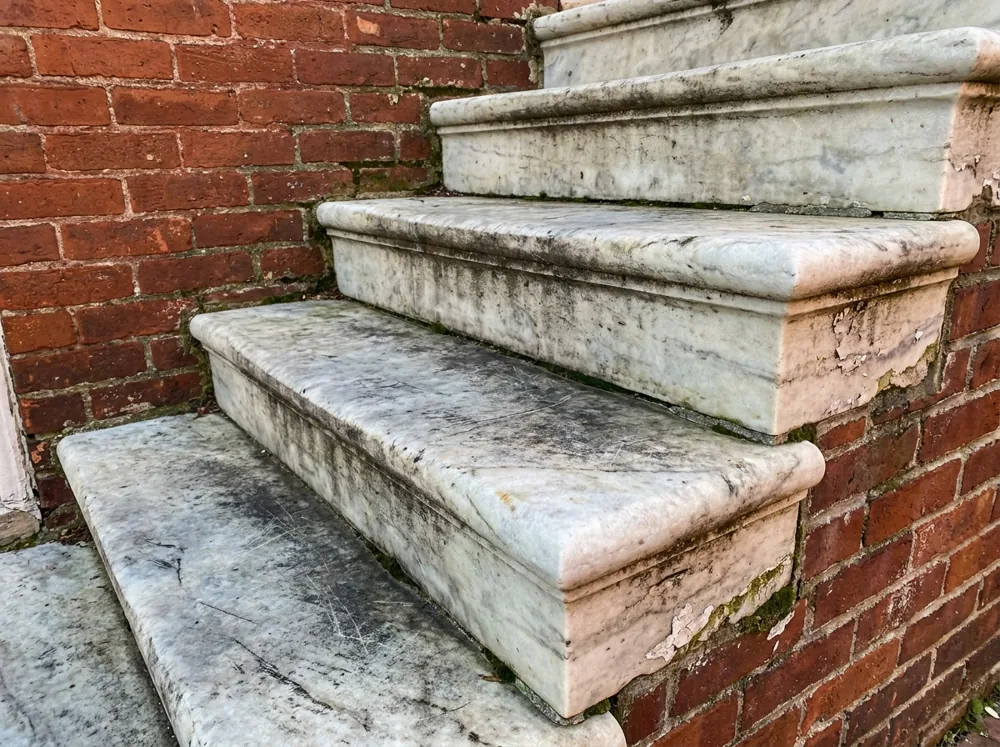
Soft Cockeysville marble takes on a gentle, worn patina over a century of footsteps and Saturday scrubbing. Honing and sealing can refresh it, acid will ruin it.
Painted Screens: Baltimore’s Only-Here Folk Art
If marble steps are Baltimore’s signature in stone, painted screens are its signature in paint, and they are one of the very few genuine folk-art traditions that belong to a single American city.
The story starts in 1913 with a Czech immigrant named William Oktavec (born Vàclav Oktavec in Bohemia), who ran a corner grocery in the East Baltimore enclave known as Little Bohemia. To shade his produce from the sun and show it off at the same time, he painted images of his fruits and vegetables right onto his store’s window screens. The effect was striking: from the street you saw the painting, but from inside the store you could still see out.
Neighbors immediately understood the appeal, and not just for advertising. In the years before air conditioning, a rowhome family that opened the windows for a breeze on a hot Baltimore evening lost all their privacy to the people walking by inches from the sill. Oktavec’s painted screens solved that perfectly: the paint on the screen mesh let those inside look out, while anyone on the sidewalk saw only a picture. People started asking him to paint pastoral scenes on their home screens, idealized cottages and countryside that doubled as a reminder of the homelands many of these immigrant families had left behind.
The Red Bungalow
Out of all those scenes, one became iconic: a bungalow with a red roof and a curving path beside a pond with white swans. Oktavec painted versions of it, often drawing from greeting cards and calendars, and the red bungalow became so standard that it was nearly ubiquitous across the city. At the height of the tradition in the 1950s, there were an estimated 100,000 to 150,000 painted screens brightening Baltimore’s rowhouse windows.
The folk art spread well beyond Little Bohemia into Highlandtown, Canton, Fells Point, and Little Italy. Other artists took it up as a trade, going door to door and often painting a screen right there on the sidewalk in front of the house it was made for. Some painters made the form their own, the famous Baltimore artist Johnny Eck was known for breaking the formula, painting his bungalow roofs a bold blue instead of the expected red, asserting a little individuality within a shared tradition.
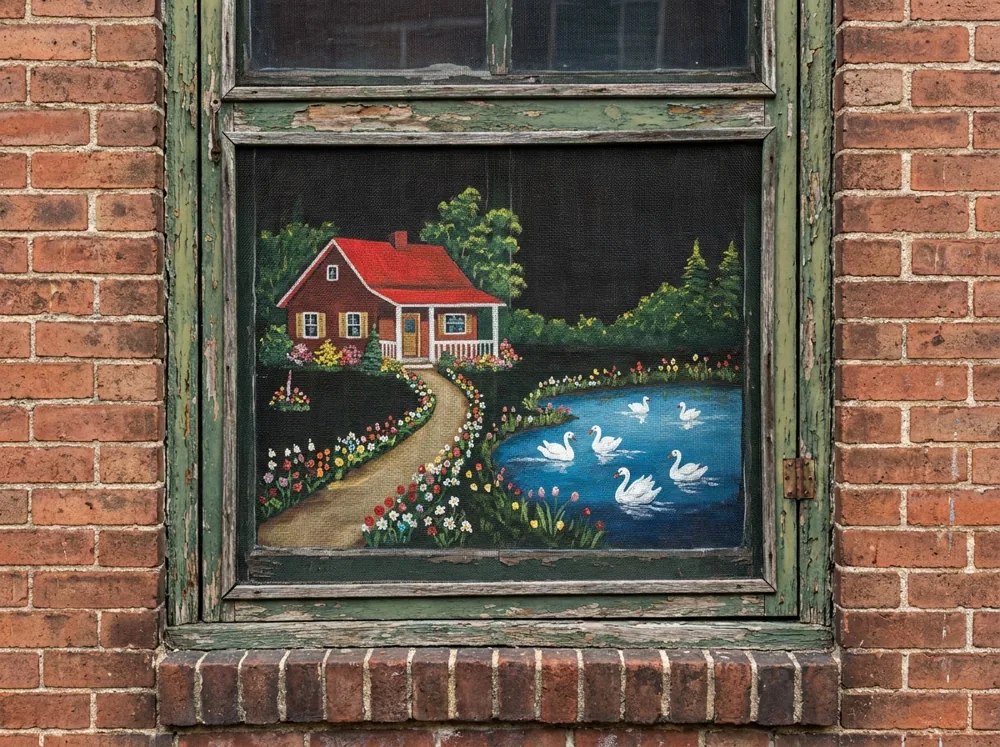
The red bungalow by the swan pond: the iconic Baltimore painted-screen scene, which gave rowhome families a breeze and their privacy at the same time.
Today painted screens are celebrated as part of Baltimore’s cultural heritage, with active societies keeping the craft alive. They are not something a general contractor paints, but they are very much part of the character of these houses, and when we renovate a Highlandtown or Canton rowhome, we treat an original painted screen as something to protect, not toss.
Brick, Cornices, and Transoms: The Architecture Up Close
Look up from the steps and the screens, and the rowhome keeps rewarding you. The brick itself, and the trim around and above it, carries a lot of Baltimore’s architectural story.
The brick. Up to the 1850s, many Baltimore rowhomes were built with soft, porous “salmon brick” produced in the brickyards of south and southwest Baltimore. It was cheap and it worked, but it drank up water and crumbled at the edges, which is why so many of these early facades were painted regularly, and later, in the twentieth century, why so many got covered in formstone. In the 1850s, local builders shifted to harder pressed brick for better houses. That denser brick did not need paint, and its uniform size let masons lay it with much tighter, finer mortar joints, the crisp brickwork you see on the better blocks.
The cornice. The crown of a Baltimore rowhome is its cornice, the decorative band running along the top of the facade just below the roofline. On Italianate rowhouses, the most common ornate style in the city, these cornices are deep and elaborate, carried on rows of decorative brackets. Because many of those brackets were cast (in iron or pressed metal) and reproduced cheaply, you will often see the same handsome pattern marching down an entire block. The cornice is the most distinctive single feature of the Italianate facade, and it is also the most commonly neglected, because it is high up and easy to ignore until water gets behind it.
Lintels, sills, and transoms. Above each window you will often find a projecting lintel, a heavy cap designed both to decorate the opening and to throw water away from it. On some later Renaissance Revival rows, those lintels and sills were cut from the same white marble as the steps. Above many original front doors sits a transom, a horizontal window that let light into the front hall, and on finer houses the door surround and transom were filled with stained glass.
These elements are exactly the kind of thing a careless renovation erases and a good one saves. A rotted cornice can be repaired or rebuilt rather than ripped off and replaced with a flat fascia board. Crumbling mortar can be repointed with the right mix instead of being smeared over. A clouded transom can be re-glazed. The difference between a rowhome that keeps its soul and one that loses it usually comes down to whether the contractor saw these details as worth the trouble.
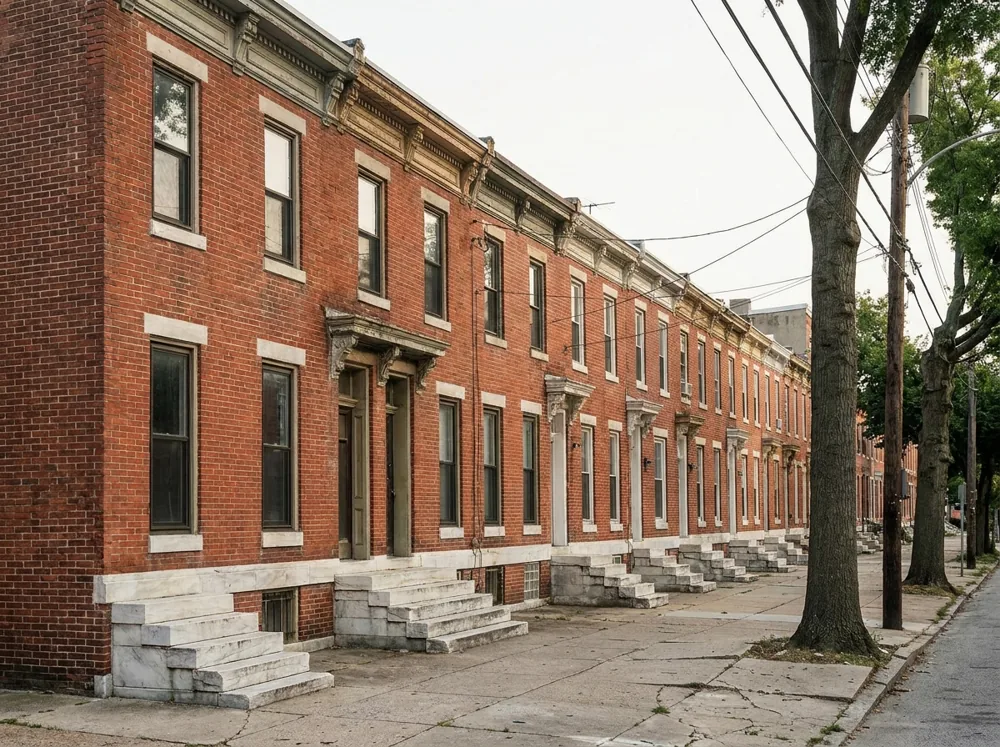
A classic East Baltimore block: tight pressed-brick facades, repeating Italianate cornices, tall narrow windows, and a ribbon of white marble steps down the sidewalk.
A Note on Formstone
No honest accounting of Baltimore rowhome character can skip formstone, the grey, stamped, faux-stone coating troweled over the brick of more than half the rowhomes in some neighborhoods. It is its own enormous topic, loved by some, loathed by others, and famously dubbed “the polyester of brick” by John Waters, and the keep-or-remove decision deserves real thought rather than a reflex. Rather than compress it here, we have written a complete, contractor’s-eye breakdown with real 2026 costs in our dedicated Baltimore formstone guide. If your house wears formstone over its original brick, start there before you decide anything.
Preserving Character During a Real Renovation
The reason all of this matters practically, and not just sentimentally, is that these details intersect with real renovation work all the time.
When we replace windows in a rowhome, we work to preserve the original opening proportions, the marble or brick lintels and sills, and any transom above the door, rather than shrinking openings or burying trim, because nothing dates a botched renovation faster than windows that no longer fit the house. When we open up or repoint a facade, we match mortar and brick to the original rather than slathering on a modern grey mix. And when steps, cornices, or transoms are worn, our default is to repair and restore first, replacing only what truly cannot be saved, and matching it sympathetically when we do.
This thinking runs through everything we do on these houses. If you are taking on a bigger project, our complete Baltimore rowhome renovation guide walks through the whole picture, party walls, plaster, knob-and-tube wiring, galvanized plumbing, CHAP historic rules, and realistic costs, with the same preservation-minded approach.
Historic Districts and Why It Matters
If your home is in one of Baltimore’s CHAP historic districts, Fells Point, Federal Hill, Mount Vernon, Bolton Hill, Canton, and others, these character details are not just nice to have, they are often protected. Visible exterior elements like original marble steps, cornices, and masonry are treated as character-defining features, and significant changes to them typically require a Certificate of Approval before work begins, a review that can run 30 to 60 days. In practice, preservation reviewers strongly favor repairing and keeping original details over removing them. We handle CHAP submissions and inspections as part of the job, and we will tell you up front what your block is likely to require so the right choice and the approval timeline line up.
Why Homeowners Trust Monarch Bay Renovations With the Details
- We see the character, not just the square footage. Marble steps, cornices, transoms, and original brick are the things that make your house yours, and we treat them that way.
- We restore before we replace. Our default is to clean, repair, repoint, and match, removing original detail only when it genuinely cannot be saved.
- We know historic materials. Soft Cockeysville marble, lime mortar, salmon and pressed brick, and the right way to clean and repair each, are second nature to us.
- Licensed, insured, and lead-safe. Fully licensed Maryland Home Improvement Contractor (MHIC #149066), Google Guaranteed, and certified for EPA RRP lead-safe work on pre-1978 homes.
- We handle the paperwork. Permits, CHAP historic-district approvals, and inspections are ours to manage, not yours.
- Free, transparent estimates. Detailed, line-item quotes with no allowance games.
The Bottom Line
The marble steps, the painted screens, the ornate cornices and fine brick, these are not just decoration. They are the reason a Baltimore rowhome feels like a Baltimore rowhome and not a house that could be anywhere. They came from a local quarry that built the Washington Monument, from a Czech grocer’s clever idea in 1913, and from generations of masons and homeowners who took pride in how their block looked. The best thing you can do in a renovation is understand them, care for them correctly, and keep them.
Whether you want help cleaning and restoring original marble steps, repairing a tired cornice, or planning a full renovation that honors what makes your house special, we will come take a look and tell you straight. Call us at (443) 602-9300 or request a free estimate online. No pressure, no obligation, just an honest opinion from people who love these houses.
Have a question about your Baltimore rowhome? Reach us through our contact page anytime.
Common Questions
- Why does Baltimore have white marble steps?
- Baltimore's signature white marble steps came from the Cockeysville quarry just north of the city, a fine white stone good enough that it was used for the upper 390 feet of the Washington Monument and the columns of the U.S. Capitol. Because the quarry was local and the marble had become nationally famous, the stone was both available and prestigious, so builders began finishing rowhome stoops with it in the late 1800s and early 1900s. A set of gleaming marble steps was a working-class status symbol, a little piece of monumental stone in front of an ordinary house, and the look spread across the city until it became one of Baltimore's defining images.
- How do you clean white marble steps without damaging them?
- Use the gentle traditional method, not harsh chemicals. The classic Baltimore approach was warm water with a pumice rubbing powder (like Bon Ami) scrubbed with a stiff brush or a pumice stone, which cleans without etching the soft stone. The single most important rule is to avoid anything acidic, no vinegar, no lemon, no acid-based brick or 'masonry' cleaners, because acid eats marble and permanently dulls and pits the surface. For deeper grime, a neutral pH stone cleaner or a mild alkaline solution works. Stubborn weathering, cracks, or worn treads are a job for professional honing and color-matched repair rather than aggressive scrubbing.
- What are Baltimore painted screens and where did they come from?
- Painted screens are window and door screens hand-painted with scenes, most famously a red-roofed bungalow beside a pond with white swans, that let people inside see out while keeping passersby from seeing in. The tradition started in 1913 when William Oktavec, a Czech immigrant grocer in East Baltimore's Little Bohemia, painted produce on his store screens to shade and advertise his wares. Neighbors loved the effect and asked him to paint pastoral scenes on their home screens, which gave them privacy and a breeze in the pre-air-conditioning era. The folk art spread through Highlandtown, Canton, Fells Point, and Little Italy, and at its peak there were an estimated 100,000-plus painted screens across the city.
- Can original Baltimore rowhome details be restored during a renovation?
- Yes, and we strongly encourage it. Marble steps can be cleaned, honed, crack-stabilized, and resealed; worn treads can sometimes be replaced with compatible marble. Original cornices, brackets, transoms, and brick can be repaired, repointed, and brought back rather than torn off. The key is working with a contractor who treats these elements as worth saving and knows how to handle soft historic marble, lime mortar, and old brick correctly. Replacing a damaged detail with a sympathetic match almost always beats ripping it out for something generic, both for the home's character and its resale value.
- Are painted screens and marble steps protected in Baltimore historic districts?
- In Baltimore's CHAP historic districts, visible exterior features including original marble steps, cornices, and masonry are treated as character-defining elements, and significant changes to them typically require a Certificate of Approval before work begins. Painted screens are a celebrated cultural tradition rather than a regulated building component, but they are very much part of the city's heritage. As a practical matter, preservation reviewers strongly favor repairing and retaining original details over removing them, so if your home is in a historic district, plan to restore these features rather than replace them, and budget time for the approval process.