

Renovation Notes
Formstone in Baltimore: History, and Whether to Keep or Remove It
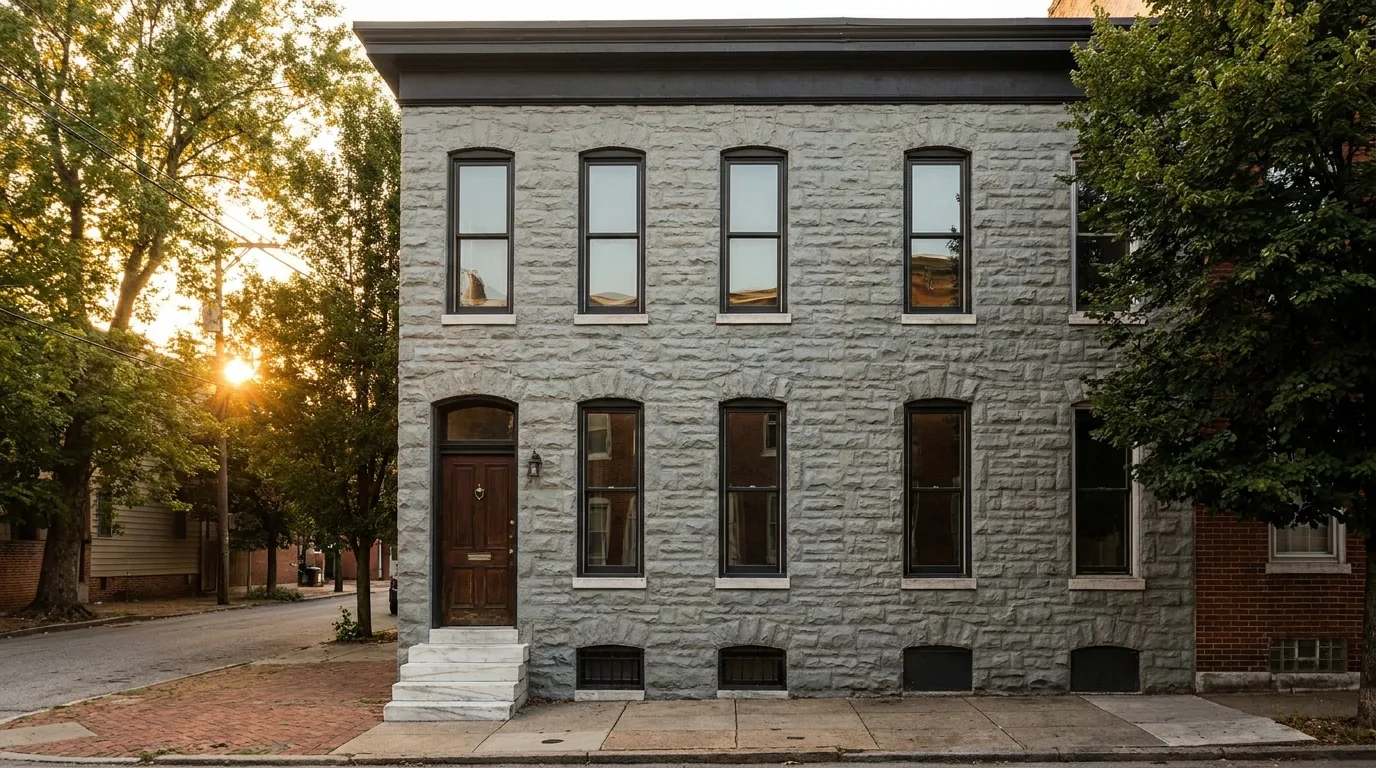
If you have spent any time on a Baltimore rowhome block, you know the look even if you never knew the name: that grey, stamped, faux-stone skin wrapped around house after house, scored to imitate cut stone and crowned with a set of gleaming white marble steps. That is formstone, and no building material on earth is more Baltimore than this one. It is on more than half the rowhomes in some neighborhoods, it has its own John Waters documentary, and every few years it sparks the same kitchen-table argument in thousands of households: do we keep it, or do we tear it off?
This is the guide we wish every Baltimore homeowner had before making that call. At Monarch Bay Renovations we work on rowhomes across the city, and formstone is one of the most emotionally charged and most misunderstood decisions our clients face. So here is the whole story, the genuinely interesting history, what formstone actually is, why it went up, and an honest, contractor’s-eye breakdown of when to keep it and when to remove it, with real 2026 numbers. We are a licensed Maryland home improvement contractor (MHIC #149066) and a Google Guaranteed business, and we publish this because an informed homeowner makes a better decision and a better client.
A textbook Baltimore formstone facade: cement troweled over brick and tooled to look like cut limestone, finished with the city’s signature marble steps.
What Formstone Actually Is
Let’s clear up the biggest misconception first: formstone is not stone, and it is not just paint. It is a cement-based stucco system built in three layers over the original brick.
Here is how the old crews actually did it. First they nailed a perforated metal lath (a galvanized wire mesh) over the existing brick face. Then they troweled on a base coat of cement mortar, roughly three-eighths to three-quarters of an inch thick, and scored it before it dried. Two more thinner coats followed, and while that final layer was still wet, a skilled applicator hand-sculpted and stamped it, pressing in joint lines and texturing the surface with tools, waxed paper, and an aluminum roller to imitate irregular blocks of cut stone. Sometimes they mixed in mica so the finished wall would sparkle a little in the sun. Color was worked in to mimic limestone, brownstone, or fieldstone.
The result was a hand-troweled masonry shell that, from across the street, reads convincingly as real stone. Up close, and especially once you know what you are looking at, the repeating “stones” and the slightly too-perfect tooling give it away.
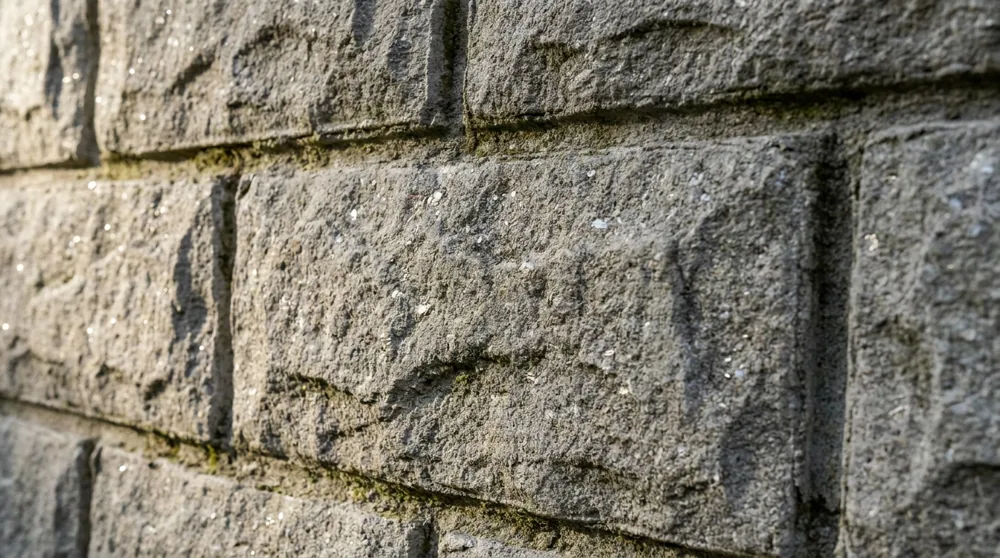
Up close, formstone reveals itself: hand-tooled cement scored to imitate stone blocks, the repeating pattern and tool marks giving away that it was sculpted, not quarried.
That metal-lath-and-cement construction is the single most important thing to understand about formstone, because it explains everything that comes later, why it is durable, why it traps moisture, and why it is so hard to remove cleanly.
A Short, Strange History of Baltimore’s Favorite Fake Stone
Formstone was patented in 1937 by Lewis Albert Knight of the Baltimore-based Lasting Products Company, a local paint manufacturer. (A nearly identical product, Permastone, had been invented in Columbus, Ohio about eight years earlier, and over the years competitors sold their own versions under names like Fieldstone, Dixie Stone, and Stone of Ages, but in Baltimore, “formstone” became the word for all of it.) Lasting Products began offering it commercially around 1938, and the timing was perfect.
Baltimore had a problem formstone seemed built to solve. Tens of thousands of its older rowhomes were built with soft, porous “salmon brick”, an inexpensive, under-fired brick that drank up water, crumbled at the edges, and needed repainting every few years just to stay weather-tight. Along came a product that promised to seal all that up permanently. A 1950 advertisement put it bluntly: formstone was “weatherproof and insulating forever; first cost is the last; no upkeep or repair.”
And the salesmen sold the dream hard. Formstone would make your home, in the company’s words, “the neighborhood showplace.” For a working-class Highlandtown or Fells Point family, wrapping the house in formstone was simultaneously a practical repair and a genuine status symbol, a way to look modern and prosperous on a tradesman’s budget. The covered houses became known affectionately as “Little Castles.” It was, as one history put it, the rage throughout the 40s, 50s, and 60s, eventually appearing on more than half of the city’s rowhomes in some areas and earning Baltimore the title of “Formstone capital of the world.”
Then came the most Baltimore footnote of all. Filmmaker and proud Baltimorean John Waters crowned formstone “the polyester of brick” and made it the subject of a 1997 documentary, Little Castles: A Formstone Phenomenon. That single phrase, equal parts affectionate and damning, captures the whole debate over this material better than any cost analysis ever could.
The Formstone Company itself wound down in the late 1960s, undercut by cheaper aluminum and then vinyl siding. But by then the city was already wearing its grey faux-stone coat, and it has been wearing it ever since.
Why Formstone Is Both Loved and Hated
Here is where the honest conversation starts, because formstone is genuinely a mixed bag, and anyone who tells you it is simply “good” or simply “bad” is selling you something.
The case for formstone is real. It did exactly what it promised for a very long time. On a house with bad salmon brick, it sheltered a failing wall for fifty, sixty, seventy years. A lot of formstone in Baltimore is still structurally sound and keeping water out today. It is also, increasingly, recognized as part of the city’s working-class heritage, this is not a defect homeowners tolerated, it is a craft tradition people were proud of, and a growing number of preservationists argue it deserves to be protected rather than scraped off.
The case against it is also real. The same metal lath that holds formstone to the wall eventually separates from the brick, and once that happens, moisture gets trapped in the gap with nowhere to breathe. Water that gets behind the coating, around a failed flashing detail, a cracked section, or a covered-over windowsill, sits against the brick and can quietly grow mold and accelerate the very deterioration the formstone was meant to prevent. Formstone also routinely buried the original architectural details, the cornices, the projecting lintels and sills that were designed to throw water away from the wall, which means in some cases it traded a self-draining facade for a sealed one. And freeze-thaw cycles, of which Baltimore gets plenty, work on cracked formstone the same way they work on any masonry.
So the real question is never “is formstone good or bad in the abstract.” It is “what condition is this particular formstone in, and what is the condition of the brick behind it?” That is a question you answer with a test patch, not an opinion.
The Keep-or-Remove Decision: An Honest Walkthrough
When a client asks us whether to pull their formstone, we don’t lead with an answer. We lead with a test cut. Here is how we actually think it through.
Step One: Open a Test Patch
Before anyone commits a dollar to removal, we open a small, discreet section of the formstone, often low or to one side, and look at three things: how the lath comes off, what the brick face looks like underneath, and whether there is any moisture, mold, or crumbling once it is exposed. This single step prevents the most expensive mistake in the whole process: ripping off an entire facade only to discover the brick beneath is in worse shape than the formstone you just destroyed.
Step Two: Judge the Brick You Find
What you uncover decides the path:
- If the brick is sound, hard, and handsome, removal is genuinely worth considering. Plenty of Baltimore homeowners pull the formstone, repoint, and fall back in love with an original brick facade they forgot they owned. In a historic district, this is often the encouraged outcome.
- If the brick is poor, soft salmon brick, or badly spalled, you are looking at the wall formstone was invented to hide. Now you have a harder choice: an expensive masonry restoration, or finishing the exposed brick with stucco or a quality breathable masonry paint, or simply keeping sound formstone in place.
There is no shame in the third option. If the formstone is solid, draining properly, and the brick behind it is rough, keeping good formstone is often the smarter, cheaper, and more honest call. It has done its job for seventy years; it can keep doing it.
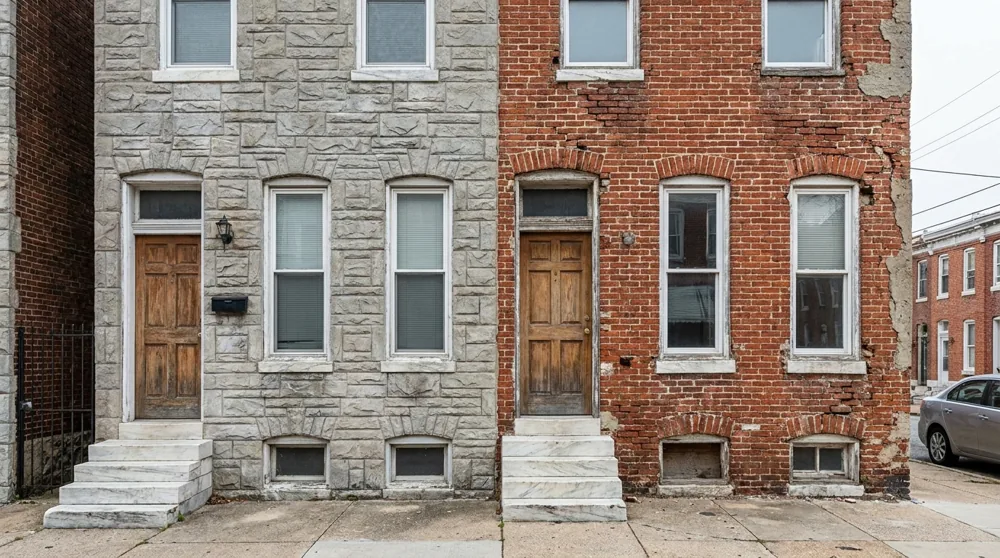
The Baltimore block in transition: original grey formstone on the left, the neighbor’s facade stripped back to its repointed brick. The right call depends entirely on what is under the coating.
Step Three: Understand What Removal Actually Involves
If the brick checks out and you decide to remove, go in with clear eyes about the work. To grip the wall in the first place, the original brick was scored and the metal lath was nailed into the mortar joints. When that lath comes off, it leaves the brick face pocked with holes and the joints torn up. That is not a sign of a bad crew, it is the nature of the material, and it is exactly why repointing is part of removal, not an upsell after it.
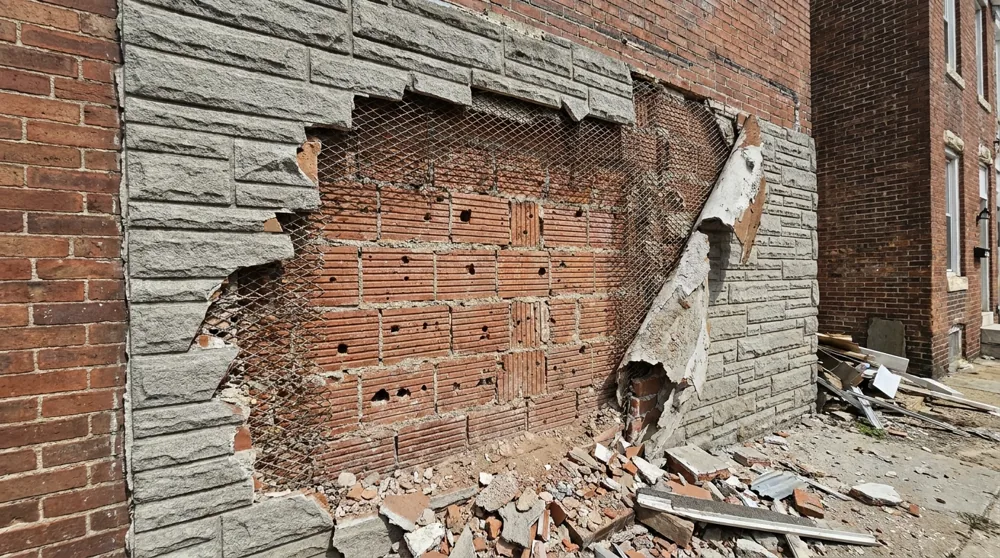
Mid-removal: the rusted wire lath and the scored, pock-marked brick beneath show why repointing is built into a formstone job, not added on afterward.
The honest sequence is: remove the formstone, strip the lath, clean the brick, repoint the joints, replace any badly damaged bricks, and only then decide whether to leave the brick exposed or re-clad over a proper weather barrier. A contractor who quotes a flat “we’ll just rip the formstone off” without a test section, a repointing line, and a plan for the brick underneath does not understand the material.
What Formstone Removal Costs in 2026
Formstone removal and brick repointing should always appear as a separate line item, never folded invisibly into a siding or facade number. Here is what the real-world Baltimore range looks like.
For a typical rowhome front, the masonry portion alone, removal, cleaning, and repointing, has historically started around $3,400 to $3,500. But that is rarely the whole bill. A well-documented Baltimore rowhome formstone-removal project came in around $6,300 all-in once you added permits and the dumpster (roughly $565), plus additional materials and labor when the exposed brick needed more than a simple repoint, in that case including replacing a deteriorated section around a first-floor window.
So a useful planning range for a rowhome facade is roughly $3,500 on the low end for a clean removal-and-repoint, climbing toward $6,000 to $10,000+ when the brick underneath turns out to be rough, when more of the facade needs rebuilding, or when the house is tall enough to need scaffolding. The single biggest swing factor is, again, the condition of the brick you can’t see until the formstone is off, which is the entire reason we quote after a test cut, not from the curb.
Two cost notes specific to older Baltimore homes:
- Lead-safe work. Homes built before 1978 may have lead paint on trim and original surfaces, and Maryland requires certified lead-safe practices (EPA RRP) during the work. We build that into the plan rather than springing it on you.
- Silica dust. Cutting and grinding cement formstone and mortar generates respirable silica, which OSHA regulates. A proper crew uses dust controls; this is not a job for a homeowner with a sledgehammer and a dream.
Renovation Implications: Formstone, Windows, and Water
Formstone is not just a facade decision, it ripples into the rest of an exterior renovation, and this is where it intersects with the other work we do.
The most common place formstone causes trouble is around openings. Because the coating was troweled over and around window and door frames, the flashing and sealing details at those openings are often buried, improvised, or simply absent. If you are replacing windows in a formstone house, the formstone has to be cut back cleanly and the new units flashed and sealed properly into the wall, otherwise you create a fresh path for water to get behind the coating, which is the exact failure mode that gives formstone its bad reputation. Sloppy window work in a formstone wall is one of the most common hidden moisture sources we find.
Formstone also drives the broader siding-or-not conversation. Once the coating is off and the brick is repointed, you stand at a fork: keep the restored brick exposed, or install new cladding over a sound wall. We cover that whole decision — vinyl versus fiber-cement, costs per square foot, and what holds up in Maryland’s climate — in our siding replacement guide. If you’re past the research stage and ready for a real quote, the Baltimore siding page has current pricing and a request form. The one thing we will say flatly here: never side directly over formstone. Capping that moisture-trapping shell with new siding seals the problem in where you can never see it again, and it puts new fasteners through deteriorating, uneven cement. Remove first, inspect, repoint, then re-clad if you choose to.
And because formstone is so woven into how these houses were built and modified, it is one chapter in the larger story of renovating these buildings, party walls, plaster, knob-and-tube wiring, galvanized plumbing, and CHAP historic rules all factor in too. If you are taking on a whole house, start with our complete Baltimore rowhome renovation guide for the full picture.
A Word on Historic Districts
If your home sits in a CHAP historic district, Fells Point, Federal Hill, Mount Vernon, Bolton Hill, Canton, and others, the formstone decision may not be entirely yours to make on your own timeline. Visible exterior changes typically require a Certificate of Approval before the work begins, and that review can run 30 to 60 days. Increasingly, preservation reviewers take formstone seriously as a historic material in its own right, so removal is not always a rubber stamp. We handle CHAP submissions and inspections as part of the job, and we will tell you up front whether your block is likely to require approval before you fall in love with one option or the other.
Why Homeowners Trust Monarch Bay Renovations With Formstone
- We know this material. Formstone, salmon brick, wire lath, and the realities of what is hiding behind a seventy-year-old facade are not a surprise to us, they are Tuesday.
- We open a test patch first. We never quote formstone removal blind. You get a real look at the brick before you commit a dollar.
- We quote repointing honestly. Removal and brick repair are separate, visible line items, no flat “rip it off” promises that turn into change orders.
- Licensed, insured, and lead-safe. Fully licensed Maryland Home Improvement Contractor (MHIC #149066), Google Guaranteed, and certified for EPA RRP lead-safe work on pre-1978 homes.
- We handle the paperwork. Permits, CHAP historic-district approvals, and inspections are ours to chase, not yours.
- Free, transparent estimates. Detailed, line-item quotes with no allowance games.
The Bottom Line on Baltimore Formstone
Formstone is not a mistake to be erased and it is not a treasure to be preserved at all costs. It is a smart, characterful, sometimes-flawed solution to a real problem, and the right move depends entirely on the condition of your particular wall. Sound formstone over rough brick is often best left alone. Failing formstone, or sound formstone over beautiful brick, may be worth removing and restoring. The only wrong answers are ripping it off blind and siding over it sealed shut.
Whether you are ready to uncover the brick underneath or just want an honest opinion on whether to leave well enough alone, we will come look at your house and tell you straight. Call us at (443) 602-9300 or request a free estimate online. We will open a test patch, show you exactly what you are working with, and put real numbers on paper, no pressure, no obligation.
Explore our full range of exterior renovation services to see how formstone fits into a complete home upgrade, or reach us through our contact page with any questions about your Baltimore rowhome.
Common Questions
- What is formstone, exactly?
- Formstone is a cement-based faux-stone coating troweled over brick rowhomes and hand-tooled to imitate cut stone. It is essentially three layers of colored cement mortar applied over a perforated metal lath that is nailed to the original brick, then scored and stamped while wet to mimic stone blocks and mortar joints. It was patented in Baltimore in 1937 by L. Albert Knight of the Lasting Products Company and applied to tens of thousands of rowhomes through the 1940s, 50s, and 60s. Filmmaker John Waters famously called it 'the polyester of brick.'
- Should I remove the formstone on my Baltimore rowhome?
- It depends entirely on what is underneath, which is why you open a test patch before deciding. Formstone is keyed into the brick with wire lath and deep scoring, so removal almost always scars the brick face and the joints need repointing afterward. If the brick beneath is sound and handsome, removal can restore a beautiful original facade and is often encouraged in historic districts. If the brick underneath is poor-quality 'salmon brick' that was failing in the first place, which is exactly why a lot of formstone went up, you may be better off keeping sound formstone or removing it and finishing with stucco or quality masonry paint. Never let anyone quote a flat 'rip it off' without a test section and a plan for the brick.
- How much does formstone removal cost in Baltimore in 2026?
- Plan for formstone removal and brick repointing as a separate line item from any new siding or facade work. A typical rowhome front-and-trim job has historically started around $3,400 to $3,500 for the masonry alone (removal, cleaning, and repointing), with documented real-world projects landing near $6,300 once permits, dumpster, and additional brick repair are included. The wild card is the condition of the brick once it is exposed, badly spalled or pock-marked brick that needs partial rebuilding pushes the number higher. We always quote it after seeing the actual wall, not from a photo.
- Does removing formstone damage the brick underneath?
- Usually some, yes. To grip the wall, the original brick was scored and the metal lath was nailed into the mortar joints, so when the lath comes off it leaves the face pocked with holes and the joints chewed up. That is normal and repairable, the brick gets cleaned and repointed, and occasionally a few badly damaged bricks get replaced. The point is that repointing is not an optional extra after removal, it is part of the job, and a contractor who leaves it out of the quote is underbidding the work.
- Why was formstone put on Baltimore rowhomes in the first place?
- Two reasons. First, a lot of early Baltimore rowhomes were built with soft, porous 'salmon brick' that absorbed water and needed constant repainting, formstone genuinely sheltered that failing brick for decades. Second, it was marketed brilliantly as a permanent, waterproof, maintenance-free upgrade that would make your house 'the neighborhood showplace.' For a working-class homeowner in the 1950s, a formstone facade was both a practical fix and a status symbol.
- Is formstone bad for my house?
- It is not automatically bad, but it has a real downside. By the 1970s formstone had earned a reputation for trapping moisture against the brick, the metal lath separates over time and water gets behind the coating with nowhere to breathe, which can quietly feed mold and accelerate brick deterioration in the very wall it was meant to protect. Sound, well-drained formstone on solid brick can sit happily for decades. Cracked, bulging, or water-stained formstone is a sign to open it up and see what is going on behind it.